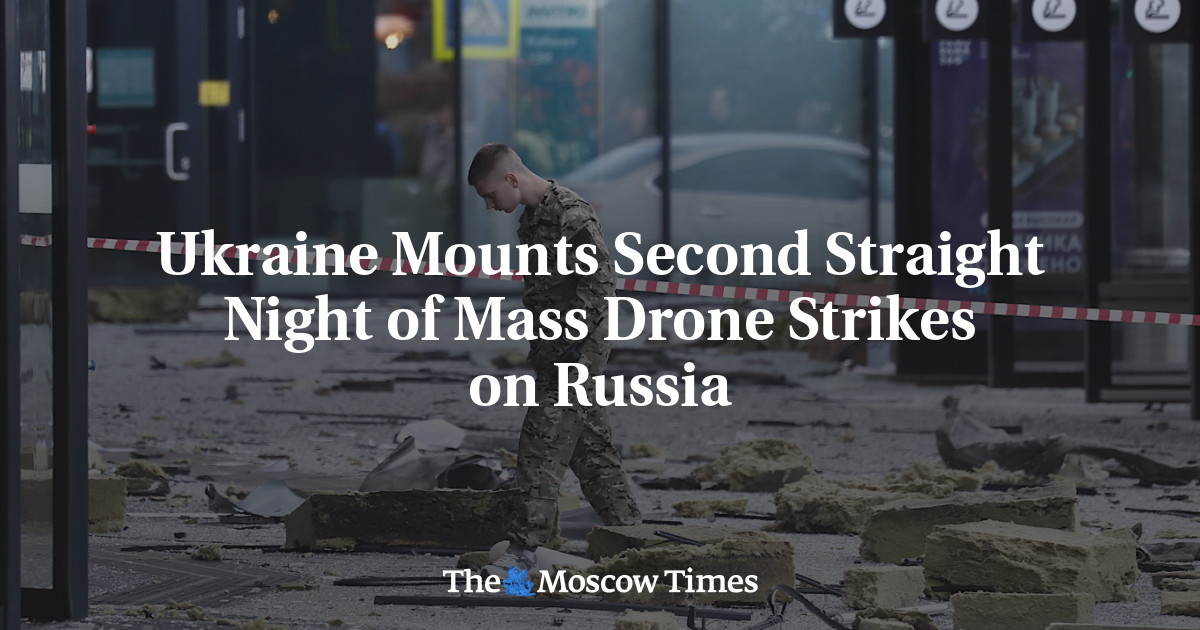
Russia's Defense Ministry reported destroying nearly 200 Ukrainian drones overnight, following 251 interceptions the previous day, marking a second consecutive night of large-scale attacks. While Moscow claimed high interception rates, regional authorities noted minor damage to industrial sites in Nizhny Novgorod, a heating plant in Voronezh, and power outages in Belgorod, with Ukraine alleging a strike on Russia's sole major explosives producer. This sustained drone campaign underscores escalating risks to Russian industrial and energy infrastructure from intensified aerial assaults.
Russia’s Defense Ministry said on Tuesday that its air defense systems destroyed nearly 200 Ukrainian drones in a second consecutive night of large-scale air attacks, with regional authorities reporting damage at several industrial sites. In the Nizhny Novgorod region east of Moscow, Governor Gleb Nikitin said 30 drones were downed over an “industrial zone” in the town of Dzerzhinsk. “Some debris landed on the premises of one enterprise, but no significant harm was caused to industrial infrastructure,” Nikitin wrote in a post on Telegram. A day earlier, he reported an attack involving 20 drones. Ukraine’s General Staff had said on Monday that its drones struck the Y.M. Sverdlov explosives factory near Dzerzhinsk. A Ukrainian intelligence official and the Council of the European Union told Reuters that the factory is Russia’s only major producer of the high explosives RDX and HMX. Meanwhile, in the southwestern Voronezh region, Governor Alexander Gusev said on Tuesday that debris from 17 Ukrainian drones downed over the region damaged the windows of a local heating plant. Russia’s state nuclear power station operator Rosenergoatom claimed later in the day that a Ukrainian drone crashed into a cooling tower at the Novovoronezh Nuclear Power Plant, located near the city of Voronezh. Rosenergoatom said the collision did not cause any notable damage to the tower and that the facility continued to operate as usual. In the neighboring Belgorod region, Governor Vyacheslav Gladkov said 1,000 residents were without power following the latest drone strikes. On Monday afternoon, Gladkov had said two people, including a worker helping to restore power, were killed in a Ukrainian rocket attack. Russia’s Defense Ministry said on Tuesday that 31 drones had been intercepted over the Belgorod region and 18 over the Voronezh region overnight. After reporting the downing of 184 Ukrainian drones, the ministry said its air defense systems shot down 34 additional drones throughout Tuesday morning. This marks the second consecutive day of heavy Ukrainian drone attacks, with Russia having reported downing 251 drones on Monday night. A Message from The Moscow Times: Dear readers, We are facing unprecedented challenges. Russia's Prosecutor General's Office has designated The Moscow Times as an "undesirable" organization, criminalizing our work and putting our staff at risk of prosecution. This follows our earlier unjust labeling as a "foreign agent." These actions are direct attempts to silence independent journalism in Russia. The authorities claim our work "discredits the decisions of the Russian leadership." We see things differently: we strive to provide accurate, unbiased reporting on Russia. We, the journalists of The Moscow Times, refuse to be silenced. But to continue our work, we need your help. Your support, no matter how small, makes a world of difference. If you can, please support us monthly starting from just $2. It's quick to set up, and every contribution makes a significant impact. By supporting The Moscow Times, you're defending open, independent journalism in the face of repression. Thank you for standing with us. Remind me later. Russia's Defense Ministry reported downing nearly 200 Ukrainian drones on Tuesday, following 251 interceptions the previous day, indicating a significant and sustained escalation in aerial attacks targeting Russian territory. These widespread assaults focused on critical industrial and energy infrastructure across regions including Nizhny Novgorod, Voronezh, and Belgorod. While Russian authorities claimed high interception rates and largely contained damage, localized impacts included compromised windows at a Voronezh heating plant and power outages affecting 1,000 residents in Belgorod. Notably, Ukraine alleged a strike on the Y.M. Sverdlov explosives factory near Dzerzhinsk, which is reportedly Russia's sole major producer of high explosives RDX and HMX. The repeated targeting of industrial facilities, a heating plant, and a nuclear power plant (albeit with no notable damage) underscores a clear intent to disrupt Russia's war-supporting capabilities and energy infrastructure. The consistent nature of these attacks, despite high reported interception rates, suggests an evolving threat landscape for Russian domestic assets. This sustained campaign heightens geopolitical risk, as reflected by the 'moderately negative' sentiment, and signals elevated operational and supply chain vulnerabilities for industries with direct or indirect exposure to Russian infrastructure or manufacturing, particularly in defense-related sectors.
AI-powered research, real-time alerts, and portfolio analytics for institutional investors.
Request DemoOverall Sentiment
moderately negative
Sentiment Score
-0.50
