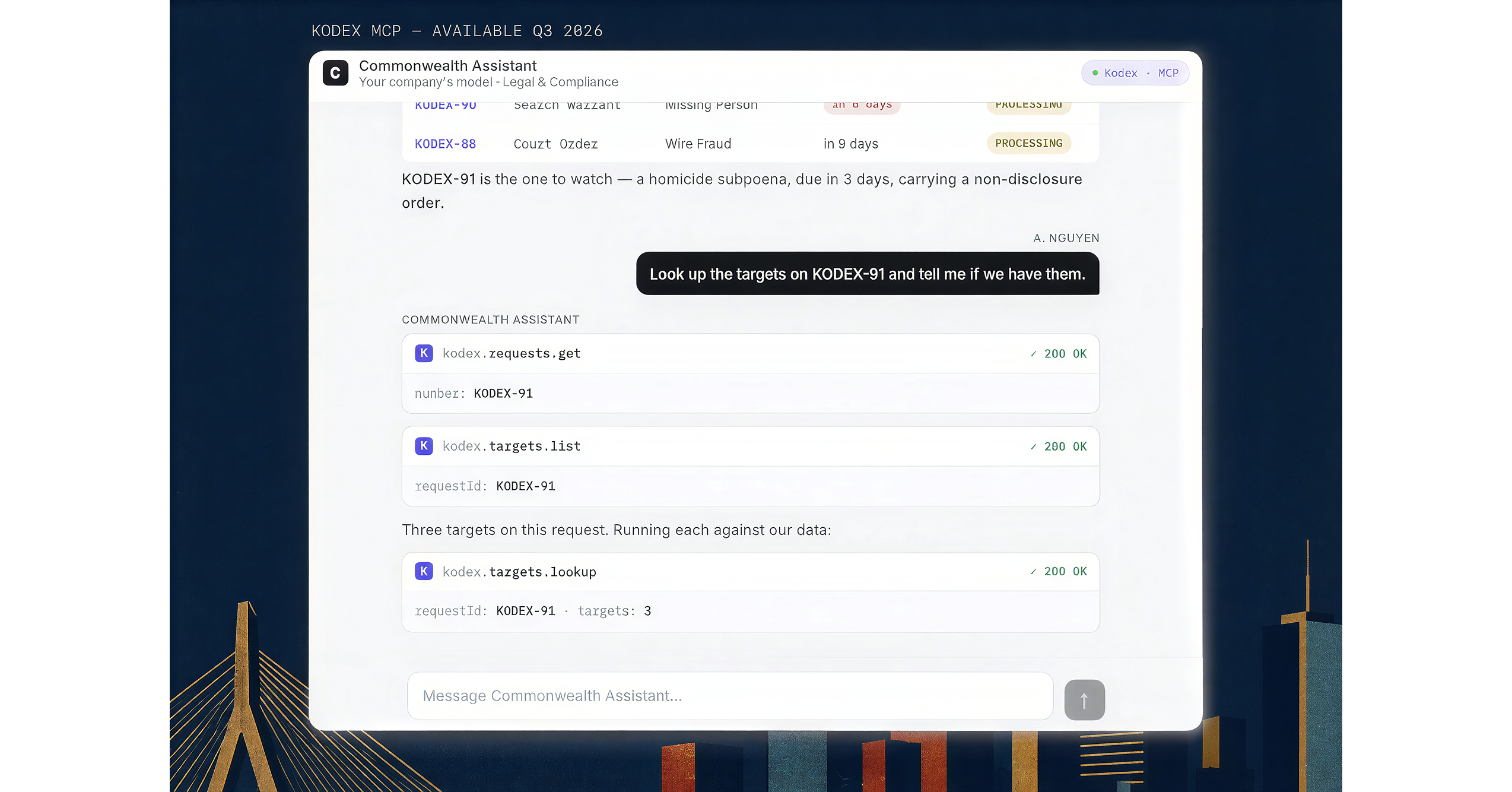
Kodex used its Q2 keynote to unveil automated “verified rails” for government/user-data requests, including AI Structured Data to structure inbound requests and an Intake Bridge for system-to-system submissions. The Intake Bridge is set to go live first under the EU’s e-Evidence Regulation on Aug. 18, 2026, and Kodex previewed an MCP server enabling scoped, auditable workflows for a company’s AI agent. Kodex also highlighted rising threats (forged court orders and fraudulent requests) and positioned its infrastructure as an auditable alternative to unverifiable email/fax requests.
This reads more like a compliance workflow standardization story than an AI monetization story. The real economic effect is that the marginal cost of making a valid request falls, which usually increases request throughput and shifts spend from manual legal ops into software and audit controls. That is a mild margin headwind for any company sitting on lots of user data, but the burden should be far less painful for scale players with mature trust-and-safety teams than for smaller platforms that still run process-heavy workflows.
The bigger second-order effect is competitive: once governments and large custodians converge on machine-readable rails, the winners are the vendors with the best verification layer and the deepest integrations, while the losers are the firms that depend on legacy, bespoke, or cross-border manual review. The EU implementation window is the cleanest catalyst, but adoption will likely be uneven; the market should expect a slow burn over 1-3 quarters before any meaningful financial readthrough shows up in expense lines or transparency metrics.
Contrarian view: the consensus may be overestimating monetization and underestimating friction. This is not a new budget category for most enterprises, and many agencies will still require human approval, so the initial revenue impact to adjacent cybersecurity/software names is probably minimal. What would falsify the “higher request volume / higher compliance burden” thesis is 2-3 quarters of stable transparency-report volumes and no commentary from large platforms about incremental automation spend or legal staffing reductions.
For now, the actionable signal is relative, not absolute: scale custodians can absorb this better than smaller peers, and any stock that trades as if this meaningfully expands top-line growth is likely ahead of itself.
AI-powered research, real-time alerts, and portfolio analytics for institutional investors.
Request DemoOverall Sentiment
mildly positive
Sentiment Score
0.15
