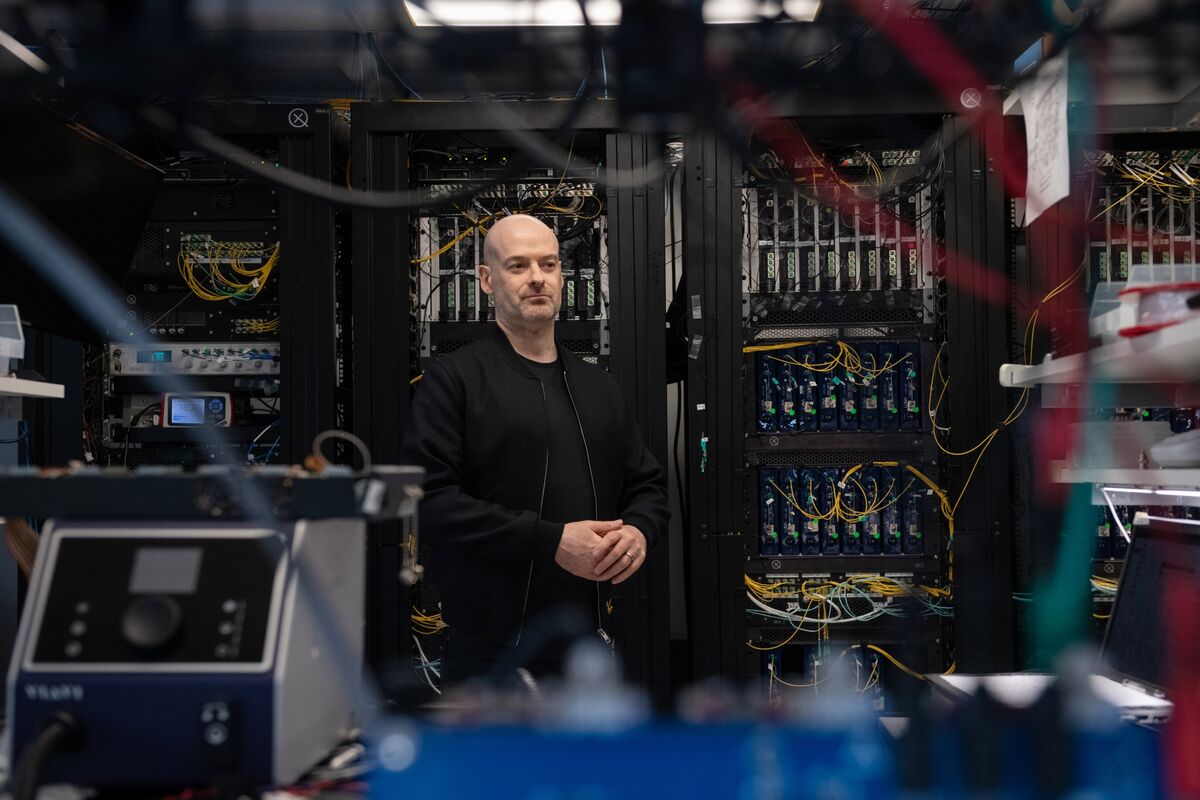
Christian Weedbrook’s stake in quantum computing startup Xanadu is now worth about $1.5 billion after the company more than tripled in value this week, making him a billionaire in days. The surge followed Nvidia’s backing of the emerging technology, highlighting growing investor enthusiasm for quantum computing and private-market valuations. The article is primarily a wealth-creation and sentiment story rather than a direct operating update.
This is less a direct endorsement of one private company and more a signal that the scarce asset in AI infrastructure is shifting from compute to ecosystem legitimacy. Once a platform leader openly underwrites a frontier category, capital tends to re-rate the entire stack: model developers, photonics, cryogenics, control systems, and the handful of public suppliers that can plausibly become picks-and-shovels beneficiaries. The first-order move is sentiment; the second-order move is talent and customer pull, because enterprise and sovereign buyers often wait for a recognized anchor before committing budgets.
The competitive implication is that quantum startups now face a bifurcation: those aligned with the dominant AI hardware narrative can raise at higher marks, while smaller peers without a clear compute adjacency may see funding terms tighten despite sector enthusiasm. That usually widens dispersion in private markets within 1-2 quarters, not because the technology is proven, but because investors start paying for perceived survivability. For public markets, the most actionable beneficiaries are not pure quantum names but adjacent semiconductor equipment, cryogenic subsystems, and advanced materials vendors that gain optionality without needing commercial quantum adoption to be near-term.
The main risk is that this is a multiple-expansion event with a weak fundamental bridge. If the next 1-2 quarters fail to produce concrete design wins, capex commitments, or a standards roadmap, the re-rating can retrace sharply as quickly as it occurred. The more crowded the trade becomes, the more vulnerable it is to a single headline that reframes quantum as still years away from monetization, which would hit the highest-duration private assets first and then spill into public “AI next wave” proxies.
The contrarian view is that the market may be overestimating how much a large AI incumbent can compress quantum commercialization timelines. Endorsement does not solve error rates, scaling economics, or the absence of a killer application; it mainly lowers the funding cost of experimentation. That suggests the best risk-adjusted expression is not a binary long on quantum dreams, but a basket of enabling suppliers and selective short exposure to overextended speculative names that already trade as if commercial utility is imminent.
AI-powered research, real-time alerts, and portfolio analytics for institutional investors.
Request TrialOverall Sentiment
strongly positive
Sentiment Score
0.72
