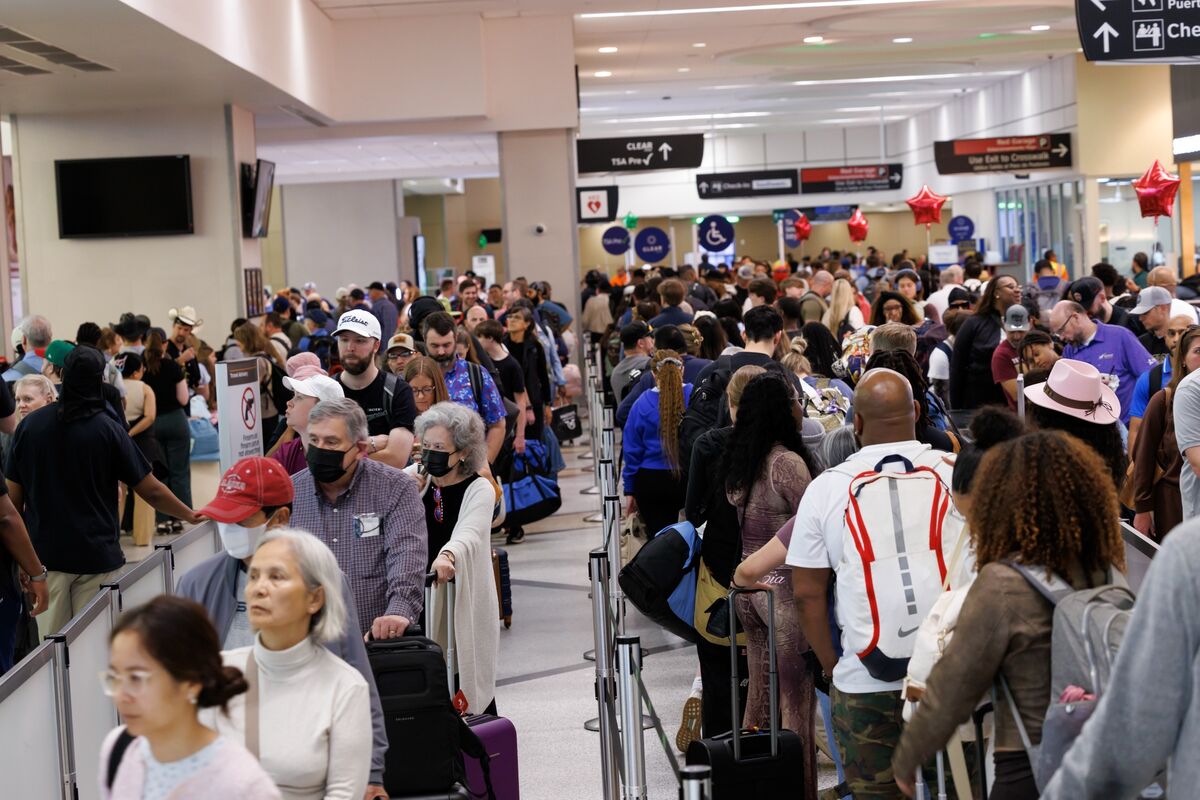
Transportation Secretary Sean Duffy warned that the ongoing partial DHS shutdown, which has left TSA agents unpaid, could force small airports to close if it continues. This raises near-term operational risk for regional airports and airlines, increasing the likelihood of travel disruptions and incremental costs; monitor shutdown developments and staffing/pay resolutions for sector exposure.
Operational contraction concentrated at secondary nodes will force airlines to reallocate seats to core trunk routes, materially changing unit economics across networks. Expect frequency compression in exposed regional markets within 1–3 weeks, which reduces regional jet utilization and magnifies unit-cost dispersion between hub-and-spoke majors and niche leisure carriers that rely on thin, frequency-driven demand.
A cascade effect through the travel supply chain is likely: increased gate/slot congestion at major airports will raise block-hour costs (each incremental 10–15 minute turn typically translates to ~$150–$350 of incremental cost per flight), degrading utilization and pushing some carriers to temporarily park aircraft or defer maintenance. Ground logistics and express parcel providers face ad hoc reroutes that can create short-term margin volatility (order-of-magnitude: a few percent hit to Q revenue/margins in stressed weeks) while road-based travel (rental cars, drive-market hotels) captures demand leaking from short-haul air routes.
Timing and reversal are binary and fast: operational normalization can occur in days if funding/staffing is restored or if agents receive retroactive pay; if the political impasse persists beyond ~2–4 weeks, expect capital consequences (deferred AIP projects, P3 acceleration, local bond-rating pressure) that play out over 3–6 months. The most relevant tail risk is a multi-week persistence that forces route rationalization and accelerates consolidation among small-market service providers.
Consensus will likely treat airline equities as a homogenous risk; that’s wrong. The dislocation is highly idiosyncratic — over-exposed ULCCs and small-market models should underperform, while hub-dominant majors and logistics providers that can capture modal substitution should outperform. Actionable trade ideas below reflect that dispersion and include explicit timeframes and risk controls.
AI-powered research, real-time alerts, and portfolio analytics for institutional investors.
Request DemoOverall Sentiment
moderately negative
Sentiment Score
-0.55
