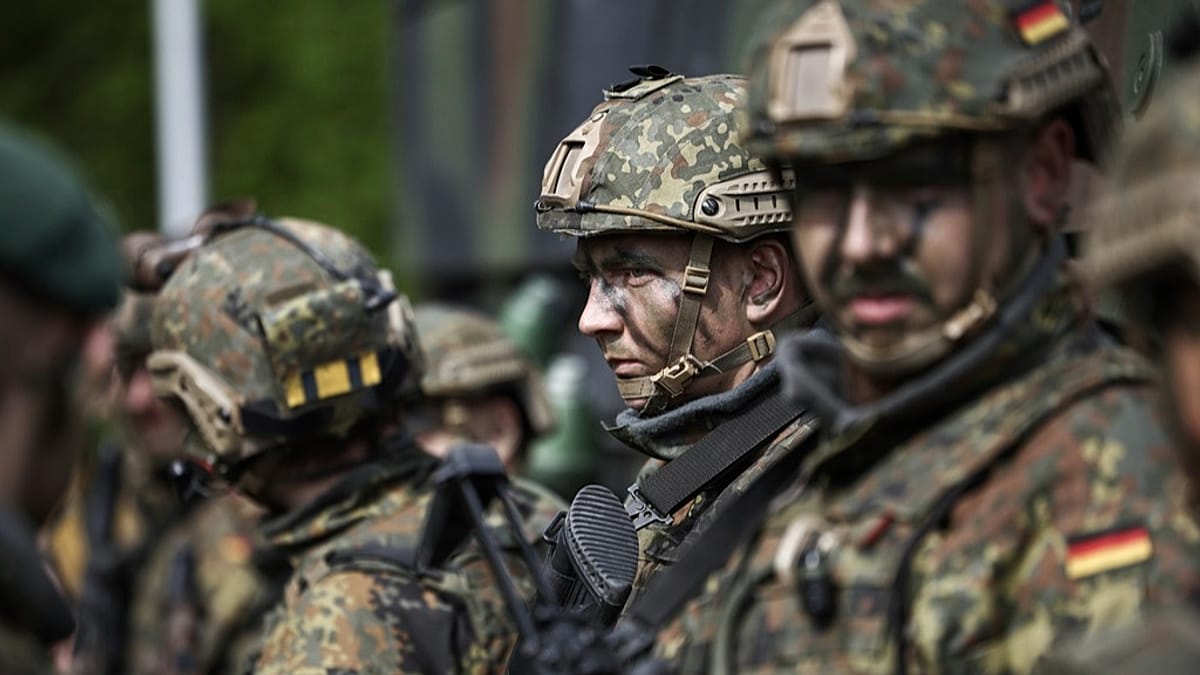
Chancellor Friedrich Merz said Germany could play a military role in securing a future peace in Ukraine, including possible deployments on NATO territory neighbouring Ukraine after a ceasefire, while France and the UK pledged troop presences and bases inside Ukraine following a peace deal. The proposal drew cross-spectrum domestic criticism and a sharp rebuke from Moscow, and any German overseas deployment would require Bundestag approval under the Parliamentary Participation Act with annual mandates and personnel limits. The Bundeswehr already participates in multiple international missions (Kosovo, Lebanon, Bosnia, South Sudan, Western Sahara) and maritime/security operations, highlighting both operational commitments and legal constraints on new deployments.
Market structure: A German willingness to provide post‑ceasefire forces materially favors defense primes and regional logistics contractors. Expect European names with land systems and sensors (Rheinmetall RHM.DE, HENSOLDT HAGN.DE) and US majors (LMT, RTX, GD) to see order‑book upside; conservatively model a 5–15% revenue tailwind for core defense suppliers over 12–24 months if mandates materialize. Cross‑asset: near‑term safe‑haven flows (USD, gold) and higher volatility in EUR vs USD are likely; oil could rise 2–5% on escalation risk while core Euro sovereign yields may widen 10–30bp on political uncertainty. Risk assessment: Tail risk of direct NATO‑Russia confrontation is low probability (~5–15%) but high impact (energy shock, sanctions, 200–500bp EM FX moves). Immediate (days): headlines move sentiment; short term (weeks–months): Bundestag debate and coalition friction will determine implementation probability; long term (years): permanent European defence budget reallocation and supply‑chain retooling. Hidden dependency: Bundestag approval rules and troop consent requirements create a binary gating event that can nullify market expectations. Trade implications: Direct plays — establish 1–3% NAV long in RHM.DE and 1–2% in ITA (iShares US Aerospace & Defense) sized by risk appetite; use 3‑6 month ATM calls (size 0.5–1% NAV) to lever upside. Pair trade — long RHM.DE vs short German export cyclicals (e.g., VOW3.DE) to capture relative defense rerating. Options — buy 3‑month ATM calls on ITA and sell 8–12 week OTM puts on RHM.DE to finance premium. Entry: scale in over 2–6 weeks and trim if Bundestag vote fails or market prices a <25% chance of deployment. Contrarian angle: Markets may be overpricing immediate troop deployment despite strong rhetoric — legal/parliamentary constraints make rapid action unlikely, so avoid paying up for near‑term multiples. Historical parallels (post‑Crimea/Balkans) show revenue realization lags 6–18 months; search for mid‑cap suppliers (HAGN.DE) as acquisition targets if bid premium emerges. Unintended consequence: EU‑level procurement consolidation could create takeover targets among smaller defence suppliers — position for M&A in 12–24 months.
AI-powered research, real-time alerts, and portfolio analytics for institutional investors.
Request DemoOverall Sentiment
moderately negative
Sentiment Score
-0.35
