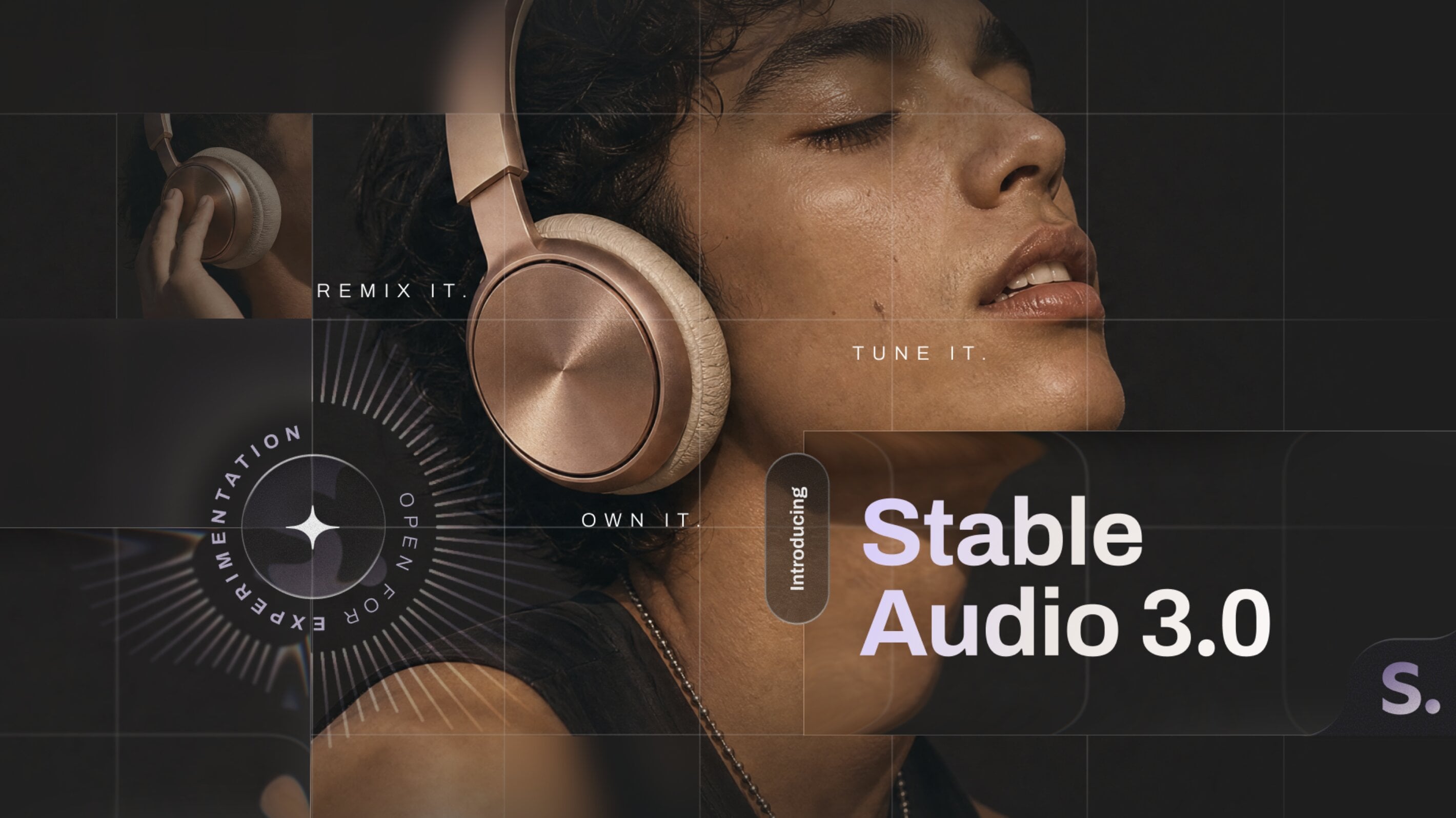
Stability AI launched Stable Audio 3.0, a four-model AI music family with three open-weight releases and generation lengths of up to 6 minutes and 20 seconds, versus 3 minutes for Stable Audio 2.0. The models are trained on fully licensed data, including 806,284 AudioSparx files plus Freesound recordings, and add LoRA fine-tuning and audio inpainting. The announcement strengthens Stability AI’s positioning in licensed generative audio, though the near-term market impact is likely limited.
This is less about a single model release than a deliberate wedge into the only defensible AI-music moat: licensed data plus distribution-friendly product design. The open-weight smaller models are a strategic land grab — they seed developers, lock in tooling, and force downstream workflow integration before incumbents can harden pricing. The economically important point is that the large model being closed while the smaller tiers are open suggests a classic funnel: open source for adoption, proprietary API for monetization.
For Warner, the near-term read is modestly constructive but not linear. If licensed-model competition becomes the default, major labels gain bargaining power because every credible entrant now needs catalog access, indemnification, and ongoing rights clarity; that shifts negotiations from one-time licensing fees to platform-level revenue share. The second-order risk is margin dilution if label partners become too effective at enabling multiple AI vendors, commoditizing the model layer and pushing value toward UX/distribution rather than catalog ownership.
Getty’s direct exposure is more narrative than financial, but the launch reinforces a broader legal bifurcation: products that can prove provenance will be easier to commercialize, while firms stuck defending training practices will face higher capital and reputational costs. Alphabet is not a direct winner here, but this raises the bar for any YouTube/creator-music integration or consumer audio feature — the winner in AI music will likely be the platform that combines licensing, latency, and editing tools, not the one with the best benchmark score.
Contrarian view: the market may be overestimating how quickly open-weight music models monetize. Six-minute generation and on-device composition are impressive, but professional adoption depends on editability, stem separation, synchronization rights, and workflow embedding; that is a 12-24 month product cycle, not a headline cycle. The bigger risk to the bullish AI-music narrative is that consumer demand normalizes while enterprise licensing becomes the real profit pool, compressing upside for the pure model providers.
AI-powered research, real-time alerts, and portfolio analytics for institutional investors.
Request DemoOverall Sentiment
mildly positive
Sentiment Score
0.35
Ticker Sentiment
