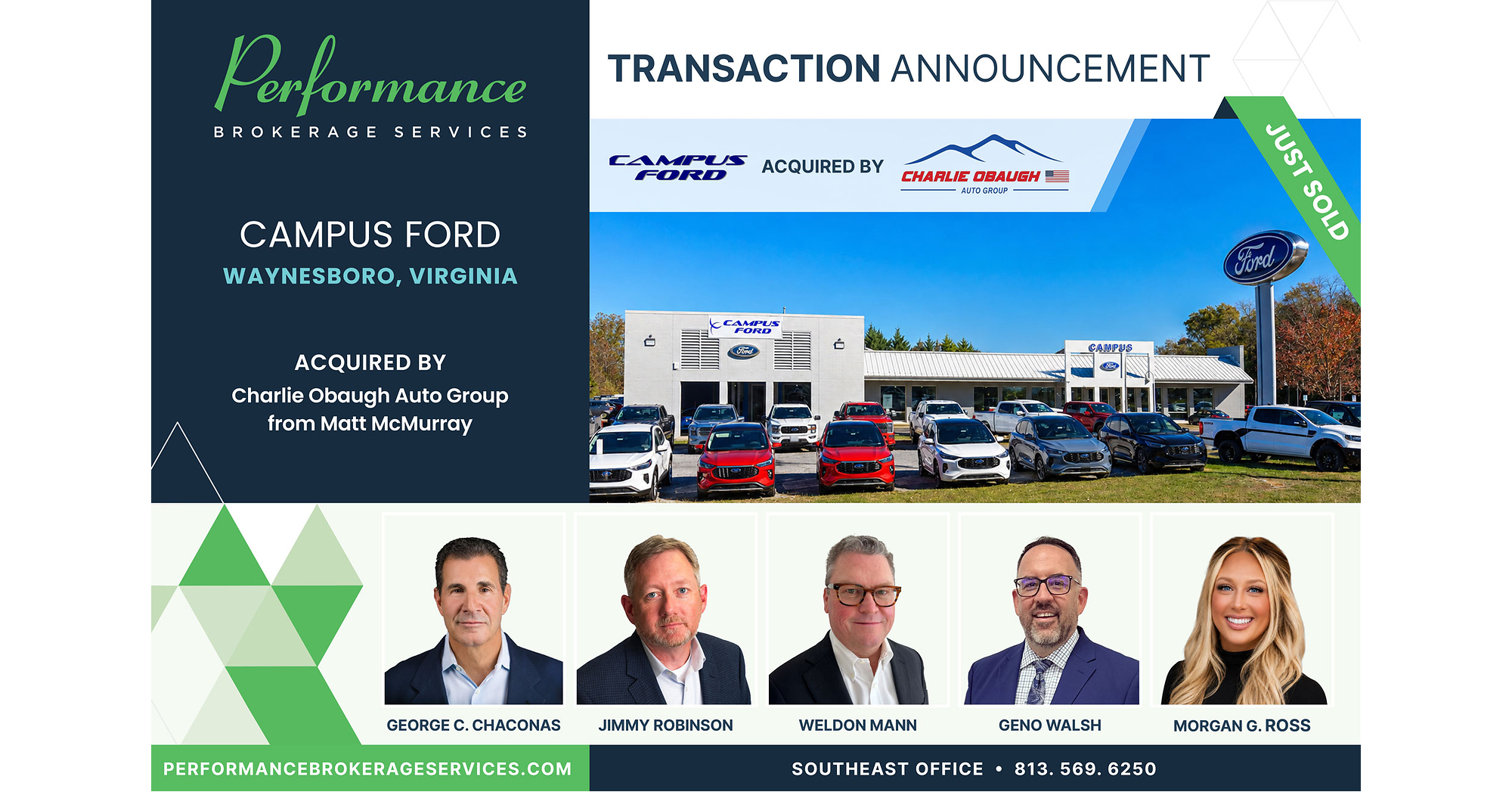
Performance Brokerage Services announced the sale of Campus Ford in Waynesboro, Virginia, from Matt McMurray to Eric Obaugh of Charlie Obaugh Auto Group. The deal adds the group’s first Ford franchise and expands its portfolio to six franchised dealerships (Chevrolet, GMC, Kia, Mitsubishi plus the new Ford). Campus Ford will be renamed Charlie Obaugh Ford and remain at its current location; the transaction is portrayed as another successful buy-sell facilitated by the broker’s Southeast advisors.
This is a signal about private market liquidity in franchise assets, not an earnings event. A healthy transfer process at a local rooftop suggests dealer capital is still available and that replacement-cost dynamics for franchise points remain firm, which supports the broader thesis that larger regional groups can keep consolidating at attractive spreads. The real beneficiary is the scale player with adjacent rooftops and better fixed-ops leverage; the real loser is the small independent dealer that has to pay up for growth and absorb higher compliance, inventory, and labor costs.
For public equities, the first-order impact is basically nil, but the second-order effect matters if buy-sell volume stays elevated into the fall. That would reinforce the advantage of larger dealer groups in service retention, digital marketing, and floorplan efficiency, while making it harder for subscale operators to defend local share. For F, this is mildly constructive only in the sense that a stronger dealer base can support network resilience; it is not a near-term EPS catalyst and should not change valuation today. For CRMT, the read-through is even weaker, though a more consolidated franchise network can modestly increase used-trade-in competition at the margin.
The contrarian view is that investors often overfit one-off rooftop transactions into a broad M&A cycle. The falsifier is a slowdown in aggregate buy-sell data, or a deterioration in dealer inventory turns/floorplan costs that turns private sales into distress transactions instead of strategic ones. If that happens, the consolidation premium fades quickly; until then, the headline is more of a confirmation than a catalyst.
AI-powered research, real-time alerts, and portfolio analytics for institutional investors.
Request DemoOverall Sentiment
mildly positive
Sentiment Score
0.15
Ticker Sentiment
