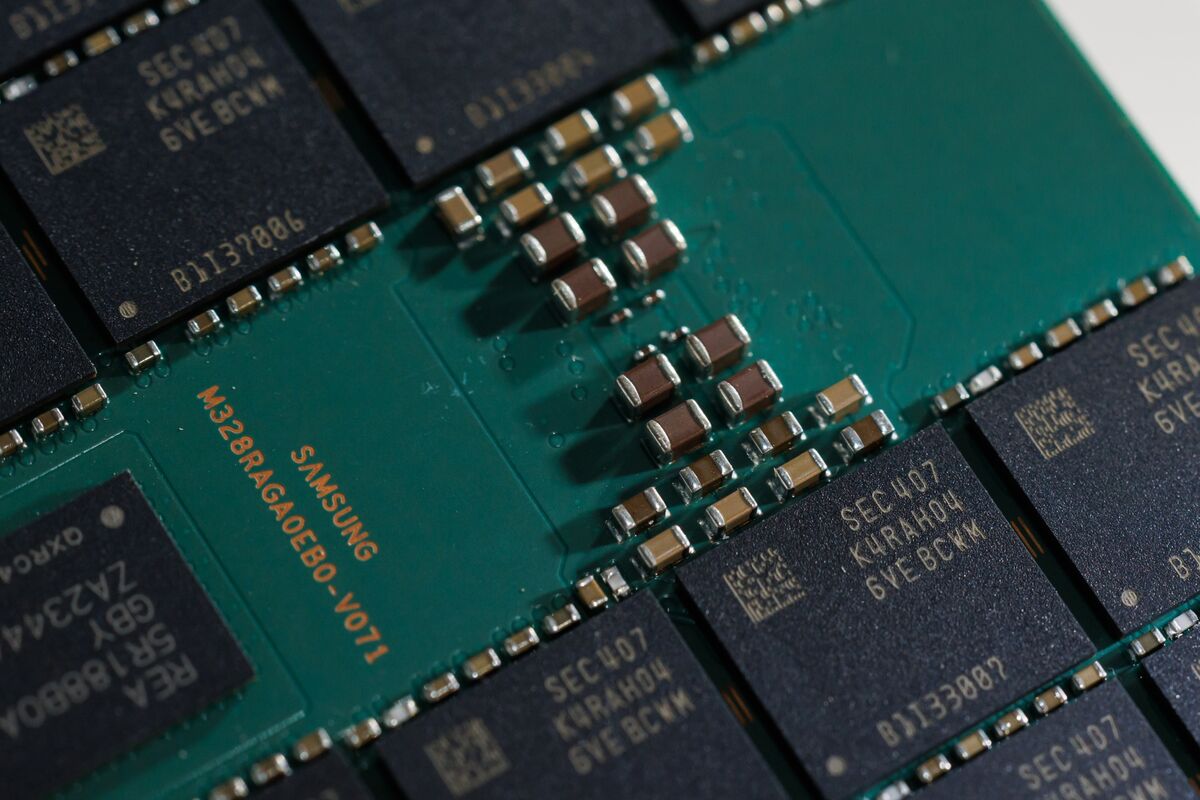
Samsung plans to spend more than 110 trillion won ($73.3 billion) on capital expenditure and research in 2026 to expand memory chip capacity and pursue AI-related technologies. The move aims to secure leadership in AI amid surging demand for high-end memory from Nvidia-driven accelerators, while the industry shift is contributing to a shortage of conventional memory chips used in cars and smartphones.
The capex wave for advanced memory will bifurcate winners: firms that supply high-end DRAM/NVM (design wins, advanced-node process control) and the equipment vendors that receive multi-quarter order visibility. Equipment bookings typically convert to revenue over 6–18 months, so expect strength in wafer-fab-equipment (WFE) revenues before we see meaningful unit-level supply relief in chips; this front-loaded flow compresses time between guidance updates and real cash conversion for the equipment names.
Second-order winners include cloud/data-center customers with long-term procurement leverage — they can lock supply and force price resets for commodity memory buyers, widening margin dispersion across OEMs. Conversely, mid-tier device OEMs with thin BOM buffers and long lead-times are most exposed to transient component inflation and forced design substitutions; that margin pressure can show up in quarterly EBIT within 1–3 quarters and will drive inventory re-pricing for the rest of the supply chain.
Tail risks live on two axes: demand normalization for large AI accelerators (a single large OEM slowdown can cut incremental high-end memory absorption materially within 3–6 months) and a capex-driven oversupply as yield learning and capacity utilization converge — oversupply risk arrives most plausibly in 12–30 months. Near-term catalysts to watch are monthly ASP/spot-price prints, equipment-booking trajectories, and public comments on fab utilization rates from foundry/equipment vendors; any of those moving materially can flip sentiment in weeks rather than years.
The market’s consensus tilt is to view this as a one-way stimulative story for all semiconductor-related equities; that’s underdone on equipment but overdone for firms exposed to commodity DRAM/NAND where margin dilution is likely. Position size and tenor should reflect this: favor leveraged, time-limited exposure to equipment and high-end memory supply capture while explicitly hedging for a 12–24 month capacity cycle reversal.
AI-powered research, real-time alerts, and portfolio analytics for institutional investors.
Request DemoOverall Sentiment
mildly positive
Sentiment Score
0.35
Ticker Sentiment
