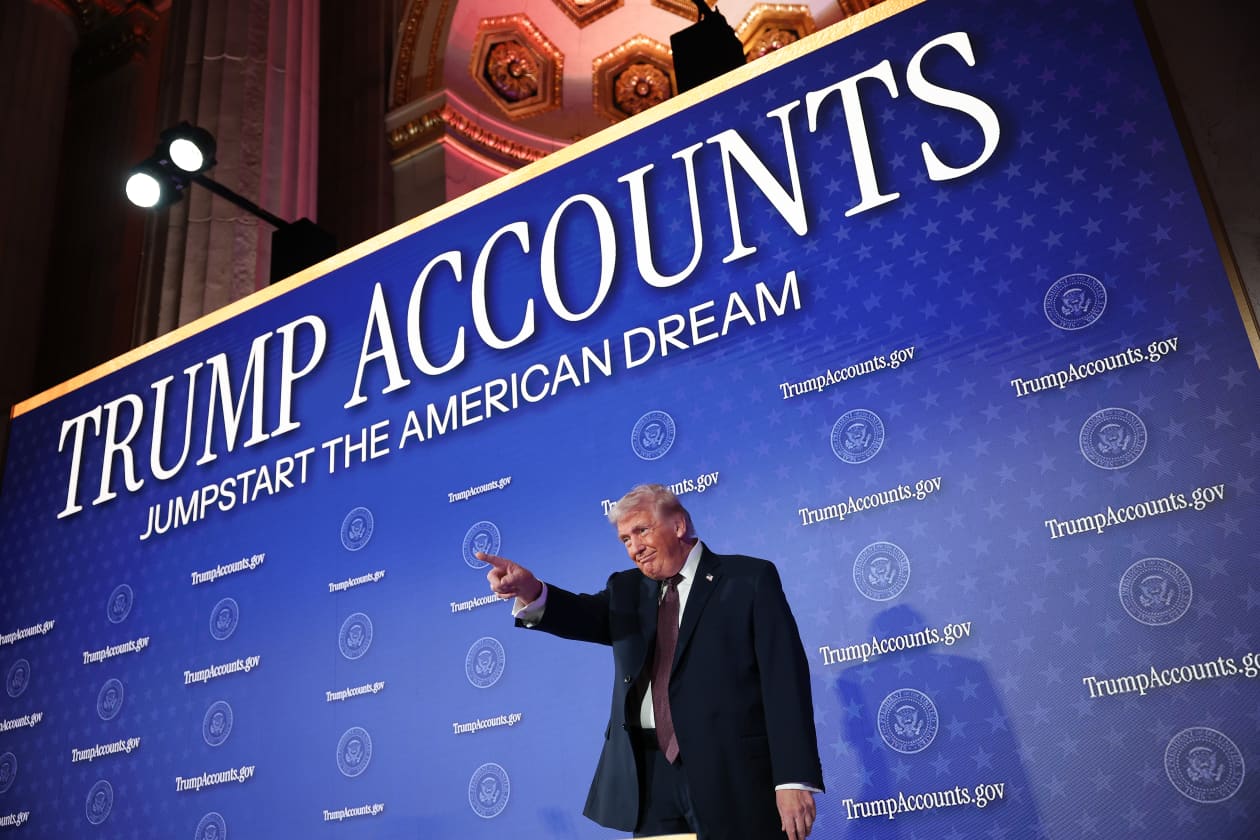
New “Trump accounts” (formally 530A accounts) launching for minors under 18 on July 4 restrict assets until adulthood to U.S. stocks only—no bonds and no international stocks—removing diversification benefits. The article warns that stocks don’t consistently outperform bonds over the long term, potentially increasing risk for children who cannot rebalance until age 18.
The market implication is less about macro flow and more about product design. If these accounts gain traction, the marginal winner is not the broad U.S. market so much as the low-cost wrapper providers and passive allocators that capture default flows into VOO/IVV/VTI-style vehicles; the losers are bond and ex-U.S. allocation sleeves that would otherwise diversify household balance sheets. The second-order effect is a modest reinforcement of U.S. equity home bias, which can keep a valuation premium intact for mega-cap growth if adoption becomes a real savings channel.
That said, the direct capital-market impact is probably small in the first 1-3 months because contribution sizes are capped by behavior, not by policy intent. The bigger catalyst is education and distribution: if brokers, banks, and payroll-linked platforms package the accounts aggressively, the take-up rate could matter for BLK, SCHW, and the largest index ETF franchises. If adoption is sluggish, this becomes a headline-only event with no meaningful earnings or flow translation.
The contrarian view is that forcing 100% U.S. equity exposure during childhood is precisely when diversification has the highest utility, so the policy may generate more future disappointment than incremental wealth. A prolonged drawdown in U.S. equities would be the cleanest falsifier: if the S&P 500 underperforms bonds or ex-U.S. equities over the next cycle, these accounts could become politically unpopular and see low utilization. For trading purposes, the only edge is in relative-flow beneficiaries, not in a directional macro call.
AI-powered research, real-time alerts, and portfolio analytics for institutional investors.
Overall Sentiment
mildly negative
Sentiment Score
-0.25
Ticker Sentiment
