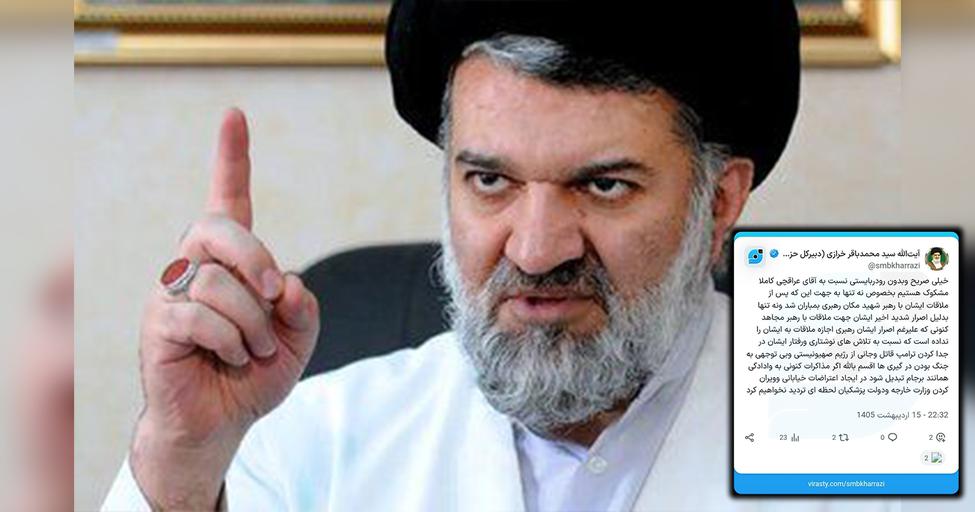
A hardline Iranian figure accused Foreign Minister Abbas Araghchi of involvement in Ali Khamenei’s death and threatened street protests and attacks on the Foreign Ministry if talks with Washington are seen as capitulation. The remarks highlight escalating factional infighting over potential Iran-U.S. negotiations amid weeks of military tension in the Persian Gulf. The rhetoric increases political and geopolitical risk around Tehran’s diplomatic team.
The market implication is not the rhetoric itself but the erosion of negotiating bandwidth inside Iran’s ruling coalition. When hardliners publicly frame diplomacy as betrayal, the probability distribution shifts toward either a harder negotiating stance or a deliberate breakdown in talks, both of which extend the premium on regional risk assets and keep shipping/security costs elevated for longer than headline volatility suggests. The immediate effect is less about an instant market shock and more about a slow ratchet higher in tail risk pricing over the next 2-8 weeks.
Second-order winners are the same industries that benefit from persistent uncertainty: defense, cyber, maritime security, and select energy names with leverage to higher crude and tanker rates. Losers are regional airlines, chemical/import-dependent industrials, and any EM assets with embedded Gulf exposure, where the risk is not just higher energy input costs but a renewed freeze in capital formation and insurance availability. The more interesting dynamic is that domestic factional conflict raises the odds of policy paralysis, which can be more bearish for local equities and the currency than sanctions alone because it reduces confidence in any policy backstop.
The catalyst sequence to watch is binary: a) whether talks continue without public humiliation, which would compress the risk premium quickly, or b) whether the hardline camp turns threats into visible street mobilization, which would signal a higher-probability disruption path over the next 1-3 months. The underappreciated risk is that even if negotiations survive, every additional concession becomes harder politically, making any eventual deal less durable and more reversible. That argues for treating any relief rally in risk assets as tactical rather than structural.
Contrarianly, the consensus may be overestimating the near-term likelihood of a full collapse. Factional threats often serve as intra-elite positioning rather than executable policy, so the first market reaction can overshoot on the downside. If the government compartmentalizes the dispute and keeps channels open, geopolitical premium can bleed out quickly, making short-volatility or event-driven hedges attractive if priced off a maximalist breakdown scenario.
AI-powered research, real-time alerts, and portfolio analytics for institutional investors.
Request DemoOverall Sentiment
strongly negative
Sentiment Score
-0.70
