

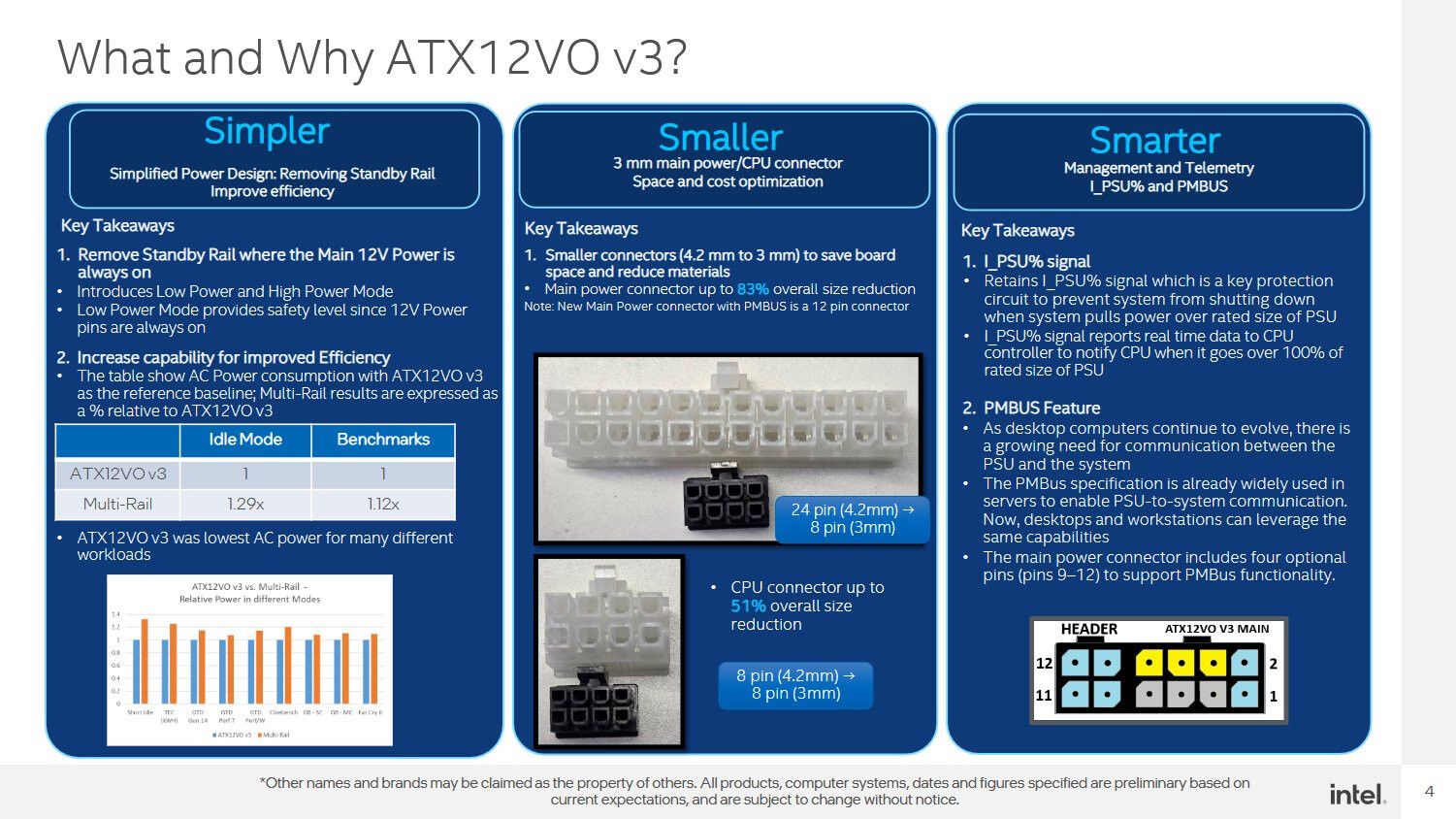
Intel is reportedly preparing ATX12VO V3, a new PC power-delivery standard that reduces connector sizes, adds PMBus monitoring, and improves idle efficiency. The revised design removes the standby rail, introduces low-power and high-power modes, and could cut connector size by up to 83% versus the 24-pin connector while lowering motherboard space and material costs. The news is incremental and mostly relevant to OEM desktop systems rather than the broader retail PC market.
This is less a consumer-PC breakthrough than a manufacturing-architecture optimization story, and that matters for who captures value. The first beneficiaries are OEM desktop builders and board vendors with high volume, low SKU complexity, because any connector/rail simplification lowers BOM cost, assembly time, and failure points; that plays directly into DELL’s enterprise and commercial channel mix. For INTC, the strategic value is leverage over the platform stack: a standard that reduces idle power and adds telemetry strengthens its control of the PC reference design, which can become a quiet margin defender in an otherwise commoditized market.
The bigger second-order effect is competitive displacement within the component ecosystem. If this standard gains traction in OEMs, it favors PSU/board suppliers that can industrialize PMBus, power telemetry, and smaller connectors quickly, while pressuring legacy ATX accessory makers whose catalogues depend on broad retail compatibility. The real adoption bottleneck is not technical but ecosystem friction: any standard that requires motherboard-side regulation and non-backward-compatible cabling tends to win in captive OEM channels first, then stalls in DIY—so the monetization window is likely 12-24 months, not a single product-cycle headline.
The contrarian angle is that the market may underappreciate how much this is about idle power and system manageability, not peak wattage. If the telemetry actually enables dynamic throttling before brownouts, it reduces support costs and warranty noise, which is more economically relevant for enterprise fleets than the headline connector shrink. The risk is that the standard remains conceptually elegant but commercially irrelevant outside locked-down OEM designs; if retail builders reject it again, the stock impact fades into a niche spec update rather than a platform re-rating.
AI-powered research, real-time alerts, and portfolio analytics for institutional investors.
Request TrialOverall Sentiment
mildly positive
Sentiment Score
0.15
Ticker Sentiment
