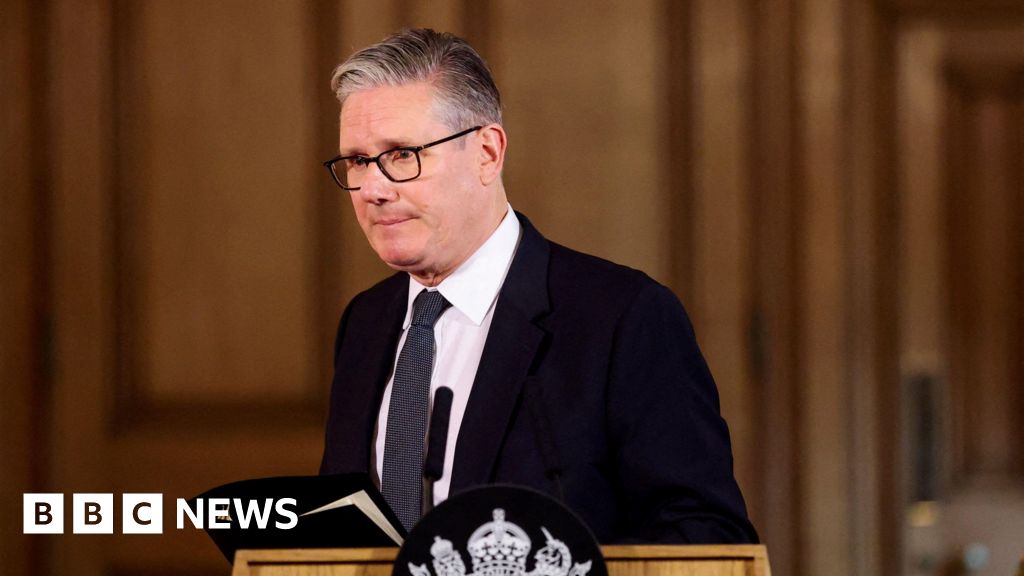
Global media coverage is portraying Sir Keir Starmer’s leadership as under severe pressure after poor UK local election results, with headlines in Germany, France, Spain, Russia, the US, India and Latin America describing a crisis or fight for survival. The article highlights growing rebellion within Labour, but no concrete challenger has yet emerged and there is no immediate policy or market-moving announcement. Impact is mostly on political sentiment rather than asset prices.
The immediate market read-through is not about UK fundamentals so much as policy slack: when a governing party looks internally fragile, it loses the ability to deliver credible fiscal drift, reform sequencing, or clean messaging to investors. That tends to widen the discount on UK domestics first — banks, homebuilders, retailers, and mid-cap cyclicals — because they are the most exposed to sentiment-sensitive capex and consumer confidence rather than direct policy changes. The second-order effect is a higher risk premium on sterling assets even if the macro data do not deteriorate further; political instability can tighten financial conditions by itself via weaker FX and delayed investment decisions.
The bigger issue is duration. This is the kind of shock that can fade in headline intensity within days, but the real damage often accumulates over months as businesses postpone hiring and households internalize that tax/spending policy may be less coherent into year-end. If leadership uncertainty persists into the autumn conference season, the market will start pricing a higher probability of either a policy reset or a snap internal transition, both of which usually compress domestic multiple expansion. That is especially relevant for UK banks and domestically leveraged consumer names, where valuation support depends on stable growth expectations more than on current earnings.
The contrarian angle is that this may be less a regime break than a repricing of expectations after an overstretched political narrative. If the opposition cannot coalesce around a faster or cleaner alternative, the volatility premium can come out just as quickly as it went in. In that case, the overreaction would be in UK beta shorts, while global investors who treat this as a systemic UK growth crisis could miss that the market’s real issue is governance credibility, not immediate recession risk.
AI-powered research, real-time alerts, and portfolio analytics for institutional investors.
Request DemoOverall Sentiment
moderately negative
Sentiment Score
-0.35
For portfolios, the most attractive setup is relative value rather than outright macro direction: short UK domestic cyclicals against quality global earners to isolate political risk from broad market beta. The catalyst window is 1-8 weeks for further leadership headlines, but the trade should be sized for 3-6 months because the economic transmission is slow. Any visible consolidation around a successor or a clear party truce would be the signal to cover quickly; absent that, the risk/reward favors staying defensive on UK home bias.
