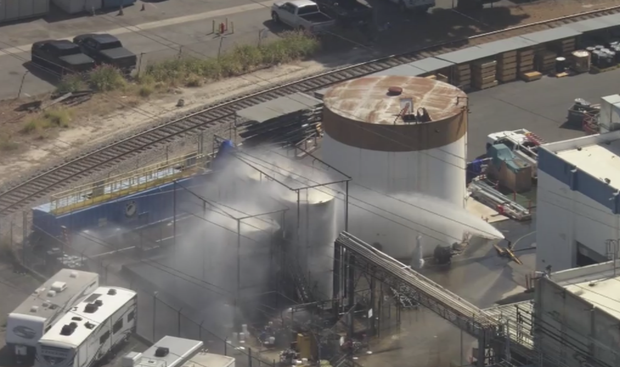
More than 44,000 people were evacuated in Orange County after officials warned a tank holding roughly 7,000 gallons of methyl methacrylate at a GKN Aerospace facility could fail or explode. The leak shut 15 Garden Grove Unified campuses, triggered school and event cancellations, and forced closure of a vote center, while no injuries have been reported. Air monitoring continues, but officials said the tank remains in a dangerous state with an uncertain timeline for resolution.
The immediate market read is not the obvious local disruption but the asymmetric risk that a single industrial containment failure becomes a multi-day operational shock for nearby manufacturers, logistics nodes, and public infrastructure. The second-order effect is a temporary tightening of last-mile mobility and workforce availability across a dense Orange County corridor, which can spill into service businesses, school operations, and any plant-dependent production schedules within a 5-15 mile radius. That matters more for regional operators with just-in-time exposure than for broad national equities, but it can still create a short-duration volatility bid in safety, hazmat, and emergency-response vendors.
For GE specifically, the direct fundamental link is weak, but the incident reinforces a broader policy tailwind for industrial monitoring, control systems, and fire-suppression retrofits. The bigger beneficiary set is likely insurers and catastrophe-exposed municipal contractors, though that is not easily expressible in a public equity basket. Over the next days, the key catalyst is whether authorities can keep the tank in a stable state without a release; if they can, the event fades quickly, but any thermal runaway or evacuation extension would extend the economic drag and increase the probability of litigation, cleanup, and asset-damage claims that linger for months.
The contrarian point: the market may overestimate the likelihood of a broad toxic plume and underestimate the cleanup/reputational costs that follow even a contained incident. This is a classic mismatch between headline risk and underwriting risk; the first is time-limited, the second can persist through insurance reserves, contract disputes, and permitting delays. The cleaner trade is not to chase the event itself, but to position for a small, persistent premium on industrial safety spend and a near-term discount on names exposed to Southern California logistics disruption.
In risk terms, the downside tail is low frequency but high severity: evacuation expansion, asset damage, or a secondary ignition would lift the implied probability of regional industrial shutdowns and public-sector spend. If the tank remains cooled and no plume develops over the next 24-72 hours, the risk premium should compress rapidly, making any panic-driven move in adjacent industrial or logistics names likely fadeable.
AI-powered research, real-time alerts, and portfolio analytics for institutional investors.
Request DemoOverall Sentiment
strongly negative
Sentiment Score
-0.78
Ticker Sentiment
