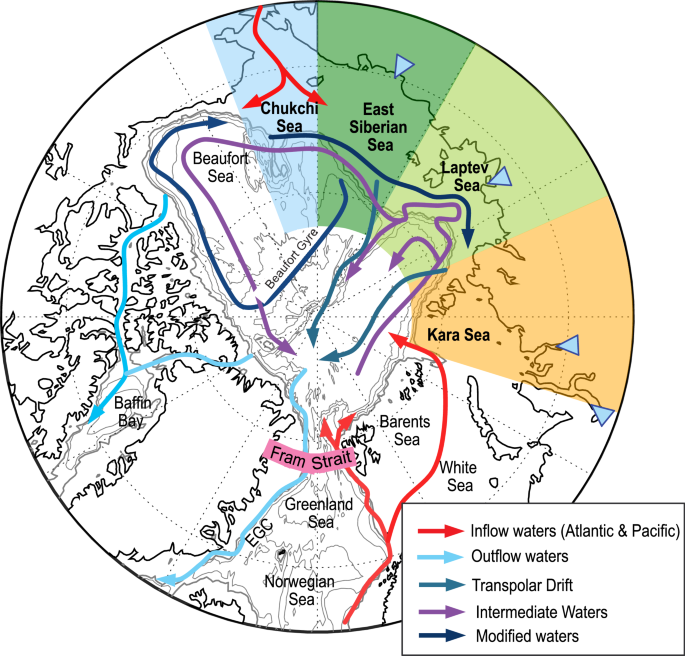
The article finds a regime shift in Arctic Ocean nitrogen biogeochemistry around 2009, with Fram Strait nitrate concentrations falling from 3.1 µM before 2009 to 1.7 µM after, alongside higher Si:N ratios. It attributes the change to a roughly doubling of benthic denitrification on Siberian shelves, driven by sea ice loss and circulation changes, implying a transition from light-limited to nitrogen-limited Arctic primary production. The piece is scientific and climate-focused rather than a direct market event, so immediate market impact is minimal.
The investable takeaway is not “Arctic ecology is changing,” but that the region appears to have crossed a nutrient throttle point: more light no longer translates into more biological throughput unless fixed nitrogen is available. That shifts the marginal value chain from ice-loss beneficiaries to entities exposed to nutrient scarcity, sedimentary oxygen stress, and broader Arctic food-web instability. The second-order effect is a likely widening dispersion inside the commodity basket: more primary production in the Pacific inflow zone can coexist with weaker productivity farther downstream, so aggregate Arctic-linked upside is increasingly concentrated in one corridor rather than basin-wide.
For shipping and infrastructure, the direct operating impact is muted near term, but the regime-shift framing matters because it implies nonlinear feedbacks and persistence. If nutrient limitation is now the binding constraint, any temporary moderation in sea-ice loss is less likely to restore the prior biological state, so positioning should focus on long-duration, not cyclical, climate exposures. The bigger market implication is for sovereign and policy capital allocation: Arctic states may face stronger pressure to fund monitoring, fisheries adaptation, and offshore platform hardening as ecosystem baselines become less predictable.
The contrarian angle is that consensus may over-translate this into a simple “more warming = more productivity” story. The article argues the opposite: there is a saturation point where additional open water stops being additive and can actually reduce downstream ecosystem carrying capacity by intensifying nitrogen export loss. That means the trade is less about broad climate beta and more about spotting who benefits from localized inflow-shelf productivity versus who loses from interior-basin nutrient depletion and food-web simplification.
AI-powered research, real-time alerts, and portfolio analytics for institutional investors.
Request TrialOverall Sentiment
neutral
Sentiment Score
0.00
