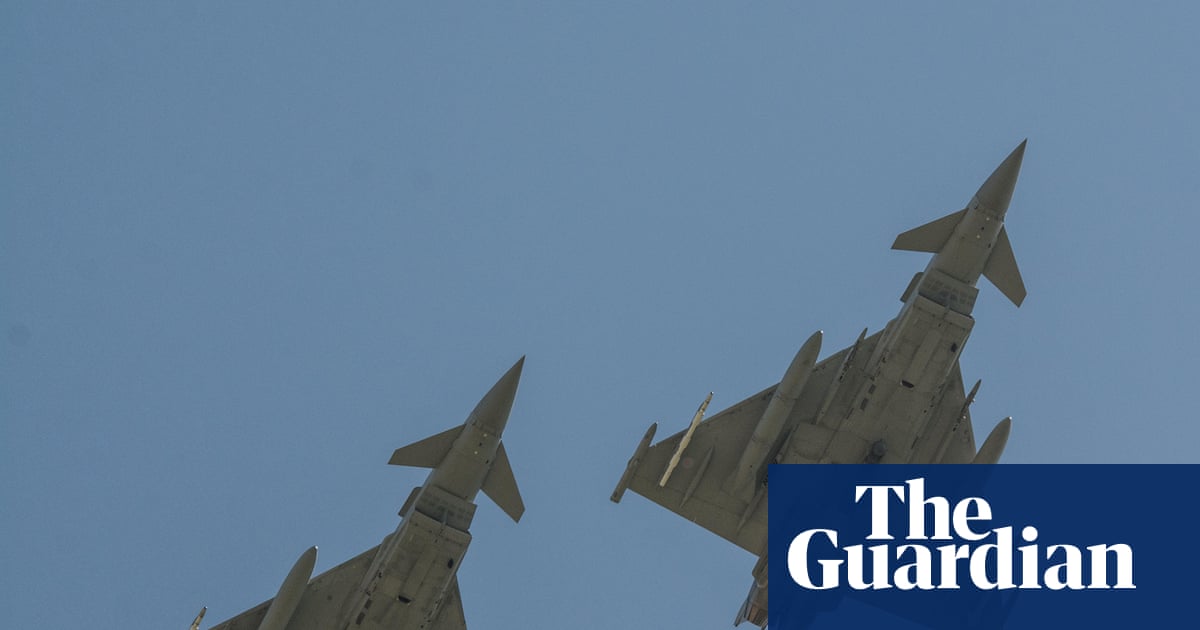
Two RAF Typhoons were scrambled from Romania to monitor Russian drones near Nato airspace, with Romanian officials saying the jets had authorisation to engage if the drones breached Romanian airspace, but no shots were fired. British defence sources said the aircraft did not enter Ukrainian airspace, countering reports of a possible shootdown over Ukraine. The incident underscores elevated cross-border military risk around Nato's eastern flank and remains a meaningful geopolitics and defense-market headline.
The immediate market read is not on the aircraft themselves but on the probability distribution of the conflict tail. Even without shots fired, the incident raises the baseline for miscalculation around NATO’s eastern flank, which tends to benefit air-defense, ISR, and EW suppliers more than traditional ground combat primes because the response requirement is faster, cheaper, and more persistent. Expect incremental budget urgency in Europe for radar coverage, counter-UAS, and forward-deployed alert aircraft; the funding path is more likely to come from expedited procurement and replenishment contracts than from large multi-year programs.
Second-order, the most exposed weak links are civilian infrastructure and insurers in the border regions, not the battlefield. Repeated drone activity near NATO airspace increases the probability of temporary airspace restrictions, localized disruption to power/logistics nodes, and higher security premiums for ports, telecom towers, and grid assets in Romania and neighboring states. That matters because the marginal cost of defense hardening is low relative to the cost of one successful spillover event, so procurement can accelerate quickly after a single near miss.
The main contrarian point is that headlines can overstate escalation while the operational reality remains contained: NATO’s rules of engagement are still constraining, so the near-term path is a grind of surveillance rather than direct kinetic escalation. That means the best expression is not a broad defense beta chase, but a basket tilted toward companies selling sensors, counter-drone systems, and electronic warfare, where order flow can re-rate on every incident. The risk to that view is a de-escalation channel or a political decision to keep responses strictly defensive, which would compress the urgency premium within weeks.
AI-powered research, real-time alerts, and portfolio analytics for institutional investors.
Request DemoOverall Sentiment
mildly negative
Sentiment Score
-0.15
Over the next 1-3 months, watch for follow-on procurement announcements and any language shift from 'monitoring' to 'intercept capability' in Romania, Poland, and the Baltics. A durable trend requires repeated incursions plus one visible infrastructure hit; absent that, the trade is more event-driven than secular. If the situation stabilizes, defense outperformance should narrow back to platform-specific fundamentals rather than the geopolitical premium.
