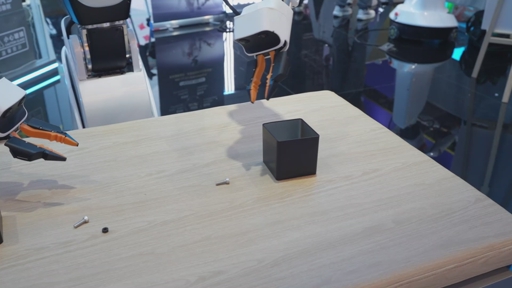
TARS a remporté le prix SAIL (Superior AI Leader) à WAIC 2026 grâce à son modèle de fondation embodied-native AWE, et a présenté AWE 3.5. Par rapport à Pi 0.5, AWE 3.5 double environ l’efficacité d’exécution (+~100%), améliore les performances sur tâches complexes et conserve une interaction en boucle fermée pendant plusieurs minutes. La société vise 10 millions d’heures de données de pré-entraînement d’ici fin 2026 et déploie des démonstrations industrielles (assemblage de faisceaux de câbles automobiles, DexHand) pour accélérer l’adoption à grande échelle.
The near-term market read-through is mostly sentiment, not earnings. The bigger signal is that embodied AI is moving from robot demos to dataset competition: the moat is shifting toward whoever can source large, validated human-action data and convert it into repeatable factory workflows. That favors compute, machine-vision, tactile-sensor, and edge-control stacks more than the robot OEM itself; the first beneficiaries are likely NVIDIA, key sensor suppliers, and integrators exposed to pilot deployments, while low-end industrial-automation vendors face a price/feature squeeze if China localizes the stack.
The second-order risk is that this is still a proof-of-concept cycle. The cost curve only improves if uptime, cycle time, and error rates hold in messy production settings; otherwise, the announcement becomes a funding and positioning event rather than a procurement wave. Over 1-3 months, watch for follow-on order disclosures, factory partnership breadth, and whether the data expansion target translates into commercially deployable SKUs; over 6-18 months, the structural winner is whichever platform locks in proprietary task data and becomes the default middleware between sensors and actuators.
Contrarian view: consensus will likely overestimate how quickly embodied AI displaces labor in manufacturing. The bottleneck is not model cleverness but safety certification, integration costs, and factory-specific edge cases, which means adoption may be concentrated in narrow, repetitive, high-value tasks first. If the market has already priced a broad robotics capex boom, the better trade may be to fade the most crowded beta in robotics ETFs and wait for actual order conversion before paying up for the theme.
AI-powered research, real-time alerts, and portfolio analytics for institutional investors.
Request DemoOverall Sentiment
moderately positive
Sentiment Score
0.35
