

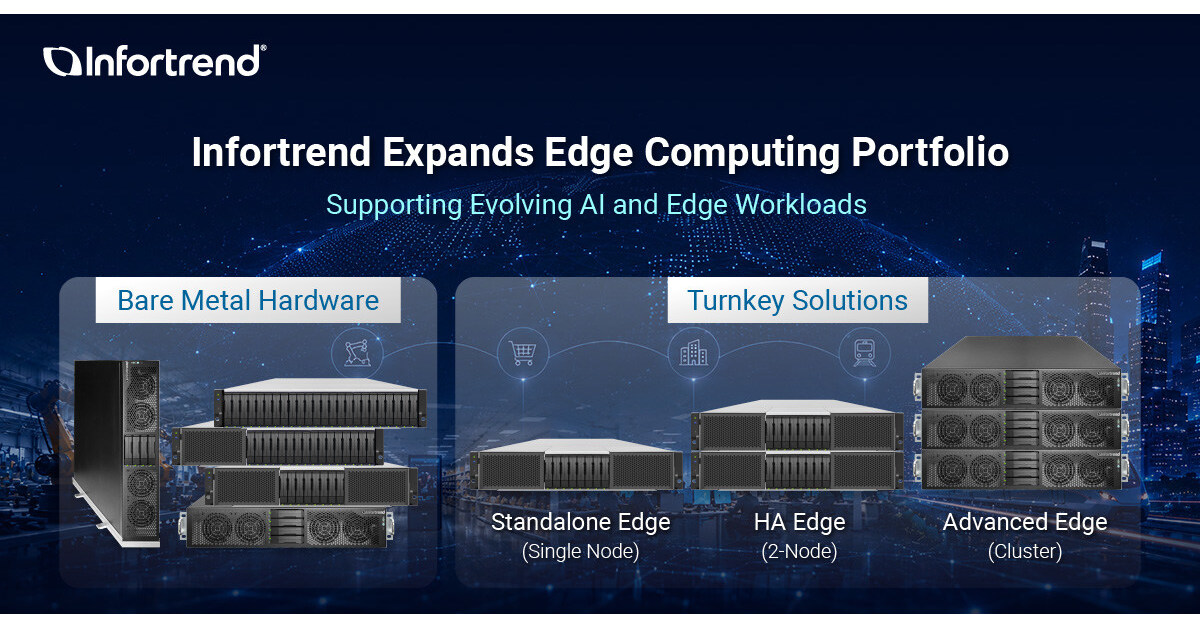
Infortrend (TWSE: 2495) expanded its edge computing portfolio aimed at edge AI inference and containerized workloads, offering bare-metal edge hardware plus turnkey solutions across Standalone (single-node), HA (redundant two-node), and Advanced (3–5 node clustered with failover and dynamic scaling). The offering is built on purpose-built KS 3000U (AMD EPYC 8004, up to 2 GPUs) and KS 5000U (dual Intel Xeon/AMD EPYC 9004/9005, up to 320 CPU cores and up to 4 GPUs). Overall, the announcement is incremental product news with limited near-term market impact.
This is better read as a distribution-channel signal than as an earnings event. The real economic value in edge AI is not the box itself but the attach of CPU, storage, management software, and service contracts; that tends to favor vendors that can sell a complete, low-touch deployment stack and penalize commoditized component suppliers. AMD is the cleaner incremental beneficiary because power-efficient, high-core CPUs are more relevant in space-constrained and clustered edge designs; Intel’s inclusion looks more defensive than share-gaining.
The immediate market reaction should be muted because the article does not prove meaningful unit demand, pricing power, or backlog conversion. The missing data is shipment volume, GPU attach rate, and whether these are production deployments versus marketing bundles; without that, the revenue impact is likely immaterial for both AMD and INTC this quarter. If channel checks show repeat orders, the next 1-3 quarters could modestly support enterprise/server CPU demand and storage attach, but this is still a small piece of the broader AI capex story.
Over 6-18 months, edge AI is a second-order beneficiary of AI proliferation: it shifts some inference spend away from centralized clouds into fragmented, lower-ASP deployments where reliability and serviceability matter more than raw scale. That is structurally better for diversified x86 and infrastructure vendors than for pure-play accelerator narratives, but the addressable market remains constrained by power, maintenance, and software complexity. Contrarian view: the market may be overestimating how quickly edge AI becomes a volume driver; most deployments will stay pilot-heavy unless there is evidence of standardized rollouts in industrial, retail, or telecom verticals.
What would falsify the thesis is a lack of follow-through in upcoming enterprise/server commentary or no visible lift in AMD/INTC data center guidance. If the next earnings cycle shows unchanged capex conversion and no edge-related order commentary, this should be treated as noise rather than a tradable signal.
AI-powered research, real-time alerts, and portfolio analytics for institutional investors.
Request TrialOverall Sentiment
mildly positive
Sentiment Score
0.15
Ticker Sentiment
