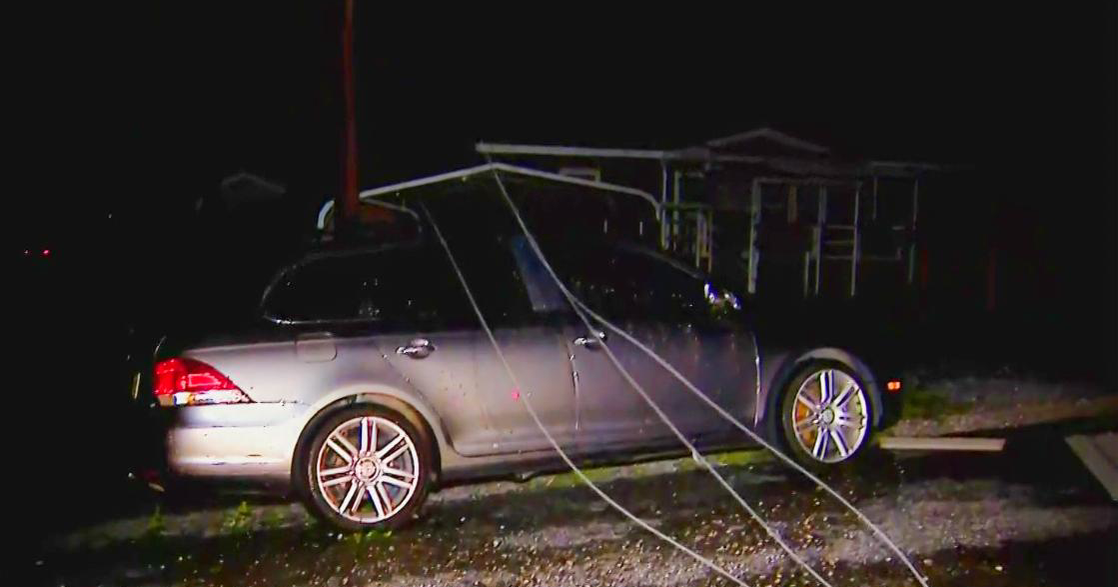
At least two people were killed and six others injured after severe storms struck North Texas, with at least 20 families displaced in Wise County and major structural damage reported across multiple neighborhoods. In Runaway Bay, officials said EF-2-or-greater winds are suspected, with vehicles tossed, power lines down, roofs missing, blocked roads, and ongoing rescue and recovery operations. The event is materially negative for affected communities but is likely to have limited broader market impact.
The immediate economic hit is not the fatalities themselves but the temporary break in local mobility and utilities: downed lines, blocked roads, and shelter displacement create a short-lived shock to retail traffic, contractor schedules, and insurance adjuster throughput. The first-order beneficiaries are emergency services, cleanup/logistics providers, and regional generators; the hidden second-order winner is anyone selling restoration labor, temporary housing, tarps, roofing materials, and water mitigation into a county where claim volume will spike faster than labor capacity.
For public markets, the cleanest read-through is to property and casualty insurers with Texas exposure. The issue is less the headline loss count than the mix: roof loss, vehicle damage, and water intrusion tend to create a broader claims tail over 30-90 days as residents discover secondary damage. If the storm track was indeed EF2-plus in pockets, reserve adequacy matters more than near-term premium growth, especially for carriers with concentration in nonstandard homeowners and auto in North Texas.
The contrarian angle is that the market may underprice the duration of the repair bottleneck. Rebuilding delays often extend beyond the weather event itself because power restoration, debris removal, and contractor availability become the gating factors; that pushes revenue recognition into multiple quarters for home-improvement and materials names even when initial sentiment is “one-off event.” Conversely, the macro drag is usually modest unless there is repeated severe-weather clustering, so this is more a micro dispersion opportunity than a broad regional growth shock.
AI-powered research, real-time alerts, and portfolio analytics for institutional investors.
Request DemoOverall Sentiment
strongly negative
Sentiment Score
-0.75
