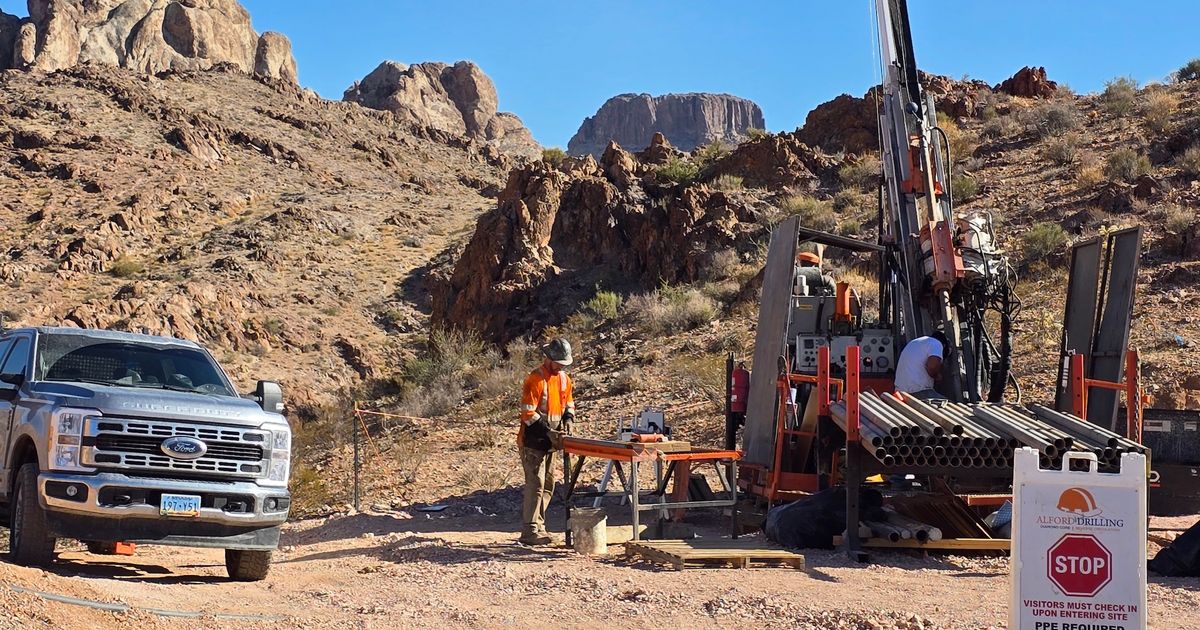
Arizona Gold & Silver reported assay results from core hole PC25-158 at the Philadelphia project showing a 60.37 metre mineralized interval averaging 4.36 g/t Au and 6.38 g/t Ag, including a high-grade 4.33 m interval at 19.37 g/t Au and 19.36 g/t Ag and a 24.21 m subinterval at 6.28 g/t Au and 7.18 g/t Ag starting at 285.85 m. The hole, drilled ~110 m north of a prior high-grade intercept, extends the Perry Discovery along strike, notes low sulfur and ~1:1 Ag:Au in the high-grade core, and the company says follow-up drilling (PC25-159) is underway while warrant exercises are strengthening the balance sheet.
Market structure: The Perry intercept materially benefits Arizona Gold & Silver (AZASF) as the primary direct beneficiary—positive drill news can drive >50–100% short-term moves in junior explorers with confirmed follow-ups. Broader winners include service contractors in Arizona and other junior explorers (GDXJ constituents) as investor risk appetite may re‑flow to explorers; global gold/silver supply balance is unchanged (this discovery is immaterial to ounces/year) so metal prices should not move significantly absent a company‑level M&A story. Risk assessment: Key tail risks are assay/replication failure (PC25‑159 negative), metallurgical recovery problems despite low sulfides, permitting/environmental litigation in AZ, and meaningful share dilution from exercise of in‑the‑money warrants; any of these could wipe out >80% of market cap. Immediate window (days) will be headline‑driven; short term (weeks–months) depends on PC25‑159 and additional step‑outs; long term (12–24+ months) depends on resource conversion, metallurgy and PEA. Hidden dependency: 1:1 Ag:Au ratio and very low sulfur suggest potentially amenable metallurgy (positive), but also lower by‑product credits. Trade implications: Direct tactical play is a small, size‑controlled long in AZASF (TSX‑V:AZS / OTCQB:AZASF) ahead of PC25‑159 results expected within 7–14 days, with a 2–3% portfolio position, stop‑loss 30% and a take‑profit tranche at +100–150% within 3 months if strike extensions confirm. Relative/value: consider pair‑trade long AZASF (2%) and short junior gold ETF (GDXJ) 1–1.5% to hedge metal price beta. Options: if liquid, buy 6–9 month call spreads (buy ATM, sell +50–100% OTM) to cap premium; if not, use outright shares and hedge tail risk with puts on GDX/GDXJ. Contrarian angles: Consensus assumes strike growth; downside is that the high‑grade is a narrow shoot near the boiling zone and may not scale—histor parallels include promising juniors that failed near‑term step‑outs. Market may underprice metallurgy upside and low processing risk (could justify higher multiple) but may overprice near‑term drill success without accounting for dilution—monitor fully diluted share count; an increase >20% from warrant exercise should trigger re‑assessment.
AI-powered research, real-time alerts, and portfolio analytics for institutional investors.
Request DemoOverall Sentiment
moderately positive
Sentiment Score
0.45
Ticker Sentiment
