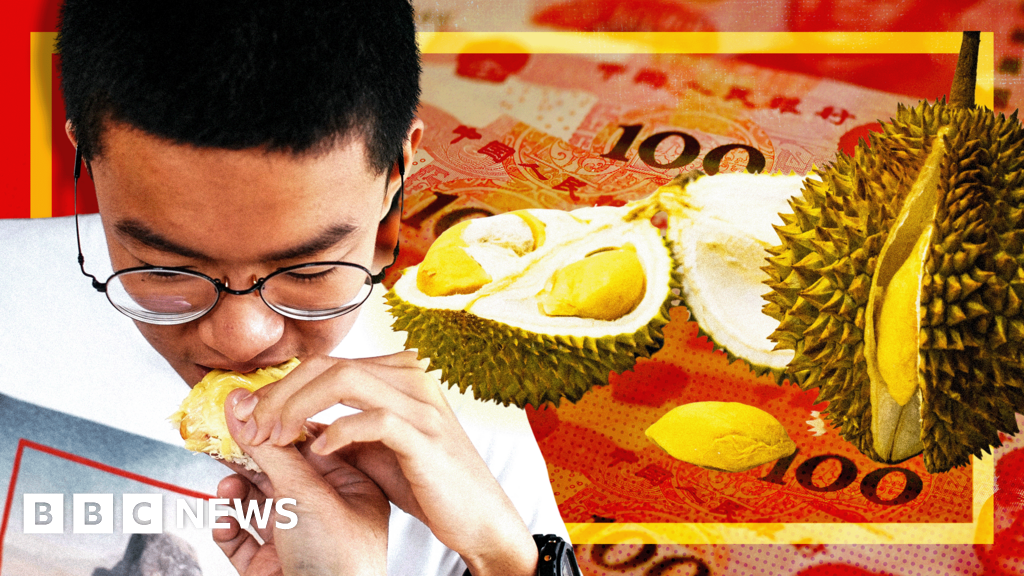
China's appetite for durian is driving a rapid export boom—China imported a record $7bn of durians in 2024, roughly three times 2020 levels and now accounts for over 90% of global durian exports—boosting premium Malaysian varieties like Musang King (retail prices $14–$100 each). The surge has prompted bilateral trade deals, infrastructure-led logistics gains (eg, China–Laos rail moving >2,000 tonnes/day), and farmer-level windfalls in producing regions, but also raises near-term supply and regulatory risks (food-safety dye findings, land disputes, and potential competition from China's Hainan production projected at ~2,000 tonnes in 2025). Investors should weigh strong demand and premium pricing for regional exporters against operational, regulatory and longer-run substitution risks from increased domestic Chinese production and trade friction.
Market structure: The immediate winners are premium Malaysian growers (Musang King), cold‑chain logistics providers and air/rail freight operators servicing perishable cargo — China imported $7bn of durians in 2024, ~3x 2020, implying a multi‑year volume tailwind. Losers include commodity palm/oil producers where land is being converted back to durian, Vietnamese coffee producers who have lost hectares (supporting coffee prices), and players exposed to sudden Chinese sanitary restrictions that can cut demand quickly. Cross‑asset: expect modest MYR appreciation vs peers, upward pressure on short‑term freight/cold‑storage equities (COLD), and selective EM equity divergence (Malaysia > Thailand) over 6–12 months. Risk assessment: Tail risks are regulatory shocks (China import bans or dye contamination scares), abrupt land‑tenure enforcement in Malaysia, and Hainan scaling faster than markets expect — any one can erase premium prices in weeks. Immediate (0–30 days) volatility will track Chinese inspection headlines; medium term (3–12 months) depends on harvest seasonality and freight capacity; long term (2–5 years) hinges on Hainan/China domestic cultivation reaching >5–10% market share. Hidden dependencies include refrigerated freight capacity, airfreight pricing, and bilateral trade agreements that can reroute flows within weeks. Trade implications: Favor exposure to cold‑chain logistics and Malaysia equity outperformance while hedging regulatory headlines; expect 12‑month upside but episodic 10–25% drawdowns around food‑safety events. Options can be used to size convexity around events (cheap puts around shipping names, call spreads on cold storage). Rotate away from pure commodity palm/oil cyclical exposure into premium food exporters and specialty agri supply‑chain names for 6–18 months. Contrarian angles: The market overprices the inevitability of Hainan “durian freedom” — varietal quality, yield curves and terroir mean Hainan scaling to 10%+ share is multi‑year and costly; shorting Malaysian premium now risks a mis-timed policy/labor shock. Also underappreciated is the second‑order boost to global coffee prices from land conversion — a 5–10% sustained coffee price rise is plausible if conversion continues, creating cross‑commodity hedging opportunities.
AI-powered research, real-time alerts, and portfolio analytics for institutional investors.
Request DemoOverall Sentiment
mildly positive
Sentiment Score
0.35
