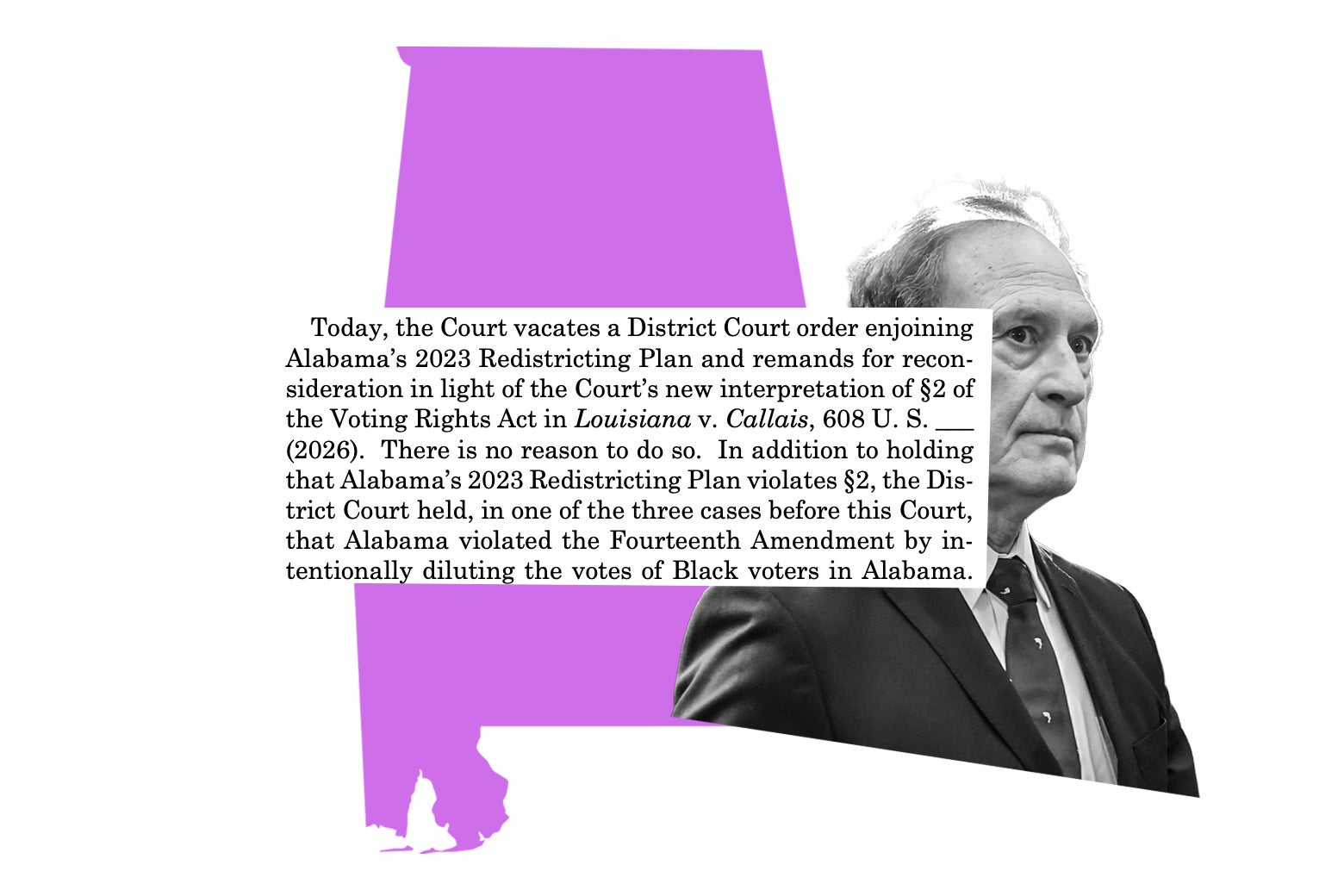
A federal court in Alabama again struck down the state’s congressional maps, finding intentional racial vote dilution and violating the 14th Amendment and Voting Rights Act principles despite the Supreme Court’s recent Callais ruling. The decision preserves a court-ordered map with two minority-opportunity districts and blocks Alabama’s last-minute attempt to enact a new gerrymander before the election. Alabama is appealing to the Supreme Court and seeking an emergency stay, keeping voting-rights and redistricting risk elevated.
The market implication is not about one Alabama map; it is that SCOTUS has now made election-law outcomes more path-dependent and more state-specific. That raises the value of legal agility inside politically exposed sectors: state-level ballot initiatives, public utility commissions, hospital-rate cases, and procurement all become more sensitive to forum-shopping and emergency injunction risk. The second-order effect is higher discount rates for long-duration regulatory stories in red states, because outcomes can now turn on last-minute judicial sequencing rather than a clean statutory baseline.
The clearest winners are administrative incumbents: election vendors, compliance consultants, and law firms with appellate capacity. The losers are not just voting-rights plaintiffs; they are any issuer or contractor whose economics depend on stable districting, entitlement flows, or local political boundaries. Expect more volatility in municipal credit spreads for counties and school districts in states where partisan control can rapidly translate into policy reversals, especially over the next 6-18 months as lower courts test the outer bounds of the new jurisprudence.
The deeper risk is institutional: if emergency-stay behavior keeps overriding lower-court fact patterns, then the next catalyst is not the merits but procedural timing. That creates a regime where traders should fade first-order headlines and instead focus on deadlines, filing windows, and injunction timing. The contrarian view is that the immediate probability of a broad market impact is still low; this is a governance/constitutional signal, not an earnings shock, so any asset-price response should be selective rather than thematic.
AI-powered research, real-time alerts, and portfolio analytics for institutional investors.
Request DemoOverall Sentiment
strongly negative
Sentiment Score
-0.70
