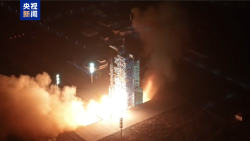
China launched the Shenzhou-23 crewed spacecraft aboard a Long March-2F rocket at 11:08 p.m. Beijing Time, with the mission reaching orbit successfully about 10 minutes later. The three-astronaut crew will perform a fast automated rendezvous and docking with the Tianhe core module and conduct over 100 scientific and application projects. The article is primarily a factual update on China’s space program and has limited immediate market impact.
This is best read as a steady compounding signal for China’s state-backed space industrial base rather than a single-event headline. The recurring cadence of crewed launches and in-orbit handoffs reduces execution risk across the entire ecosystem: launch services, guidance/navigation, thermal protection, ground systems, and payload integration. The second-order beneficiary is not the headline rocket contractor alone, but the wider supply chain that gets validated by repetitive human-rating standards — avionics, specialty materials, radiation-hard electronics, and environmental control systems.
The more important commercial implication is institutionalization of demand. Once crewed missions move from proof-of-concept to routine operations, procurement shifts from lumpy capex to a multi-year sustainment budget with clearer visibility, which typically supports higher valuation multiples for the prime integrators and select component suppliers. The Hong Kong astronaut angle also matters geopolitically: it broadens the narrative from pure prestige to talent integration and soft-power signaling, which can help justify continued fiscal support even if short-term industrial ROI is opaque.
The main risk is that investors overestimate near-term monetization. Much of the scientific payload work has low direct revenue conversion; the economic payoff is mostly through technology spillovers and government-led industrial policy, which can take 2-5 years to show up in earnings. A reversal would require either a mission failure, budget reprioritization away from strategic tech, or a broader macro tightening that forces slower procurement cycles in China’s defense/space ecosystem.
Contrarian take: the market may already be too comfortable treating China’s space program as a one-way strategic winner. The real alpha is likely in the less obvious enablers — components, testing, and ground infrastructure — while the most visible primes may be capped by state pricing and policy constraints. That makes this a better theme for selective long exposure than broad basket chasing.
AI-powered research, real-time alerts, and portfolio analytics for institutional investors.
Request DemoOverall Sentiment
neutral
Sentiment Score
0.12
