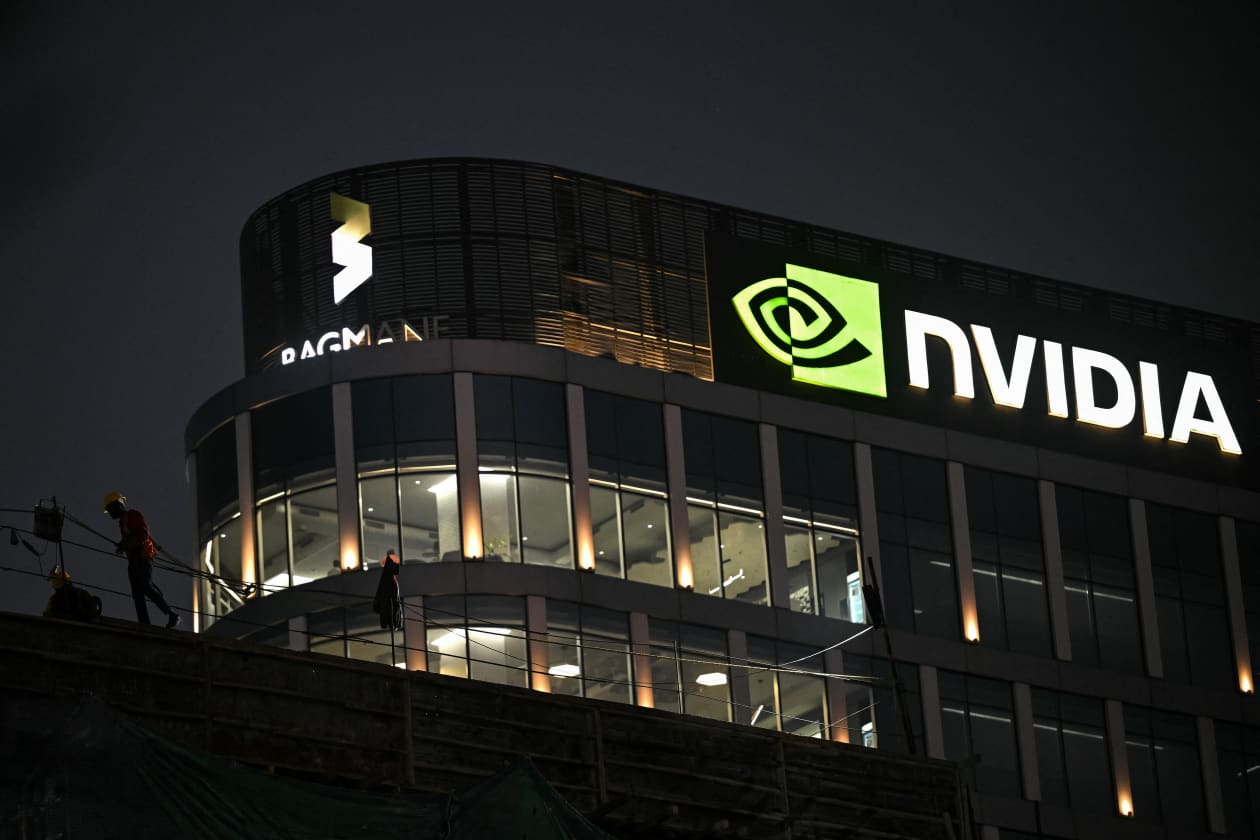
The PHLX Semiconductor Index has doubled this year, but Nvidia is up only 14% year to date and ranks last in the 30-stock index, while Broadcom is second-to-last at +15%. The article frames the move as a relative-performance story, with an analyst noting Nvidia’s size limits its ability to keep beating expectations by a wide margin. Overall tone is mixed but largely factual, with limited immediate market impact.
The key signal is not that semis are strong, but that leadership is broadening away from the two names most tied to consensus AI spend. When the largest winners stop being the marginal drivers of index upside, it usually means positioning has become crowded in the obvious longs and the market is rewarding companies with cleaner near-term execution or less demanding expectations. That creates a stealth bullish backdrop for second-tier semis and equipment names, while making the mega-caps more vulnerable to any disappointment in booking cadence or gross-margin expansion.
For NVDA and AVGO, the second-order issue is expectation gravity: at scale, each quarter needs more absolute dollar beat to move the stock, while the market becomes less forgiving if growth merely remains excellent. That asymmetry matters over the next 1-2 earnings cycles, especially if hyperscaler capex growth moderates even slightly or if customers start normalizing inventory after the AI rush. In that scenario, the names can still compound fundamentals, but multiple expansion likely shifts elsewhere in the chain.
The contrarian angle is that underperformance in these leaders may be constructive rather than bearish if it reflects rotation into under-owned beneficiaries of the same AI buildout. Consensus is likely overestimating how much of the AI trade has to come from the most obvious winners; the better risk-adjusted expression may now be through tooling, analog, memory, or semiconductor equipment where expectations are lower and operating leverage can surprise. The move is probably not a call to fight the sector, but to reduce concentration in the crowded center and own the picks-and-shovels with cleaner setup.
Catalyst risk is concentrated around the next print and any commentary on order normalization, lead times, or customer digestion. Near term, the stocks can still squeeze if guidance inflects, but over 3-6 months the more likely failure mode is not a collapse in demand, but a de-rating from slower incremental surprise. If the index keeps levitating without these leaders participating, it reinforces that leadership is fragmenting — which is typically a warning sign for passive-weighted exposure in the biggest names.
AI-powered research, real-time alerts, and portfolio analytics for institutional investors.
Request DemoOverall Sentiment
neutral
Sentiment Score
-0.05
Ticker Sentiment
