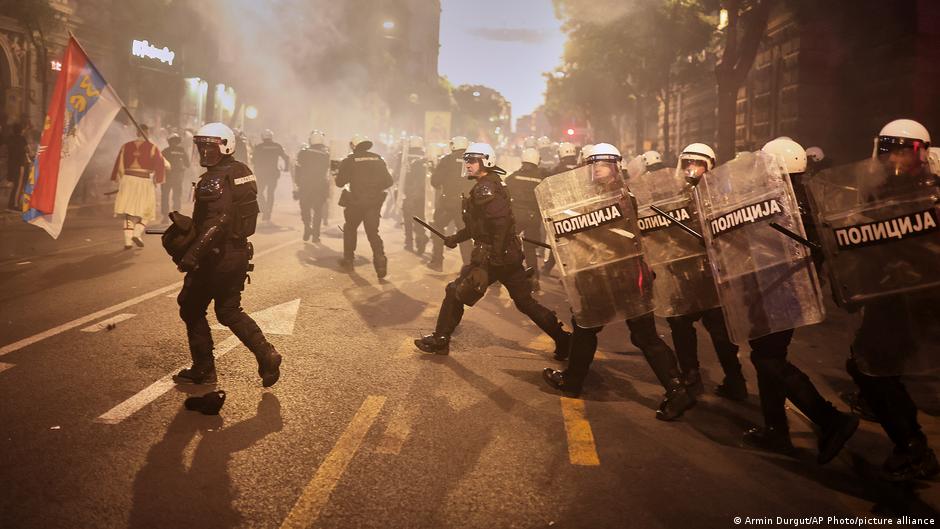
Tens of thousands protested in Belgrade, with clashes breaking out as demonstrators demanded early parliamentary elections and an end to President Aleksandar Vucic's 12-year rule. The unrest follows the November 2024 Novi Sad station collapse that killed 16 people and sparked allegations of corruption, and it comes amid warnings that Serbia's democratic backsliding could jeopardize about €1.5 billion in EU funding. The situation raises political and governance risk for Serbia, though the immediate impact is primarily country-specific rather than market-wide.
This is less a one-day protest headline than a slow-moving sovereign-risk repricing. The important second-order effect is not the street violence itself, but the regime’s increasing incentive to substitute coercion for policy adjustment, which tends to delay EU capital, widen local funding spreads, and keep the currency and duration complex under pressure. The market should care most about the next 1-3 months: any escalation around transport shutdowns, media crackdowns, or mass arrests would push the story from political noise into a financing-cost event for domestically exposed assets.
The sharpest loser set is local banks, construction-linked contractors, and infrastructure concession beneficiaries that rely on state capex continuity and EU co-funding. Even without direct sanctions, governance deterioration usually shows up first in higher bid spreads, slower project awards, and more expensive refinancing for quasi-sovereign issuers. A less obvious beneficiary is the opposition ecosystem itself: if unrest forces a broader electoral reset, the probability of policy normalization rises, which could re-rate the entire local cyclical basket in the outer 6-12 months.
The consensus may be underestimating how much of the negative news is already embedded in valuation for Serbian risk assets, but overestimating the regime’s ability to suppress the issue without economic cost. If the government keeps hardening, the economic drag becomes self-reinforcing through funding access and EU disbursement risk; if it softens, it creates event-driven upside. That asymmetric setup argues for hedges rather than outright macro shorts unless protests broaden materially beyond student-led demographics and begin to affect labor participation or logistics.
The most tradable impulse is a short-duration risk hedge rather than a directional EM bet: the catalyst path is political, not fundamental, so timing matters more than thesis. Any move toward early elections would likely compress risk premia quickly, but until then the balance of probabilities favors periodic spikes in volatility and temporary underperformance in domestic Serbia proxies versus broader CEEMEA.
AI-powered research, real-time alerts, and portfolio analytics for institutional investors.
Request DemoOverall Sentiment
strongly negative
Sentiment Score
-0.60
