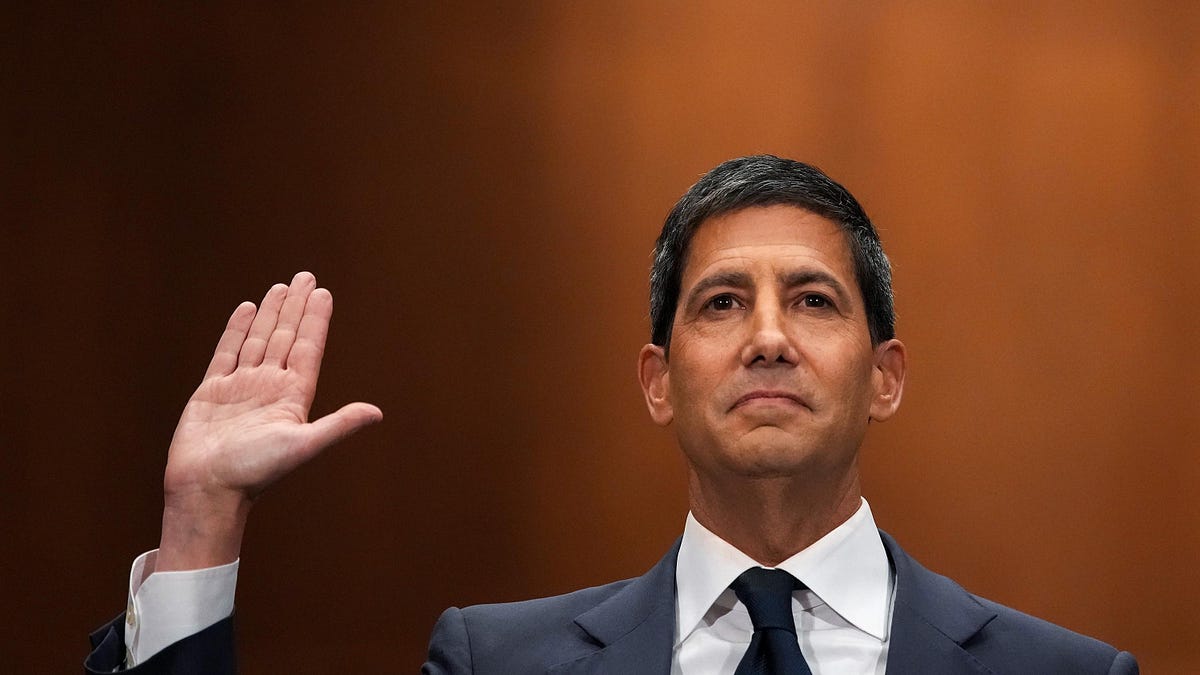
The article argues that Kevin Warsh failed to convincingly defend Federal Reserve independence at his confirmation hearing, refusing to answer questions on Trump's pressure campaign against Jerome Powell and the Cook firing dispute. It highlights rising tension between Trump’s demand for immediate rate cuts and inflation risks tied to the Iran war, with long-term Treasury yields already ticking higher on Warsh’s nomination and markets now pricing fewer rate cuts. The piece suggests a potential confrontation over rates is becoming more likely, with implications for Fed credibility, inflation expectations, and bond markets.
The market is starting to price a higher probability that Fed governance becomes a political variable rather than a policy anchor. That matters less for the front end than for the term premium: if investors conclude rate-setting is constrained by White House pressure, long-duration assets should cheapen even if the next move in policy rates is unchanged. The clean expression is not “higher rates forever,” but a wider range of outcomes and a higher volatility regime across yields, breakevens, and USD funding.
The second-order effect is that the inflation impulse from geopolitical disruption is now colliding with a potentially less credible central bank. That is a toxic mix for duration-sensitive equities, especially long-duration growth and levered balance-sheet names that trade on a stable discount rate. The bigger risk is not one 25 bp cut delayed; it is the market beginning to assign a persistent inflation risk premium because the Fed may not be able to lean against supply-shock inflation without political backlash.
The contrarian setup is that consensus may be over-focused on the nominee optics and under-focused on institutional process. Even a compliant chair cannot move rates alone, and if the committee resists overt politicization the disappointment trade could unwind quickly. But that cuts both ways: if the administration escalates pressure or litigation, the “independence discount” on Treasuries, financials, and USD proxies can reprice over days rather than quarters, with the most damage in instruments that assume low volatility and steady easing.
Near term, the best risk/reward is to position for curve steepening and higher inflation compensation, while avoiding outright directional bets on policy rates. The trade should be framed as a governance shock hedge, not a macro crash call: the catalyst set is hearing follow-through, litigation headlines, and any sign the new chair is willing to absorb political fire rather than defend the institution. If those catalysts fade, the trade should be cut quickly; if they intensify, the move can extend for months as investors demand a higher risk premium for holding duration.
AI-powered research, real-time alerts, and portfolio analytics for institutional investors.
Request DemoOverall Sentiment
moderately negative
Sentiment Score
-0.45
