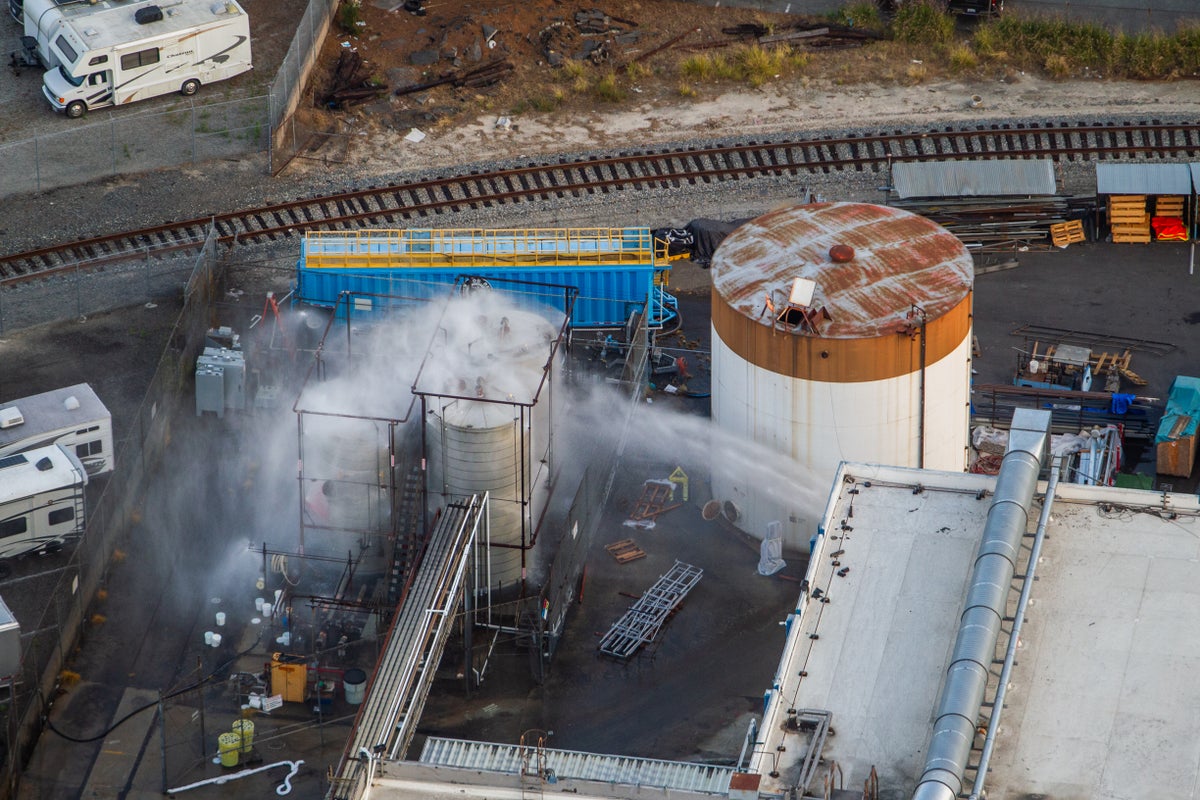
Nearly 50,000 people were evacuated in Orange County after a leak at GKN Aerospace's Garden Grove facility involving about 7,000 gallons of methyl methacrylate, a highly flammable industrial chemical. Officials said a newly discovered pressure-relieving crack may reduce explosion risk, but the incident has already triggered a state emergency, regulatory scrutiny, and a federal class-action lawsuit. Air monitoring remains within normal limits, though the situation still poses operational, legal, and community-safety risks.
The immediate market read is not a broad GE-link event but a localized liability shock with potentially asymmetric downstream effects for industrials exposed to aerospace coatings, specialty chemicals, and environmental remediation. The discovered crack reduces the probability of a catastrophic release, but it does not remove the legal overhang: once a community evacuation and emergency declaration occur, the damages stack shifts from cleanup costs to nuisance, property-value, and business-interruption claims that can persist for quarters. That matters more for the operator and any adjacent property insurers than for the parent aerospace ecosystem, because the litigation tail is likely to be driven by class actions and regulator scrutiny rather than a one-off incident response.
The second-order risk is regulatory contagion. After a high-visibility chemical incident, California localities often tighten inspection cadence, permit enforcement, and storage standards for volatile organics, which can create near-term friction for facilities with similar handling profiles across aerospace, defense, and advanced manufacturing. The clean-air readings also create a potential sentiment trap: if public health metrics stay benign, the equity market may fade the headline quickly, but settlement value can still rise because the strongest plaintiffs’ leverage comes from evacuation disruption, not measured exposure.
For public comps, the event is modestly negative for firms with large Southern California manufacturing footprints and for industrial landlords whose tenant base includes hazardous-material users. It is potentially positive for specialty environmental service providers, industrial fire-safety vendors, and legal defense insurers if inspections and remediation spend widen over the next 1-3 months. The key catalyst is not the tank status itself but whether the investigation uncovers prior compliance gaps; that would extend the story from days into a multi-quarter balance-sheet issue.
The contrarian angle is that the market may over-discount the headline for the wrong names while underpricing the probability of a narrow, operator-specific liability outcome. If the incident resolves without a release, the equity impact on diversified aerospace suppliers should be minimal; however, if regulators find documentation failures, the damage could be concentrated in legal expense, insurance deductibles, and local permitting delays rather than broad operational shutdowns. That creates an opportunity to fade any indiscriminate selloff in aerospace primes while staying alert to a short-term trade in remediation and environmental services.
AI-powered research, real-time alerts, and portfolio analytics for institutional investors.
Request DemoOverall Sentiment
strongly negative
Sentiment Score
-0.60
Ticker Sentiment
