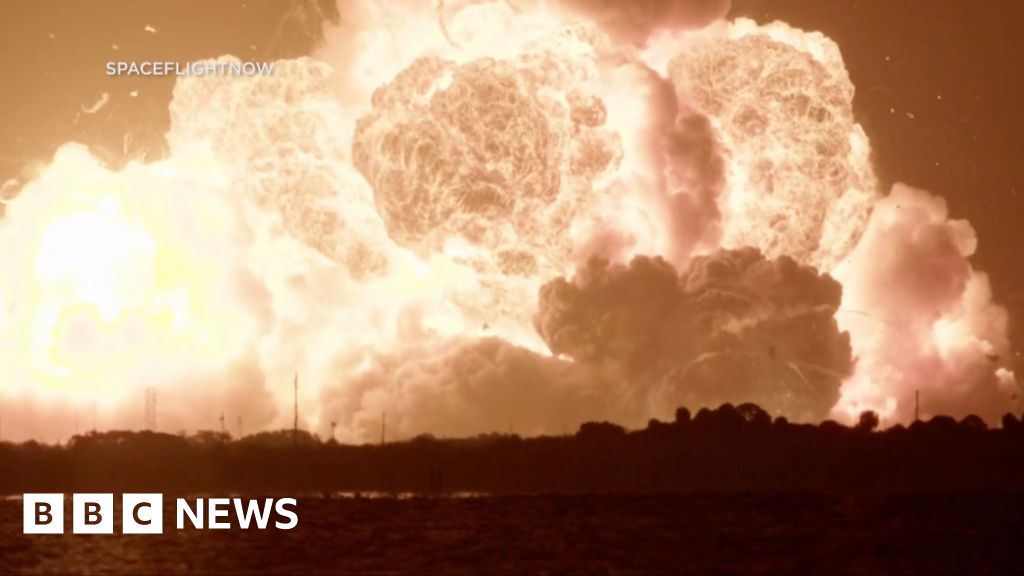
Blue Origin’s rocket exploded during a hotfire test at Cape Canaveral around 21:00 local time, with the company saying it experienced an anomaly and that all personnel are accounted for. The incident could delay an upcoming launch and adds to recent setbacks after the FAA opened an investigation into a prior New Glenn mishap. Officials, including the FAA and Space Force, are reviewing data; there is no public safety threat and no impact to air traffic.
The immediate market read-through is less about a one-off launch failure and more about schedule credibility compounding at the exact wrong point in the commercial launch cycle. For AMZN, the issue is not direct revenue leakage from this event, but a higher probability of delay in a program that was already trying to prove it can scale from “successful demo” to “reliable cadence”; that usually compresses multiple expansion before it shows up in fundamentals. The second-order winner is the broader launch ecosystem: any multi-month slip at Blue Origin improves negotiating leverage for competitors with cleaner execution records and increases the value of scarce launch windows for satellite operators.
ASTS is the cleaner sympathy short because it is more exposed to launch timing slippage than the average investor model assumes. Even if the incident does not directly ground its next mission, the market tends to reprice satellite deployment timelines on a portfolio basis when a major provider hits an anomaly, and that can widen valuation dispersion across pre-revenue space names. The key nuance is that the damage is asymmetric: a few weeks of delay are usually noise, but a quarter or more can force working-capital burn, push revenue recognition, and raise the probability of dilution or heavier reliance on alternate launchers.
The contrarian view is that this may be a sentiment overreaction for AMZN and a useful de-risking event for investors who were implicitly capitalizing flawless execution into the story. Blue Origin has already demonstrated recovery capability before, and the market often over-penalizes hardware failures that are part of the test regime while underestimating how quickly engineering teams can isolate root cause and restart. If the investigation is short and the next milestone is rescheduled within weeks rather than months, the alpha opportunity is likely in relative value rather than outright direction.
AI-powered research, real-time alerts, and portfolio analytics for institutional investors.
Request DemoOverall Sentiment
mildly negative
Sentiment Score
-0.35
Ticker Sentiment
What matters over the next 2-8 weeks is whether there is knock-on damage to launch backlog, insurance pricing, or regulator posture. If the failure appears isolated and non-recurring, the selloff in space-adjacent names should fade quickly; if it reveals a systems-level issue, then launch cadence risk becomes a 1-2 quarter headwind for the entire category.
