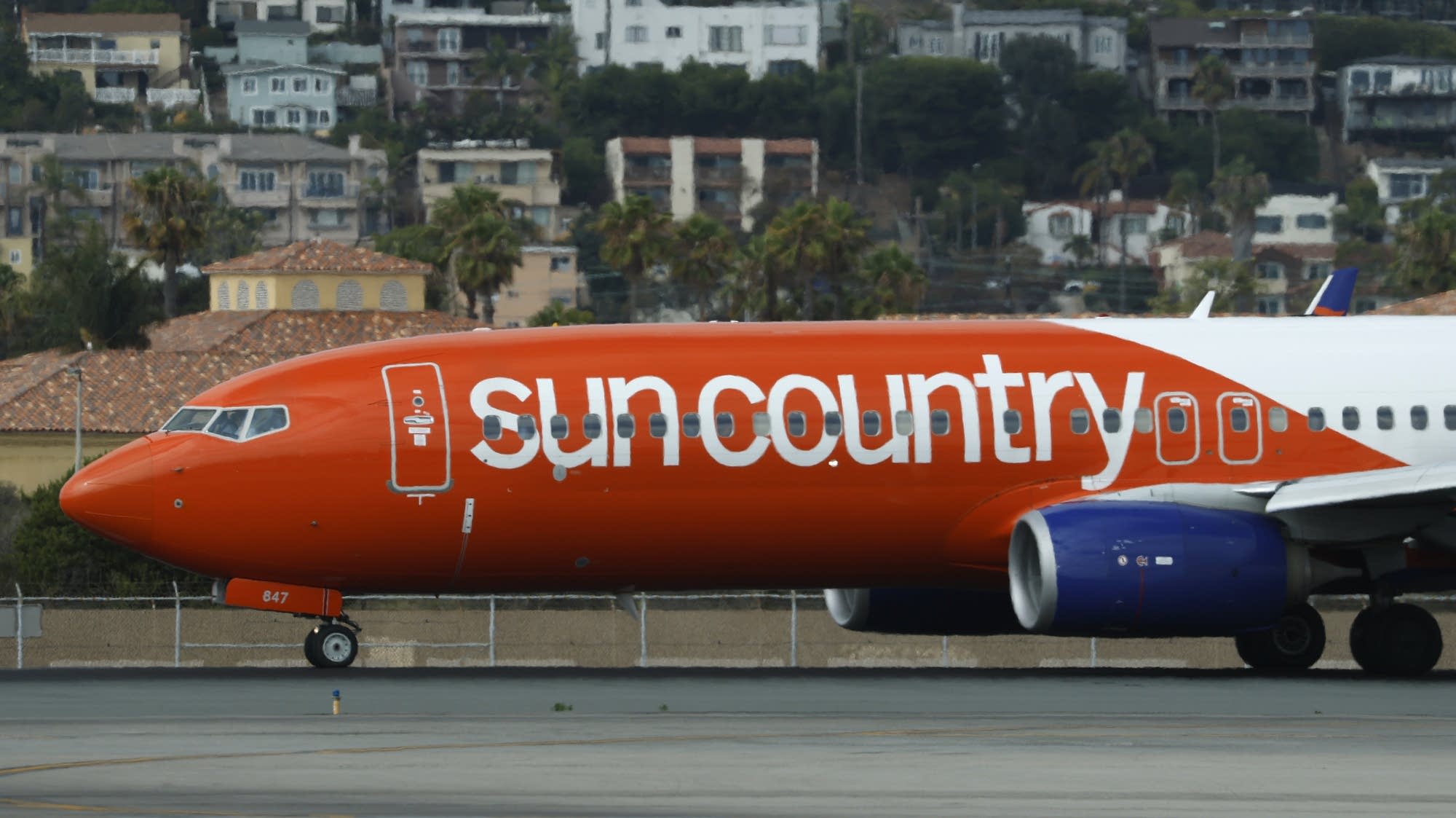
Allegiant Air and Sun Country have completed a merger, creating a larger budget airline aimed at travelers. The deal is strategically positive for scale and network breadth in the low-cost carrier segment, with potential benefits to pricing power and operating efficiency. The transaction is meaningful for the airline industry and could affect competitive dynamics among budget carriers.
This merger is less about near-term demand lift and more about capacity discipline in a structurally oversupplied leisure-airfare segment. Combining two discounters should improve schedule density, aircraft utilization, and procurement leverage, which matters because ultra-low-cost carriers usually compete on marginal cost gaps of only a few points; even a modest synergy realization can flip a marginal route network from breakeven to high-teens EBIT margins. The immediate winners are likely be the surviving management team and adjacent airport/local market power, while the losers are smaller ULCC peers that must either match capacity cuts or defend share with weaker pricing.
The second-order effect is that consolidation can reduce fare volatility, which is usually good for airline equities but not uniformly good for consumers. If the merged carrier rationalizes overlapping leisure routes, legacy carriers may get a cleaner shot at capturing price-insensitive travelers without needing to discount as aggressively, especially on secondary-city leisure corridors. That creates a subtle positive for larger network airlines with premium/corporate mix, because they can preserve yield while ULCCs lose their role as the main marginal price setter.
The key risk is execution: integration benefits typically take 12-24 months, while labor, fleet, and IT integration can create a 6-9 month window of elevated disruption where load factors slip and unit costs rise. If management underestimates scheduling complexity or if regulators force slot/route concessions, the merger could destroy the very density advantage it is supposed to create. A softer consumer backdrop would also blunt the pricing power thesis quickly, since budget carriers are the first place demand shows up as down-trading before disappearing entirely.
The contrarian view is that the market may overestimate how much pricing power two combined discount networks can really exert. In leisure travel, consumers are highly substitutable and increasingly sensitive to all-in fees, so any attempt to raise fares risks demand leakage back to legacy carriers, major online agencies, or alternative vacation choices. The merger may ultimately be more defensive than accretive: a way to survive a tougher cost of capital environment rather than a catalyst for sustained multiple expansion.
AI-powered research, real-time alerts, and portfolio analytics for institutional investors.
Request DemoOverall Sentiment
mildly positive
Sentiment Score
0.45
