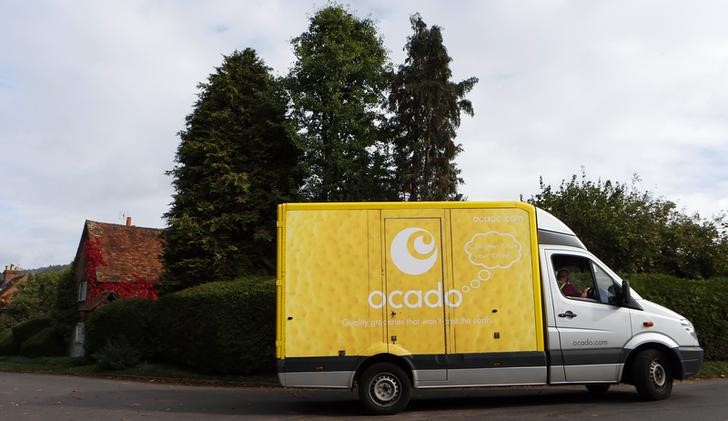
Ocado will receive a $350 million cash payment from Kroger in January after Kroger decided to close three customer fulfilment centres and cancel a planned Charlotte site, a move that offsets lost future capacity fees but reduces Ocado’s fiscal 2026 fee revenue by about $50 million. Jefferies estimates pro-forma net debt will fall from £1.05bn to roughly £0.75bn on receipt of the payment, and Ocado reiterated its goal of turning cash flow positive this year; shares rose ~6% in London trading. Analysts noted the payment exceeds prior expectations and that remaining live sites show operational improvement, though Kroger will now shutter four sites in total.
Market structure: The $350m Kroger payment materially improves Ocado’s near-term balance sheet (pro-forma net debt from ~£1.05bn to ~£0.75bn) while crystallising a ~£50m FY26 fee-revenue haircut and closure of four CFCs. Direct winners: Ocado creditors and equity (deleveraging), third-party last-mile operators and incumbent grocers (Amazon AMZN, Walmart WMT) who can pick up displaced volume; loser is Kroger (KR) on execution/strategy credibility and Ocado’s recurring revenue base. Reduced CFC capacity tightens online-grocery fulfilment supply in affected metros, raising marginal delivery costs and potential pricing power for remaining operators over next 6–18 months.
Risk assessment: Tail risks include a larger Kroger pullback (10–25% probability) that would remove >£50m/yr more in fees, operational failure at remaining 5 CFCs, or delayed Re:imagined rollouts that derail Ocado’s cash-flow target for FY25–FY26. Time horizons: immediate — share reaction into the January payment; short-term (1–3 months) — investor sentiment and Q-results; long-term (2026–2028) — realization of efficiency benefits or further partner losses. Hidden dependency: Ocado’s path to cash-flow positivity relies on new live sites and licensing wins — track new contract announcements and run-rate CFC throughput metrics.
Trade implications: Tactical long OCDO exposure is justified by deleveraging but should be calibrated — balance-sheet improvement reduces tail-risk but recurring revenue is trimmed by ~£50m. Implement cost-limited bullish option structures ahead of the January payment and maintain a small hedge against Kroger downside (pair trade). Credit/bond: expect tighter OCDO credit spreads on receipt of funds — consider buying OCCDO corporate bonds or credit protection shorts if spreads don’t tighten within 60 days.
Contrarian angles: Consensus may overpay for the headline cash while underestimating the value of Ocado’s Re:imagined tech — if rollout accelerates, margin expansion could surprise in 2026–27. Conversely, investors may be complacent: the payment is a one-off and market may underprice lost annuity fees; watch for further Kroger retrenchment. Historical parallel: earlier Ocado partnership shocks produced volatile recoveries only after tangible new partner wins — a repeat pattern would favour option-levered longs rather than bare equity into uncertain partner outcomes.
AI-powered research, real-time alerts, and portfolio analytics for institutional investors.
Request DemoOverall Sentiment
moderately positive
Sentiment Score
0.45
Ticker Sentiment
