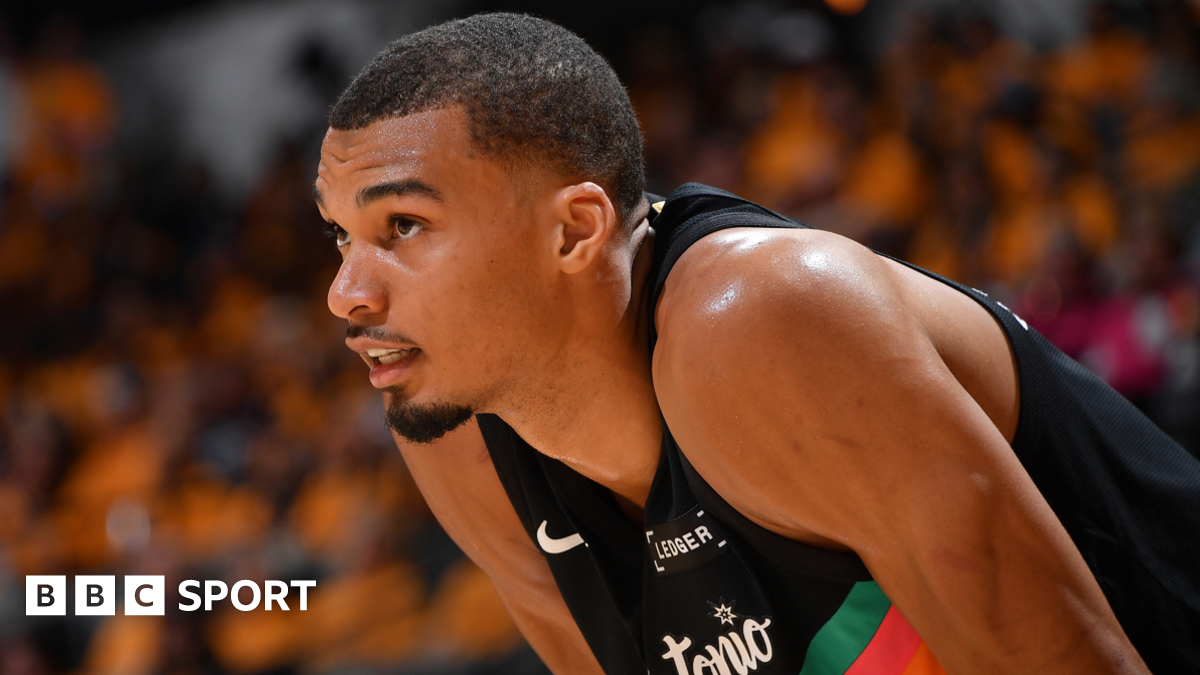
The Minnesota Timberwolves took a 1-0 lead over the San Antonio Spurs with a 104-102 road win, despite Victor Wembanyama's record 12 blocks and a near triple-double of 11 points and 15 rebounds. In the Eastern Conference, the New York Knicks opened their series with a dominant 137-98 home win over the Philadelphia 76ers, with Jalen Brunson scoring 35 points and OG Anunoby adding 18. The article is sports coverage with no material financial-market implications.
The market read-through is less about the scoreboard and more about how quickly narrative can decouple from underlying edge. In playoff terms, teams that dominate process but lose on variance often see their prices stay elevated if the market believes the next-game correction is imminent; here, the risk is that the “better team” premium remains intact for San Antonio despite the upset, which can keep short-term sentiment from following the result. That creates an opportunity to fade overreaction in both directions, because playoff series pricing typically overweights Game 1 while underweighting coaching adjustment speed over the next 48 hours.
The second-order dynamic is that high-variance outcomes compress the probability distribution for the series, which benefits liquidity-driven and mean-reversion trades more than outright directional bets. Minnesota’s win can be sustained only if the return-to-form on offense is real, while San Antonio’s path depends on translating defensive disruption into cleaner shot quality, not just more stops. If Game 2 normalizes even partially, the market will likely snap back toward the higher-seed favorite, making the current price action vulnerable to a quick reversal.
The Knicks’ margin is more important as a market technical than as a sports result: it signals a potential continuation regime where momentum, not fundamentals, drives near-term pricing and media engagement. That is usually fertile ground for public overreach after a string of blowouts; the more extreme the dominance, the more sensitive the setup becomes to one average performance. The key contrarian point is that markets often extrapolate playoff blowouts linearly, but series outcomes are highly path-dependent and can revert sharply once rotation minutes tighten and opponents adjust scheme.
From a risk perspective, the next catalyst window is 1-3 days, not weeks: Game 2 is the first real test of whether these moves were signal or noise. If the favored teams respond decisively, the current upset/fatigue narrative breaks fast; if they stumble again, the market will start pricing a genuine shift in series probability rather than a one-off. That makes this a better relative-value setup than an absolute one, especially for traders who can express conviction through line movement, totals, or correlated sentiment baskets.
AI-powered research, real-time alerts, and portfolio analytics for institutional investors.
Request DemoOverall Sentiment
neutral
Sentiment Score
0.00
