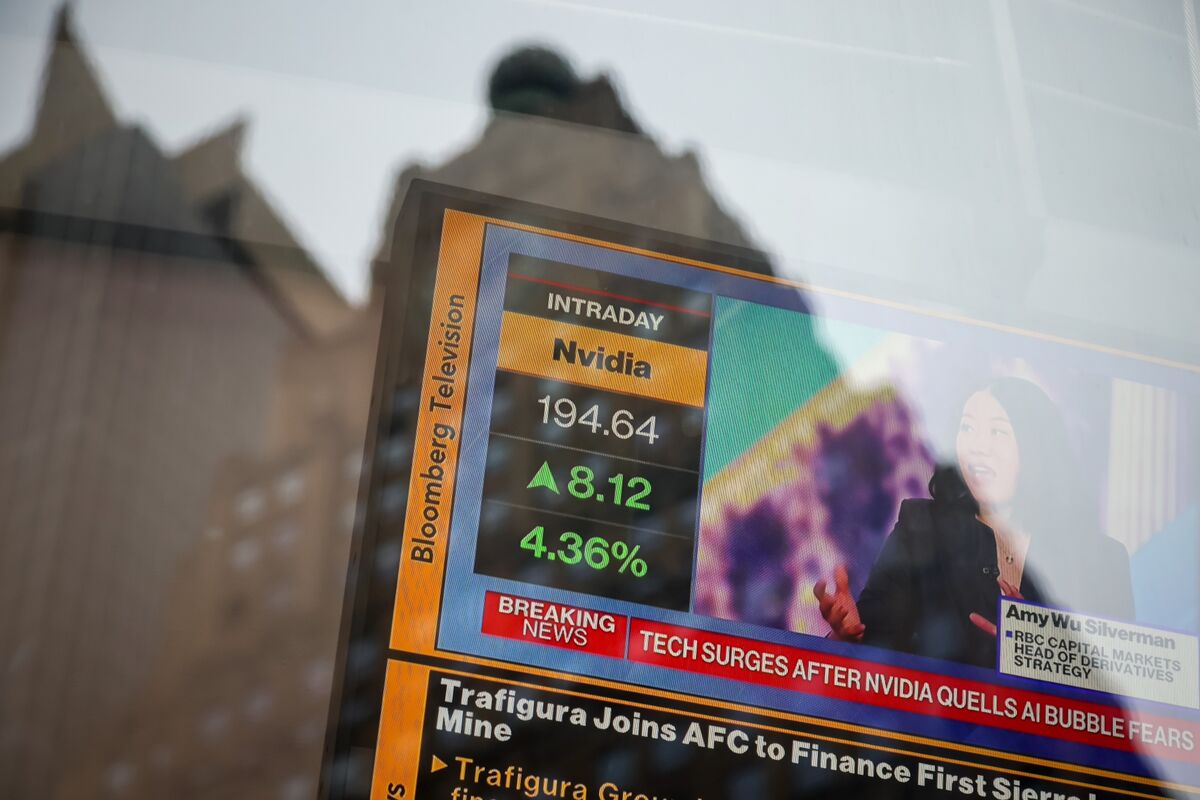
Nvidia’s recent quarterly results were sufficient to calm some fears about an overheated AI-driven rally, but the market reaction was choppy: the stock jumped when results were released after the close on Wednesday, then fell through Thursday and only partially recovered on Friday, leaving the S&P 500 roughly flat while Nvidia lagged. The episode prompted profit-taking in the market and highlights lingering vulnerabilities around Nvidia’s outlook and product roadmap (notably attention being drawn to Gemini 3), underscoring continued investor focus on company fundamentals and positioning amid elevated volatility.
Market structure: The post-earnings chop signals concentrated positioning risk around NVDA — a 10–20% move in either direction will disproportionately reprice tech indices, skew options surfaces and trigger flows into/de-risking from correlated AI names. Direct winners in a downside scenario are lower-multiple GPU peers (AMD, INTC) and enterprise software vendors that sell AI services rather than hardware; losers are high-multiple hardware suppliers and exchange-traded funds heavily weighted to NVDA. Cross-asset: expect elevated NVDA implied vol (IV) relative to SPX for 2–8 weeks, temporary equity market risk-off spilling into front-end Treasury demand and USD strength on drawdowns.
Risk assessment: Immediate (days) risk is flow-driven volatility and gamma pinning from option roll-offs; short-term (weeks–months) risks are guidance downgrades or negative commentary on product roadmap (e.g., reaction to Gemini 3 narratives); long-term (quarters–years) risks remain competitive displacement, export-controls/regulatory action, or hyperscaler inventory rebalancing. Hidden dependencies include hyperscaler contracting cadence and channel inventory (2–3 quarter lag), and concentrated derivative dealer books that amplify moves. Key catalysts: next 30–90 days of customer commentary, January earnings cadence, and IV normalization events.
Trade implications: Priced-in fragility argues for defined-risk exposure: favor LEAP call spreads to retain upside while capping premium bleed, use short-dated put spreads to hedge near-term tail risk, and employ pair trades (long AMD vs short NVDA) to play relative valuation compression over 1–3 months. Rotate 2–4% of equity risk from hardware into AI software/AI services (MSFT, GOOGL) over 1–3 months to capture secular spend. Entry: hedge or trim within 5 trading days; add long defined-risk on a >15% pullback; exit or reassess if NVDA reclaims post-earnings highs within 10 trading days.
Contrarian angles: The market is fixated on short-term roadmap headlines while underpricing structural data-center demand that can sustain revenue upside for 12–24 months; a 15–25% pullback would likely be overdone relative to fundamentals and create a buy opportunity. Historical parallels (2019–2021 tech rotations) show leader drawdowns often preceded renewed outperformance when demand stayed intact. Unintended consequence: heavy hedging can induce a volatile squeeze if dealer gamma flips; set buy triggers and size limits to avoid crowding into the same re-entry band.
AI-powered research, real-time alerts, and portfolio analytics for institutional investors.
Request DemoOverall Sentiment
moderately negative
Sentiment Score
-0.25
Ticker Sentiment
