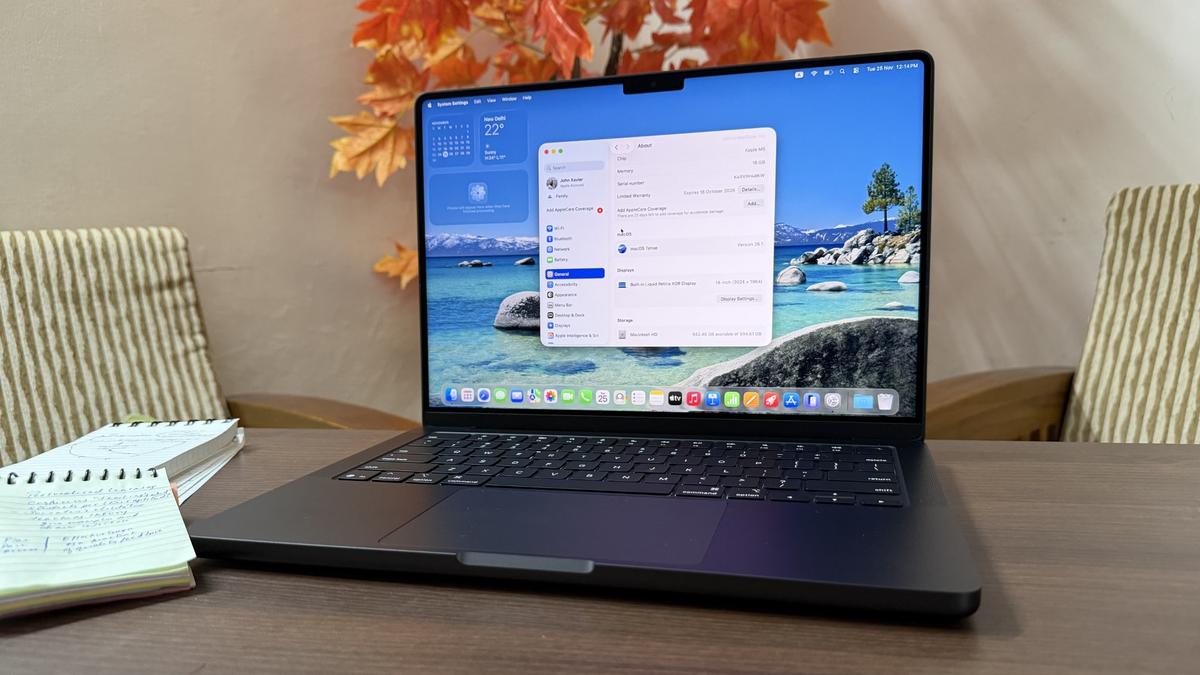
The MacBook Pro M5 14-inch ships with Apple’s M5 (10-core CPU, 10-core GPU), 16GB base unified memory (configurable), 512GB–2TB SSD, a 14.2-inch Liquid Retina XDR display with 120Hz ProMotion and real-world battery life of roughly 10–15 hours. Benchmarks show ~15% single-core and ~18% multi-core gains over the M4 but at higher sustained power draw and warmer single‑fan thermals; review positions the update as an incremental upgrade likely to drive upgrades from pre‑M4 owners but unlikely to materially shift demand among recent M4/M4 Pro customers, implying limited near‑term impact on Apple’s revenue trajectory.
Market structure: The M5 14-inch is an incremental upgrade that preserves Apple’s pricing power and gross-margin profile but is unlikely to materially expand unit share vs. the M4 cohort; expect meaningful demand only from pre‑M4 owners (flux ≈ 10–20% of buyers) and new buyers in education/corporate. Component beneficiaries (TSMC, SK Hynix, Samsung NAND) see modest near‑term order uplift for higher‑margin SKUs, while traditional PC OEMs (DELL, HPQ) face continued single‑core performance disadvantage and possible share erosion in premium thin‑and‑light segments.
Risk assessment: Tail risks include a thermal/recall episode or TSMC node supply shock that could compress margins >200bps; regulatory antitrust action remains a multi‑quarter tail risk that could affect App Store/service multiple. Immediate (days) — limited stock reaction to a marginal review; short (weeks/months) — holiday sell‑through and channel inventory will determine Q1 guidance; long (quarters/years) — upgrade cycle lengthening (M4→M5 marginal) could shave unit growth by 3–5% annually if consumers delay.
Trade implications: Favor tactical AAPL exposure sized 2–3% of equity risk for 3–6 months to capture holiday strength and services tailwinds; use structured options to cap downside (see below). Pair trades: long AAPL vs. short DELL/HPQ to capture margin differential and ASP resilience. Expect modest compression of implied volatility post‑launch; monetize by selling short‑dated calls after any >5% pop.
Contrarian angles: Consensus underestimates the stickiness of Apple’s services/upgrade economics — even incremental hardware wins sustain ARPU growth, so downside may be underpriced. Conversely, the market may be underestimating a potential elongation of upgrade cycles; if M4 owners skip M5, ASP and unit growth could disappoint by 2–4% next fiscal year, making a cautious options‑hedged approach superior to outright long exposure.
AI-powered research, real-time alerts, and portfolio analytics for institutional investors.
Request DemoOverall Sentiment
mildly positive
Sentiment Score
0.25
Ticker Sentiment
