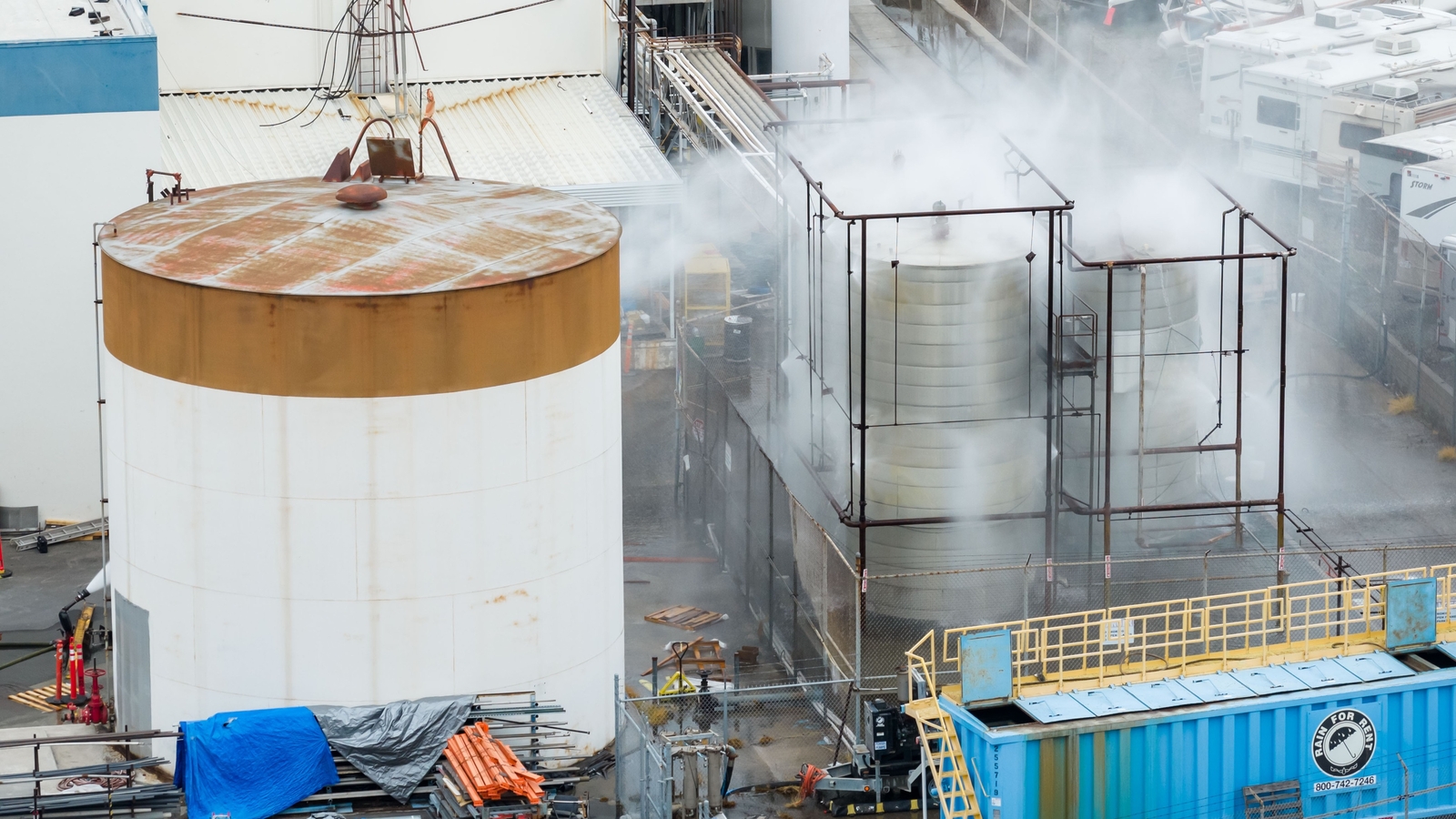
Officials said the worst-case BLEVE explosion risk at an unstable chemical tank in Garden Grove has been mitigated, allowing a reduction in the evacuation zone. About 16,000 residents remain impacted while crews continue cooling the tank, assessing a potential plume or fire risk, and there have been no injuries. The tank initially held about 6,500 gallons of methyl methacrylate, much of which is now believed to have cured or gelled.
The immediate market read is not about the incident itself but about process quality under stress: the absence of injury and the controlled de-risking argues against a broad re-rating of the relevant industrial complex. The more important second-order effect is operational: this kind of localized chemical event is a reminder that downstream aerospace and specialty-manufacturing customers face higher compliance, insurance, and shutdown-friction costs even when the headline hazard is contained. That tends to widen the gap between well-capitalized primes with redundant sourcing and smaller suppliers that rely on single-site production.
For GE specifically, this is a governance and supply-chain screen rather than a direct earnings event. If the facility is tied into aerospace supply chains, the incremental risk is a short-lived disruption to a narrow set of parts rather than a durable demand issue; the bigger concern is any forced audit across adjacent chemical-handling vendors, which can delay deliveries for weeks even after the physical incident is stabilized. That kind of operational caution usually favors diversified aerospace franchises over suppliers with concentrated footprint risk.
The contrarian angle is that the market may underweight how often “contained” industrial incidents later show up as insurance, remediation, and permitting costs spread over multiple quarters. That matters less for the immediate zone of impact and more for contract renegotiations, higher working-capital needs, and slower throughput if regulators tighten inspections. The tail risk is not a large explosion anymore; it is a longer administrative drag that can quietly hit margins over the next 1-3 quarters.
Catalyst-wise, the next real inflection is whether the temperature trend keeps falling over the next several days. If it does, the event likely fades quickly; if readings plateau or weather turns unfavorable, expect renewed scrutiny and a wider operational overhang. In that scenario, the best setups are relative-value trades, not outright directional shorts.
AI-powered research, real-time alerts, and portfolio analytics for institutional investors.
Request DemoOverall Sentiment
neutral
Sentiment Score
0.05
Ticker Sentiment
