

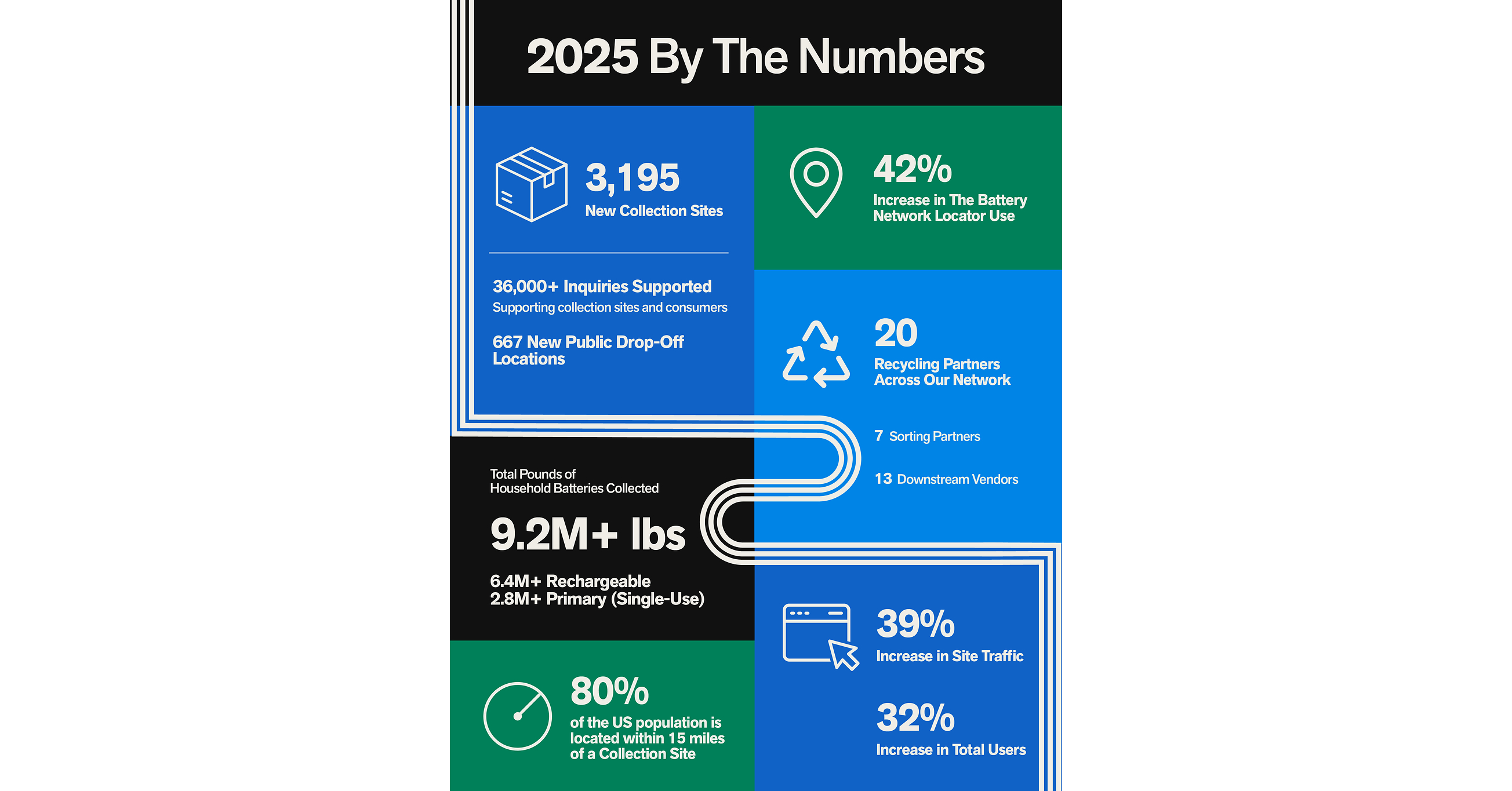
The Battery Network reported Americans recycled over 9.3 million pounds of batteries in 2025, with recycling access expanding by adding more than 3,100 new collection sites nationwide. Consumer interest also rose—battery drop-off searches were up 42% YoY, website visits up 39%, and users up 32%, with 4 in 5 Americans living within 15 miles of a collection site. The report also cited e-bike battery collections of 50,000 pounds (+14% YoY) and OneDrum™ shipments up nearly 26% YoY, supporting momentum toward a more circular battery economy.
This reads as a demand and compliance signal, not a monetizable earnings event. The economic value in battery recycling accrues to whoever controls collection logistics, hazardous-material handling, and downstream metals recovery; the headline numbers are still too small relative to the addressable battery universe to move public-company fundamentals. In the near term, the main beneficiary is the network operator model — retailers, waste/logistics platforms, and industrial recyclers with existing routes — because incremental volumes can be absorbed with limited new fixed cost.
The second-order effect is on liability and channel behavior: easier collection reduces fire and disposal risk for municipalities, retailers, and fleet operators, which should slowly increase participation as battery penetration rises. That matters more over 6-18 months than over days, because the real catalyst is not awareness but whether stewards sign longer-term contracts and whether collection economics improve as high-energy formats become a larger share of the mix. If commodity prices for recovered metals weaken, the circular-economy narrative can persist while unit economics quietly deteriorate.
The contrarian miss is that search traffic and site count can overstate actual monetizable throughput; convenience often front-loads engagement before tonnage follows. For public equities, the best setup is not a pure-play recycler story but a low-beta services exposure with existing infrastructure and less execution risk. On the other hand, speculative recyclers can trade on sentiment alone and then give it back quickly if quarterly volumes, gross margin per pound, or contract wins do not inflect.
AI-powered research, real-time alerts, and portfolio analytics for institutional investors.
Request TrialOverall Sentiment
mildly positive
Sentiment Score
0.25
Ticker Sentiment
