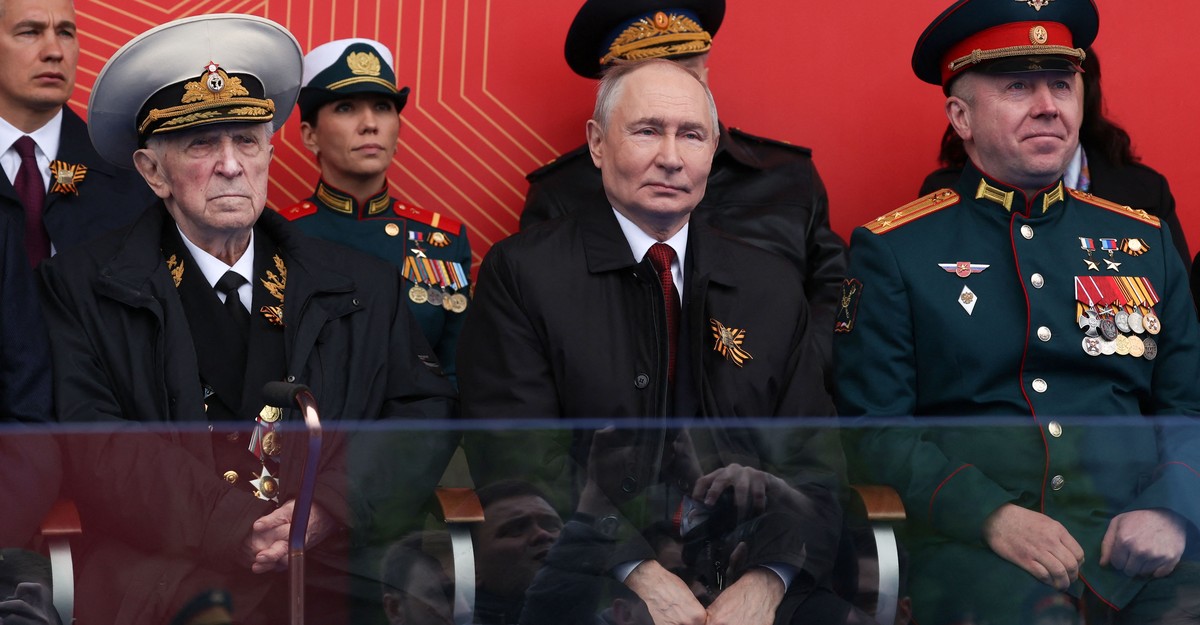
Ukraine’s drone campaign has brought the war visibly home to Moscow, disrupting airport operations, public internet access, ATMs, and security around Putin’s May 9 parade. The article says Russia’s war has lasted more than four years, killed or wounded over 1 million Russian soldiers, and produced no clear military or political success. The piece highlights growing domestic strain from high inflation, high rates, and tightening controls, underscoring a widening gap between propaganda and reality.
The key market signal is not the parade itself but the regime shift in perceived regime stability: when the state must visibly harden the capital, it forces a premium on internal security, telecom resilience, and logistics redundancy. That typically redirects incremental fiscal spending away from growth-enhancing capex and toward point-defense, jamming, censorship, and emergency response, which is inflationary at the margin and structurally negative for consumer confidence. The second-order effect is that every visible security failure increases the Kremlin’s need to over-control information, which further degrades digital commerce and payments and raises friction costs across urban services.
From a competitive-dynamics angle, the losers are domestic firms exposed to metro-area consumption and “always-on” infrastructure: ride-hailing, e-commerce, retail payments, and any business reliant on mobile data uptime. Repeated air-defense scares also create a hidden tax on aviation and airport throughput, since even short disruptions cascade into missed connections, hotel costs, and labor inefficiency. Over months, that should widen the gap between state-favored defense/cyber contractors and the broader private sector, because the state’s answer to insecurity is procurement, not liberalization.
The catalyst path matters: near term, risk is a renewed drone incident, parade/security embarrassment, or another communications blackout; medium term, the more important tail risk is a broader normalization of urban disruption that bleeds into wages, migration, and elite capital flight over 3-12 months. What could reverse it is a meaningful de-escalation on the battlefield or a durable cease-fire, but the article’s core point is that the propaganda bargain has already broken psychologically. The market should assume the information-control trend persists even if kinetic intensity temporarily falls.
Contrarian view: the obvious trade is to short Russia exposure, but that is often crowded and structurally constrained. The better miss in consensus is that persistent insecurity is bullish for select non-Russian defense, counter-drone, EW, and critical-infrastructure cybersecurity names, while also supporting regional logistics rerouting in Poland, Baltics, and Gulf transshipment nodes. The pain may be underpriced in urban Russian consumer activity, but the spillover winners are likely more durable and investable than the direct losers.
AI-powered research, real-time alerts, and portfolio analytics for institutional investors.
Request DemoOverall Sentiment
strongly negative
Sentiment Score
-0.60
