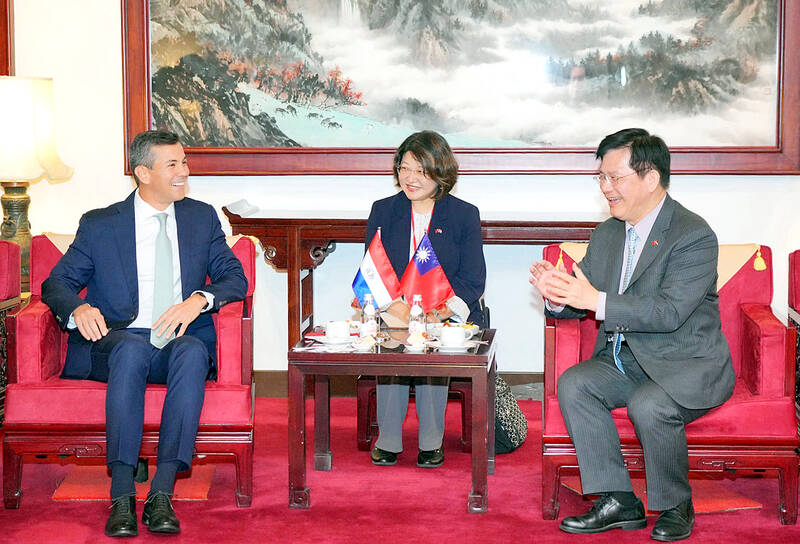
Paraguayan President Santiago Pena reaffirmed Paraguay’s diplomatic ties with Taiwan during his first official state visit to Taipei, while also saying he encouraged Honduras to review its relationship with Taiwan. The article also noted the arrival of new Hyundai Rotem trains for Taipei’s expanding metro network and highlighted Taiwan’s first indigenous submarine completing its 13th sea trial ahead of a July delivery target. Overall, the piece is largely geopolitical and policy-focused with limited direct market impact.
The main market implication is not Taiwan recognition itself, but the slow tightening of diplomatic optionality around China’s regional influence. If Honduras reopens the Taiwan channel, it would signal that Beijing’s Latin America playbook is losing marginal effectiveness, which matters more for narrative and future allocation decisions than for immediate fundamentals. The second-order effect is on firms with exposure to Taiwan-backed development finance, agricultural exports, and infrastructure procurement in smaller emerging markets that view Taipei as a donor alternative to Beijing.
The bigger tail risk is escalation without kinetics: a “quarantine” framework shifts the investable question from invasion probability to trade interruption probability. That is relevant for semis, shipping, and air cargo because customs-style interference can be calibrated to look reversible while still creating meaningful inventory and lead-time shocks; even a 1-2 week disruption would ripple through auto, industrial, and electronics supply chains. The key catalyst window is the next 3-6 months, when any rhetoric around inspections, maritime safety, or “documentation requirements” could move risk premiums faster than formal sanctions.
Defense and logistics are the cleaner beneficiaries than broad Taiwan beta. Indigenous submarine milestones reinforce a multi-year capex cycle in Taiwanese naval, sensor, and shipbuilding ecosystems, while the incoming metro rolling stock highlights continued urban infrastructure spend that is largely insulated from geopolitical noise. Quarantine-signage virality is trivial on its face, but it reflects an important behavioral point: Taiwan is actively normalizing resilience messaging, which often precedes higher public tolerance for precautionary spending in biosecurity, border control, and civil defense.
Consensus is likely underpricing the asymmetry between headline risk and actual fund flows. The market tends to sell Taiwan risk only on invasion headlines, but the more durable trade is around persistent friction: inspections, insurance repricing, and rerouting costs that gradually compress margins in transport and electronics without forcing a binary de-risk event. That makes the opportunity less about a one-day geopolitical shock and more about buying optionality on recurring disruption at low implied volatility.
AI-powered research, real-time alerts, and portfolio analytics for institutional investors.
Request DemoOverall Sentiment
neutral
Sentiment Score
0.05
