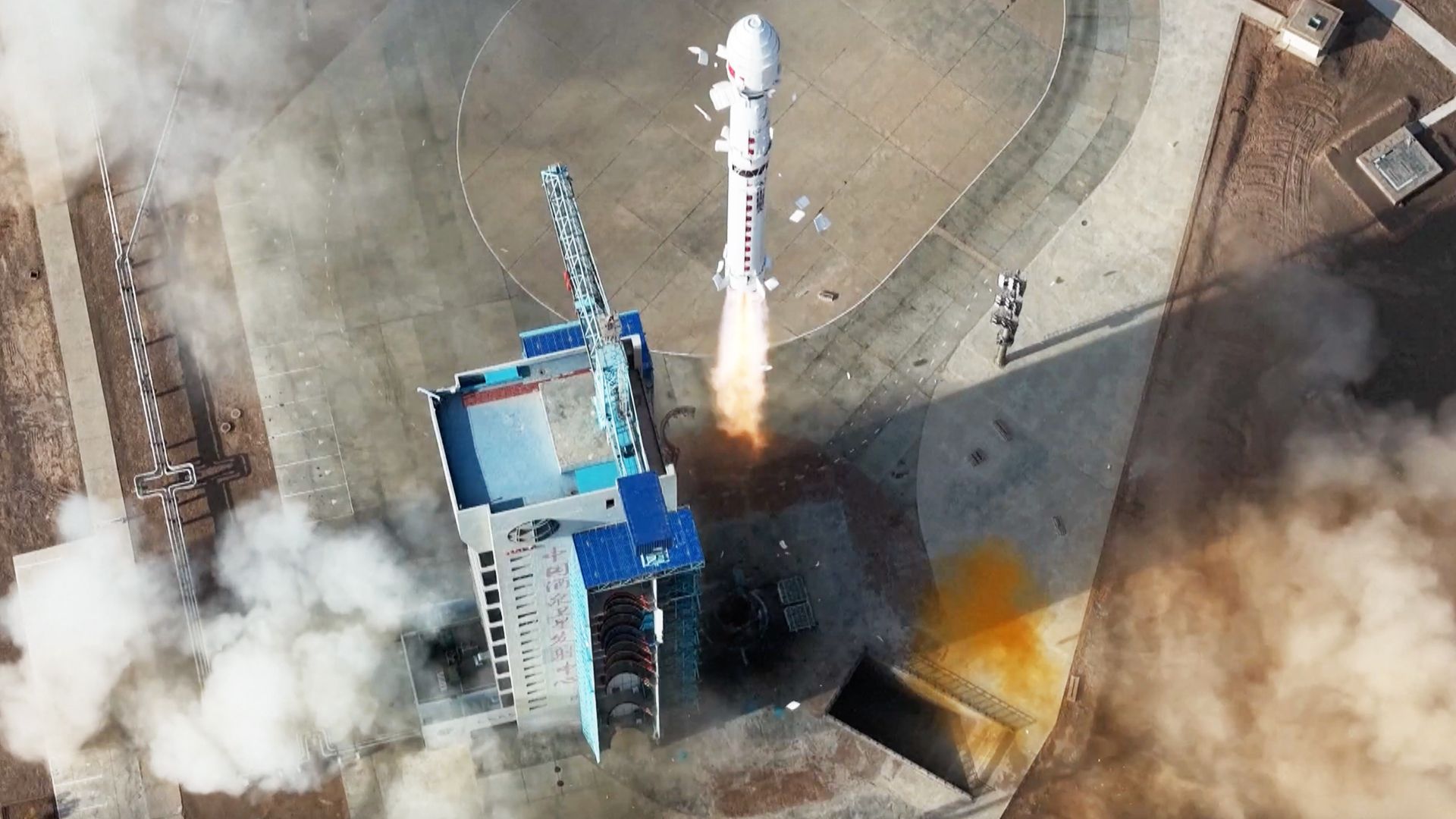
China launched three Long March rockets in under 19 hours, a national record that pushed its 2025 orbital-launch tally to 83—well above last year’s 68—according to state-owned CASC. The trio included a Long March 6A placing Guowang broadband satellites into low Earth orbit and two classified military payloads (Yaogan 47 on a Long March 4B and TJSW-22 on a Long March 3B) from Taiyuan, Jiuquan and Xichang. Although not a global record (SpaceX has conducted 159 orbital missions in 2025 and six rockets launched worldwide in an 18-hour span in April), the cadence underscores China’s accelerating launch capacity and the simultaneous build-out of commercial broadband constellations and military space assets, with implications for competition in orbital services and launch markets.
China launched three Long March rockets in under 19 hours, a national record that the state-owned China Aerospace Science and Technology Corporation (CASC) highlighted after the missions pushed its 2025 orbital-launch tally to 83 versus 68 last year. The triple launch included a Long March 6A deploying Guowang broadband satellites from Taiyuan, a Long March 4B carrying the classified Yaogan 47 from Jiuquan, and a Long March 3B lofting the classified TJSW-22 from Xichang, underscoring concurrent commercial- and military-oriented activity.
Five orbital launches occurred within a 24-hour window when two SpaceX Falcon 9 flights (a Starlink batch and the NROL-77 mission) are included, and the article notes SpaceX has completed 159 missions in 2025 — so China’s cadence is accelerating but not globally dominant. A prior April 28–29 period saw six rockets launch in 18 hours from multiple providers, highlighting that high-frequency multi-provider launch windows are feasible and competitive.
Rising Chinese launch cadence and simultaneous build-out of a commercial broadband constellation plus classified military payloads carry direct implications for launch-service competition, satellite-constellation deployment timelines and geopolitical risk for space-sector counterparties. Market-impact signals in the article are mildly positive, but investors should treat this as a structural signal of intensified competition and potential pricing or policy responses rather than an immediate equity catalyst.
AI-powered research, real-time alerts, and portfolio analytics for institutional investors.
Request DemoOverall Sentiment
mildly positive
Sentiment Score
0.25
Ticker Sentiment
