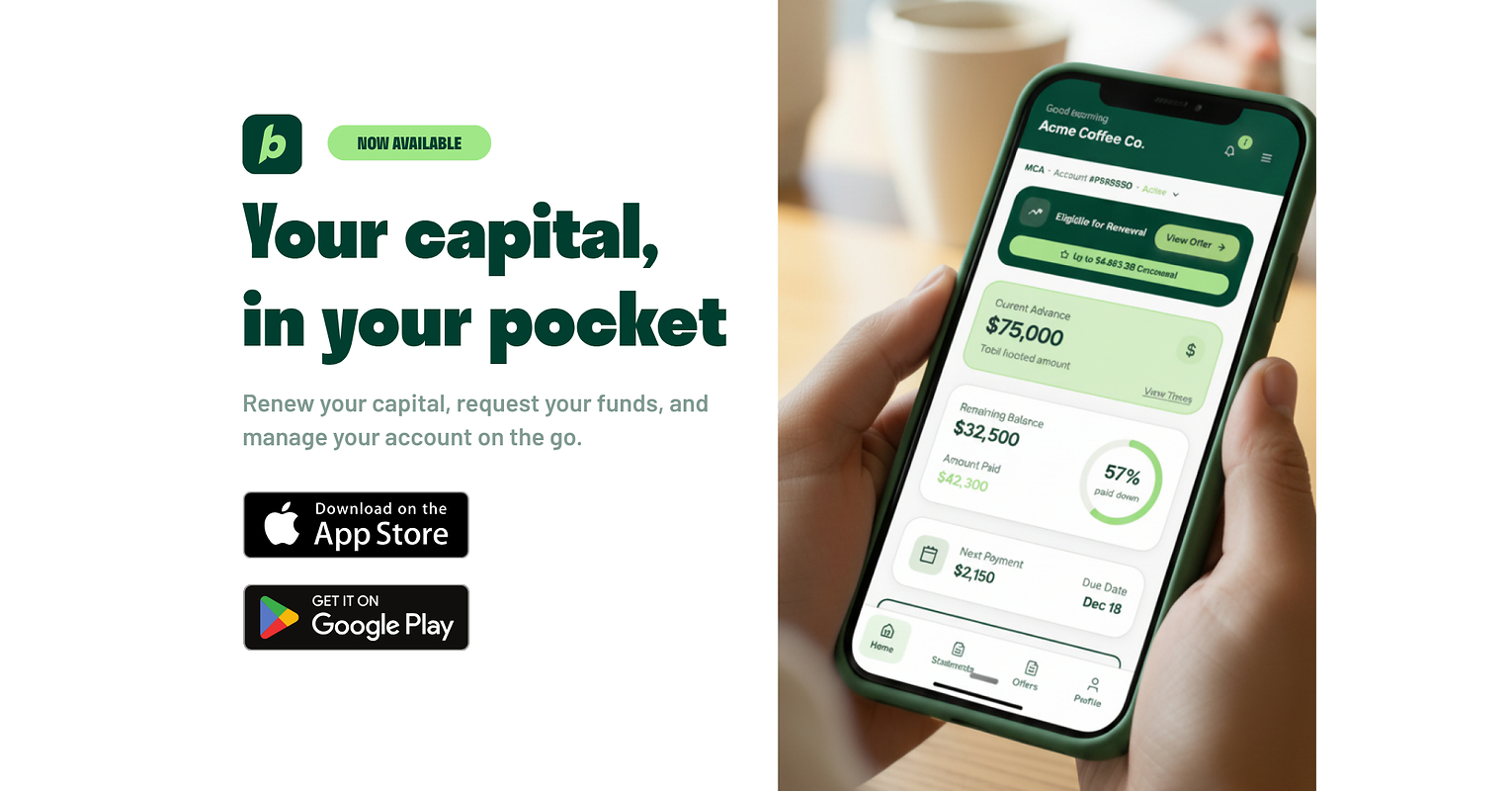
Byzfunder launched a native iOS and Android app for active small business customers, enabling real-time tracking of MCA/ByzFlex balances, payoff schedules, and payment history, plus renewal offers without resubmitting bank statements. The app also supports ByzFlex Flexline requests with same-day wire transfers for requests made before 4 p.m. ET. While the $1.75B deployed to 30,000+ businesses since 2019 is reiterated, the announcement is primarily product/engagement focused and likely to have limited near-term market impact.
This is a distribution/retention upgrade, not a demand shock. The economic lever is lower friction in renewals and servicing, which can improve lifetime value and shorten cash conversion for the lender if underwriting quality holds; the same feature set can also mask weakening credit if management leans too hard on easier re-buys. The public-market read-through is less about the named company and more about where embedded, mobile-first capital is becoming table stakes: merchant platforms with data gravity should defend share better than standalone point-solution lenders.
Near term, the market impact should be negligible and any share reaction would likely be short-lived unless the company later quantifies higher renewal conversion, lower CAC, or faster funding velocity. The 1-3 month catalyst is proof-of-use data: app installs, active-user frequency, renewal acceptance rate, and delinquency progression. If those metrics do not improve, the launch is mostly a UI layer on top of the same underwriting engine.
The contrarian risk is that convenience can be mistaken for moat. In MCA-style lending, better UX can accelerate volume but also pulls forward credit risk; if the book quality softens, charge-offs will show up 2-4 quarters later, not immediately. For GOOGL specifically, there is no meaningful first-order economics here beyond immaterial app distribution noise, so this is not a portfolio event for Alphabet.
For public comps, the more relevant question is whether merchant platforms like SQ and SHOP can use owned distribution and transaction data to bundle working capital more cheaply than independent lenders. If that thesis broadens, it pressures legacy lenders and supports embedded-finance names; if not, this stays a private-market story with little tradable edge.
AI-powered research, real-time alerts, and portfolio analytics for institutional investors.
Request DemoOverall Sentiment
mildly positive
Sentiment Score
0.15
Ticker Sentiment
