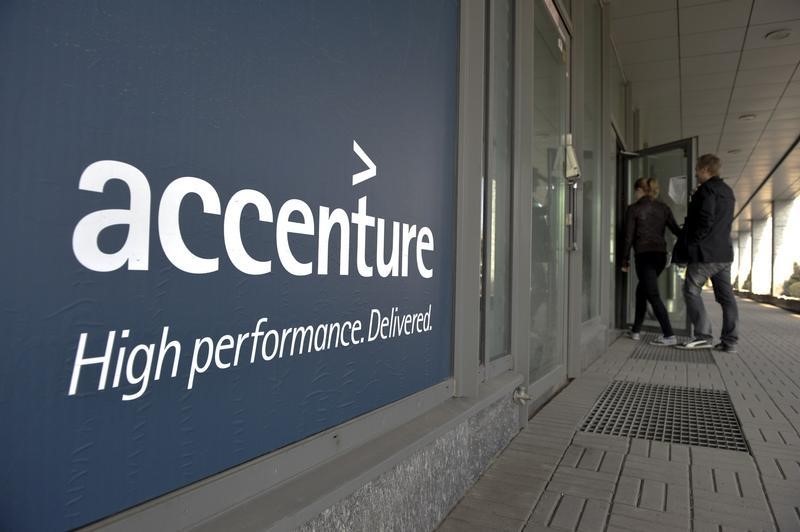
Accenture beat Q2 estimates with revenue of $18.04B versus $17.84B consensus and EPS of $2.93 versus $2.84, delivering ~4% y/y revenue growth and 4% EPS growth; bookings were $22.1B with a 1.2x book-to-bill. Management raised fiscal 2026 constant-currency revenue growth to 3%-5% (4%-6% ex-U.S. federal), lifted EPS guidance to $13.65-$13.90 and raised free cash flow guidance to $10.8B-$11.5B (street ~$10.3B); the company expects >$5B in M&A this year ($2B completed) and highlighted AI integration and expanded cybersecurity offerings with Microsoft/Avanade. Evercore cut its price target to $250 from $300 but kept an Outperform, Jefferies maintained a Hold with a $215 target, and the stock is down ~27% YTD and ~38% below its 52-week high.
Accenture is being re-priced as investors debate whether services firms can capture the bulk of AI spend or will be disintermediated by hyperscalers and point AI vendors. The firm's strategy to fold AI across offerings and expand managed services increases recurring revenue optionality, but it also amplifies near-term margin and hiring volatility as labor intensity rises and delivery scale matters more than project wins. A steady book-to-bill and active M&A cadence suggest management is prioritizing capability build vs. short-term buybacks, which makes free cash flow conversion the critical metric to watch over the next 4–12 quarters. The partnership with Microsoft (and joint ventures like Avanade) is a double-edged sword: it accelerates go-to-market and deal flow but deepens platform dependency and funnels incremental infrastructure spend toward hyperscalers rather than independent hardware vendors.
Second-order winners include Microsoft (platform and cloud capture), cybersecurity specialists that ride Accenture’s managed security distribution, and boutique consultancies that get acquired to fill capability gaps. Second-order losers are likely to be mid-cycle hardware suppliers and integrators that rely on on-prem upgrade cycles — if Accenture standardizes on cloud-first templates, those replacement cycles shrink. Key near-term catalysts that will re-rate the stock are cadence of large strategic wins, disclosure on margin trajectory as headcount rises, and pace/price of tuck-in M&A; negative catalysts are sustained client insourcing, slowing deal intensity, or a major implementation failure.
The consensus risk seems skewed toward near-term AI execution risk and underestimates Accenture’s leverage to managed, subscription-like revenue streams over 12–24 months. That asymmetry creates a favorable risk/reward for patient, event-driven exposures that size position around headline deal execution and FCF realization milestones. Monitor attrition, utilization, and large client pipeline conversion as the real-time health metrics — these will lead price action before headline guidance revisions do.
AI-powered research, real-time alerts, and portfolio analytics for institutional investors.
Request DemoOverall Sentiment
moderately positive
Sentiment Score
0.40
Ticker Sentiment
