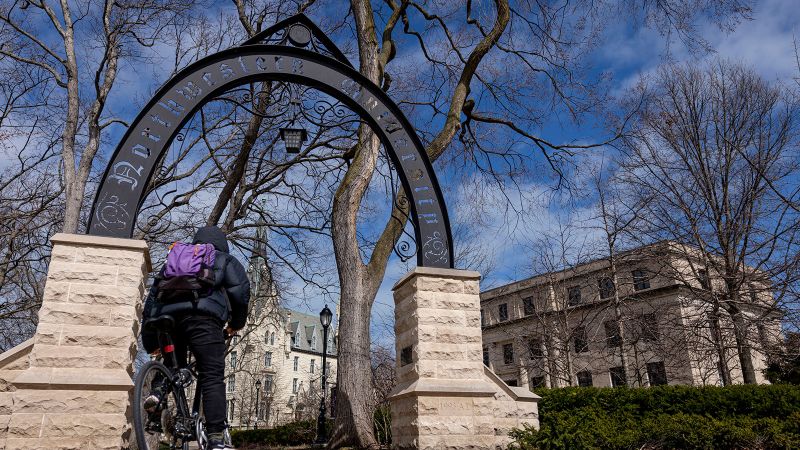
The Department of Justice announced a $75 million settlement between Northwestern University and the Trump administration that restores previously frozen federal funding and ends an antisemitism investigation, with the university agreeing to comply with federal anti‑discrimination laws and implement mandatory antisemitism training for students, faculty and staff. The DOJ said it will close pending investigations and treat Northwestern as eligible for future grants and contracts after an earlier freeze of $790 million tied to Title VI inquiries.
Market structure: Direct winners are Northwestern (restores $790M grant eligibility) and universities that comply with new DOJ conditions; losers are smaller private colleges with thin liquidity that could face similar probes. Expect modest re-allocation of federal research dollars back into large research universities over 1–4 quarters, improving cash flow for labs and IP-transfer pipelines; marginal pricing power accrues to large academic centers that act as grant hubs.
Risk assessment: Tail risks include escalation of politically driven enforcement to multiple universities (low-probability, high-impact) that could freeze $1–2B+ in grants industry-wide and spike liquidity stress in niche muni markets within 30–90 days. Hidden dependency: biotech/med-tech startups and CROs that depend on campus labs for early-stage validation could see quarter-to-quarter revenue delays; catalyst to watch is the DOJ’s public roll-out of similar agreements and university bond spread movements.
Trade implications: Favor assets that benefit from normalized grant flows (biotech exposure) and hedge political volatility. Near-term/30–180 day trades should be size-limited and event-driven—options can monetize asymmetric payoff if enforcement flares. Avoid one-way exposure to private-university credit until covenant clarity and legal reserve impacts become visible over next 60–120 days.
Contrarian angles: Consensus treats this as idiosyncratic; but underappreciated is the precedent risk: DOJ agreements set a playbook that could compress valuations for smaller research schools and raise credit spreads by 50–150bp if two or more peers face probes. If that happens, long select municipal-bond funds exposed to state universities and short niche private-university credits is a mispricing to exploit over 3–12 months.
AI-powered research, real-time alerts, and portfolio analytics for institutional investors.
Request DemoOverall Sentiment
neutral
Sentiment Score
0.05
