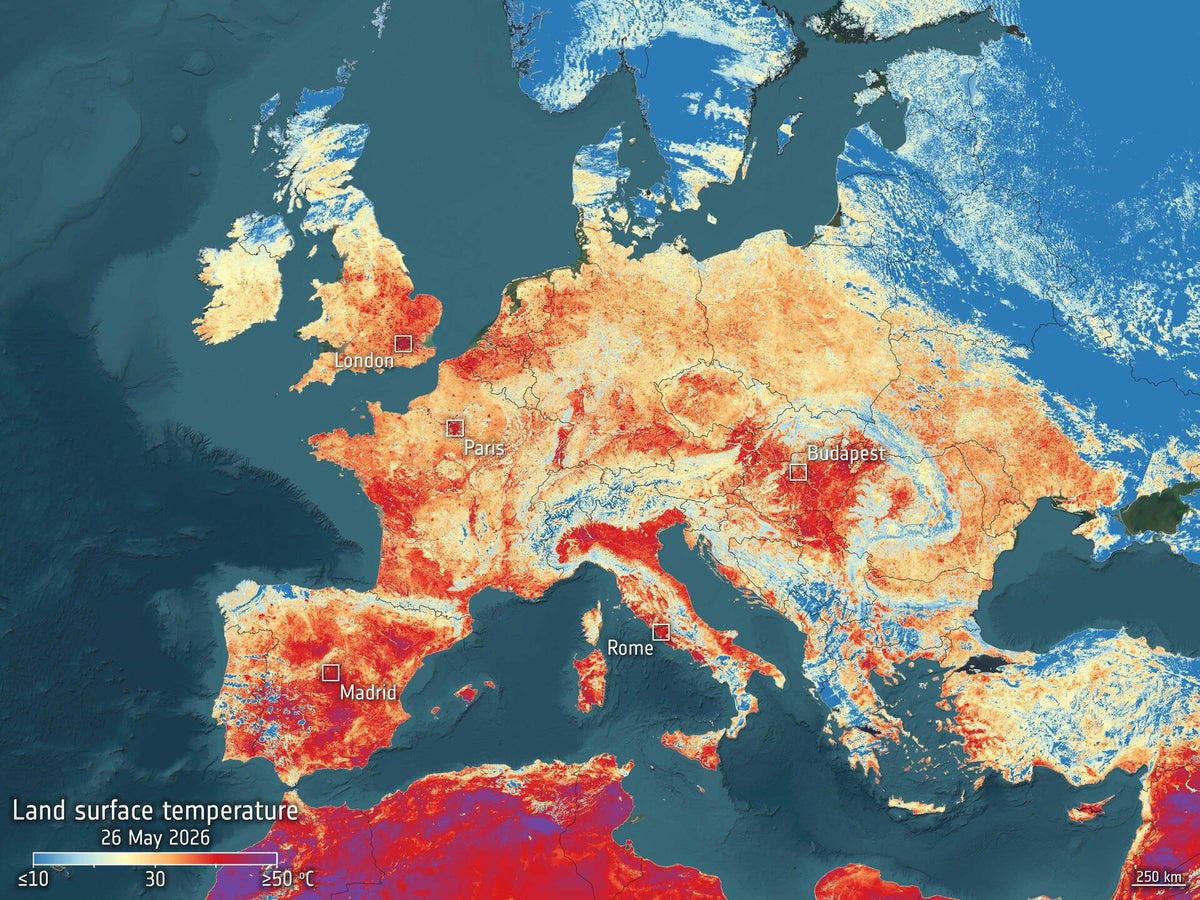
A spring heat wave across Western Europe has shattered temperature records, with at least 12 deaths reported in the U.K. and at least seven in France tied to the extreme heat. England, Wales, Scotland and Northern Ireland saw 23 weather stations exceed the prior U.K. record of 32.8°C, while London’s Kew Gardens hit 35.1°C and France logged its hottest May on record at a 24.9°C average. The article says climate change likely made the event three to five times more likely, and the lack of air conditioning in Europe raises further health and economic risk.
This is not just a weather shock; it is a near-term stress test for systems that Europe has underinvested in for years. The immediate economic winners are concentrated in categories that monetize acute temperature spikes: bottled water, ice, portable cooling, and grid flexibility. The losers are broader and more persistent — labor productivity in outdoor and uncooled indoor work, rail and road transport reliability, agriculture, and insurers with event-frequency exposure that is increasingly decoupled from historical pricing models.
The second-order effect that matters most is behavioral and political. A single extreme episode raises the probability of accelerated policy response around building retrofits, urban cooling, and air-conditioning adoption, which is structurally positive for electrical equipment, HVAC, and insulation demand over 12-36 months. But that same adaptation is a slower burn in Europe than in the U.S., so the market may be underestimating how much margin pressure heat imposes on consumer-facing and industrial names every summer once these events become recurring rather than exceptional.
The contrarian view is that the obvious long climate-adaptation basket may already be partially crowded, while the more compelling trade is short complacency in Europe’s energy and utilities stack where peak-load stress, low hydro output, and higher loss-of-load risk can force expensive balancing measures. The real tail risk is a sequence effect: if another heat episode follows within weeks, mortality, transport disruption, and public-health costs can become nonlinear, pushing governments toward emergency spending and regulatory action faster than consensus expects. That makes the catalyst window days-to-weeks for operational disruption, but months-to-years for capex re-rating and insurance repricing.
AI-powered research, real-time alerts, and portfolio analytics for institutional investors.
Request DemoOverall Sentiment
strongly negative
Sentiment Score
-0.70
