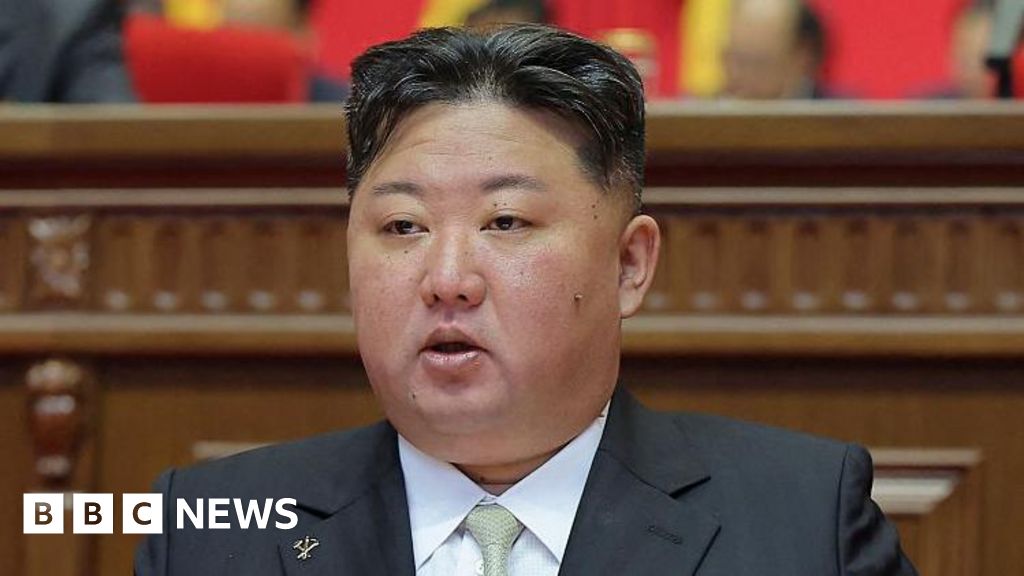
At the Ninth Congress of the Workers' Party of Korea, Kim Jong Un announced plans to expand North Korea's nuclear arsenal and operational reach while stating Pyongyang will only 'get along' with the United States if Washington accepts it as a permanent nuclear power. He rejected rapprochement with South Korea, highlighted continued missile and warhead development (SIPRI estimates ~50 assembled warheads and fissile material for up to 40 more), and signalled willingness to deal directly with the US — a development that raises regional security risk and could influence safe-haven flows and defense-sector positioning.
Market structure: Geopolitical hawkishness favors defense primes (Lockheed Martin LMT, Northrop Grumman NOC, RTX RTX) and cyber/security vendors (CRWD, PANW) via durable backlog and pricing power; expect 6–18 month revenue re-rating if US/Japan/SK capex increases by even 5–10%. Safe-haven assets (USD, JPY, CHF, gold GLD, long-duration Treasuries TLT) should outperform risky FX/EM (KRW, KOSPI) in the immediate 48–72 hour window, pressuring Asian equities and regional credit spreads by 25–75bp. Supply/demand: marginally tighter defense supply (lead times +3–9 months) will allow suppliers to push higher margins, while shipping/reinsurance premiums could rise 10–30% if sanctions enforcement intensifies.
Risk assessment: Tail risks include a localized military clash that spikes Brent >$20 (~20–30% move) and equity drawdowns >8% in 1–2 weeks, or broader sanctions on Chinese trade corridors that disrupt semiconductors. Time horizons: immediate (days) = risk-off flows; short-term (weeks–months) = procurement repricing and options vol expansion; long-term (years) = sustained regional rearmament and supply-chain reshoring. Hidden dependencies: Chinese posture and Trump–China summit outcomes are binary catalysts; a conciliatory US–China outcome could unwind defense optimism quickly.
Trade implications: Tactical plays favor 2–3% long positions in LMT/NOC via 3‑month call spreads to cap premium, 1–2% in GLD/GDX for tail hedges, and 1–2% long TLT if 10y Treasury yields drop >15bps. Relative trades: pair long LMT (2%) / short JETS ETF (1.5%) or major airline AAL (1%) using 2–3 month put spreads; add CRWD/PANW exposure (1–2%) as asymmetric cyber upside. Entry: initiate within 48–72 hours, scale over 4–12 weeks, trim at 6–12 months or upon positive diplomatic signals.
Contrarian angles: The market may have front‑run a sustained defense rally — prices could be crowded; avoid outright large-cap defense longs >4% if IV is up >30% vs 90‑day average. South Korean equities may be oversold: consider a tactical 1–2% contrarian long in Samsung ADR (SSNLF) or EWY if KOSPI falls >8% intraday, with a stop-loss at -12%; historical parallels (2017 DPRK cycle) show 2–8 week mean reversion once immediate tests abate. Unintended consequence: escalation that disrupts semiconductor fabs would sharply reprice global tech — keep net tech exposure hedged if geopolitical noise persists beyond 30 days.
AI-powered research, real-time alerts, and portfolio analytics for institutional investors.
Request TrialOverall Sentiment
moderately negative
Sentiment Score
-0.50
