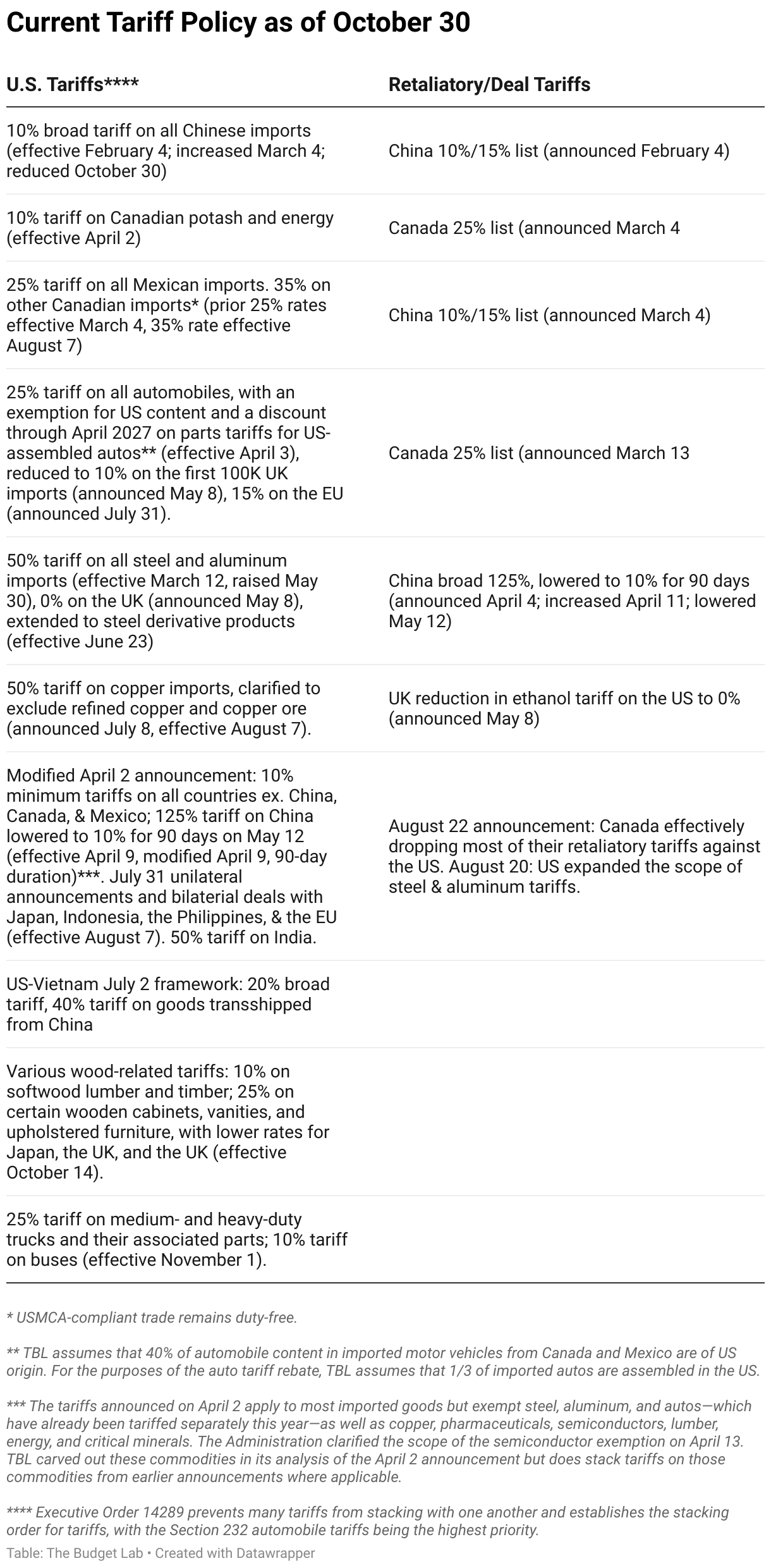
The Budget Lab (TBL) estimates that current U.S. tariffs, incorporating new duties on heavy vehicles and a reduced IEEPA tariff on Chinese imports, have elevated the effective tariff rate to 17.9%, the highest since 1934. This policy is projected to increase consumer prices by 1.3% in the short run, costing the average household $1,800, and slow real GDP growth by 0.5 percentage points in both 2025 and 2026, resulting in a persistently 0.35% smaller economy long-term. The tariffs are also expected to raise unemployment by 0.7 percentage points by late 2026, disproportionately burden lower-income households, and generate $2.2 trillion in net dynamic revenue over 2026-35. Commodity prices for apparel, metal products, food, and motor vehicles are anticipated to see significant increases.
The Budget Lab (TBL) estimates current U.S. tariffs, incorporating new duties on heavy vehicles and reduced IEEPA tariffs on Chinese imports, have elevated the effective tariff rate to 17.9%, the highest since 1934. This policy is projected to increase the overall price level by 1.3% in the short run, costing the average household $1,800, and reduce real GDP growth by 0.5 percentage points in both 2025 and 2026. The long-run effect is a persistently 0.35% smaller U.S. economy, equivalent to $105 billion annually.
These tariffs are expected to significantly impact the labor market, with the unemployment rate rising 0.3 percentage points by late 2025 and 0.7 percentage points by late 2026, leading to 490,000 fewer payroll jobs. The burden is regressive, with lower-income households facing a disproportionately higher cost, experiencing a short-run burden more than three times that of the top decile. While U.S. manufacturing output expands by 3.2% in the long run, this is offset by contractions in construction (-4.0%) and agriculture (-0.7%).
Commodity prices are set to see substantial increases, with leather and apparel rising 24% and textiles 15% in the short run. Electrical equipment and consumer electronics face 16-18% price hikes, while motor vehicle prices are projected to increase 10%, adding approximately $5,000 to the cost of an average new car. These price increases, alongside a 1.9% rise in food prices, indicate broad inflationary pressures across consumer goods.
AI-powered research, real-time alerts, and portfolio analytics for institutional investors.
Overall Sentiment
strongly negative
Sentiment Score
-0.75
