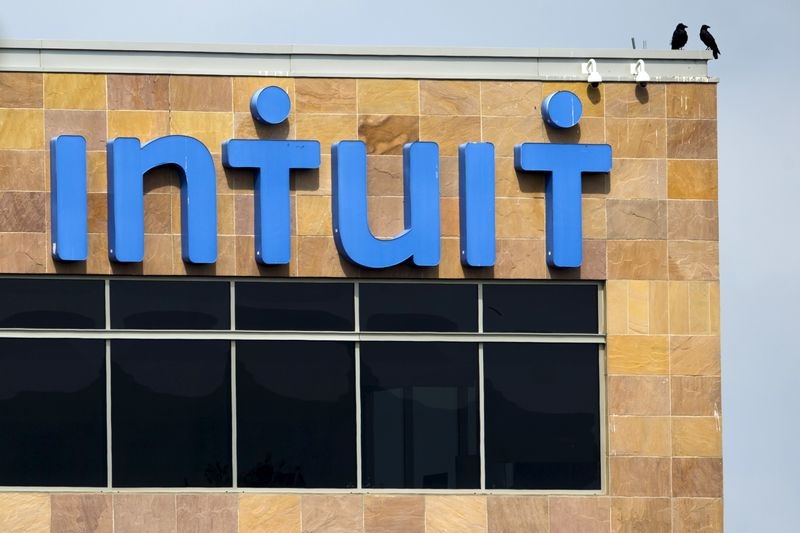
Rothschild Redburn upgraded Intuit to Buy and raised its price target to $700 from $670, projecting 13% annual revenue growth and 15% annual free cash flow growth over the next five years and implying ~46% upside. Intuit reported Q2 FY2026 non-GAAP EPS $4.15 vs $3.68 expected and revenue $4.65B vs $4.53B, with 17.4% YoY revenue growth and a 33.3% adjusted operating margin; shares trade at $473.67, down 42% from the 52-week high. Several analysts (Truist, TD Cowen, Stifel) reaffirmed Buy ratings though some cut price targets to $500 from higher levels; fiscal 2026 guidance remains unchanged. Valuation metrics cited include an 80.9% gross margin and a PEG of 0.69, with InvestingPro flagging the stock as undervalued per its Fair Value analysis.
Intuit’s core assets function more like regulatory-anchored platforms than pure SaaS — that structural advantage creates optional monetization pathways beyond subscription ARPU (embedded lending, payment float, data-driven tax products). Over a 2–5 year horizon those optionalities can drive FCF multiple expansion even if revenue growth decelerates, because incremental gross margins on finance/payment flows are materially higher than software revenue.
Near-term the biggest market-moving levers are tax-season guidance and regulatory action. Guidance conservatism is a deliberate handle management uses to smooth expectations; a positive surprise post-season would compress downside risk quickly, while any state/federal enforcement or changes to tax-prep distribution could reset valuation multiples for years.
Second-order winners include small-business banking partners, payroll integrators and payment processors that sit inside the QuickBooks ecosystem — they capture spread and fee upside as Intuit upsells merchant services and lending. Conversely, standalone tax-prep challengers and legacy payroll providers face accelerated disintermediation but could become acquisition targets to shore up competitive gaps, creating strategic M&A tailwinds.
The consensus underweights two outcomes: 1) a higher-margin embedded-financials pathway that materially lifts FCF growth over 3–5 years, and 2) the regulatory tail that could force product re-architecture and slow international expansion. Both are binary and justify asymmetric option strategies rather than a blunt buy-and-hold at current multiples.
AI-powered research, real-time alerts, and portfolio analytics for institutional investors.
Request DemoOverall Sentiment
mildly positive
Sentiment Score
0.30
Ticker Sentiment
