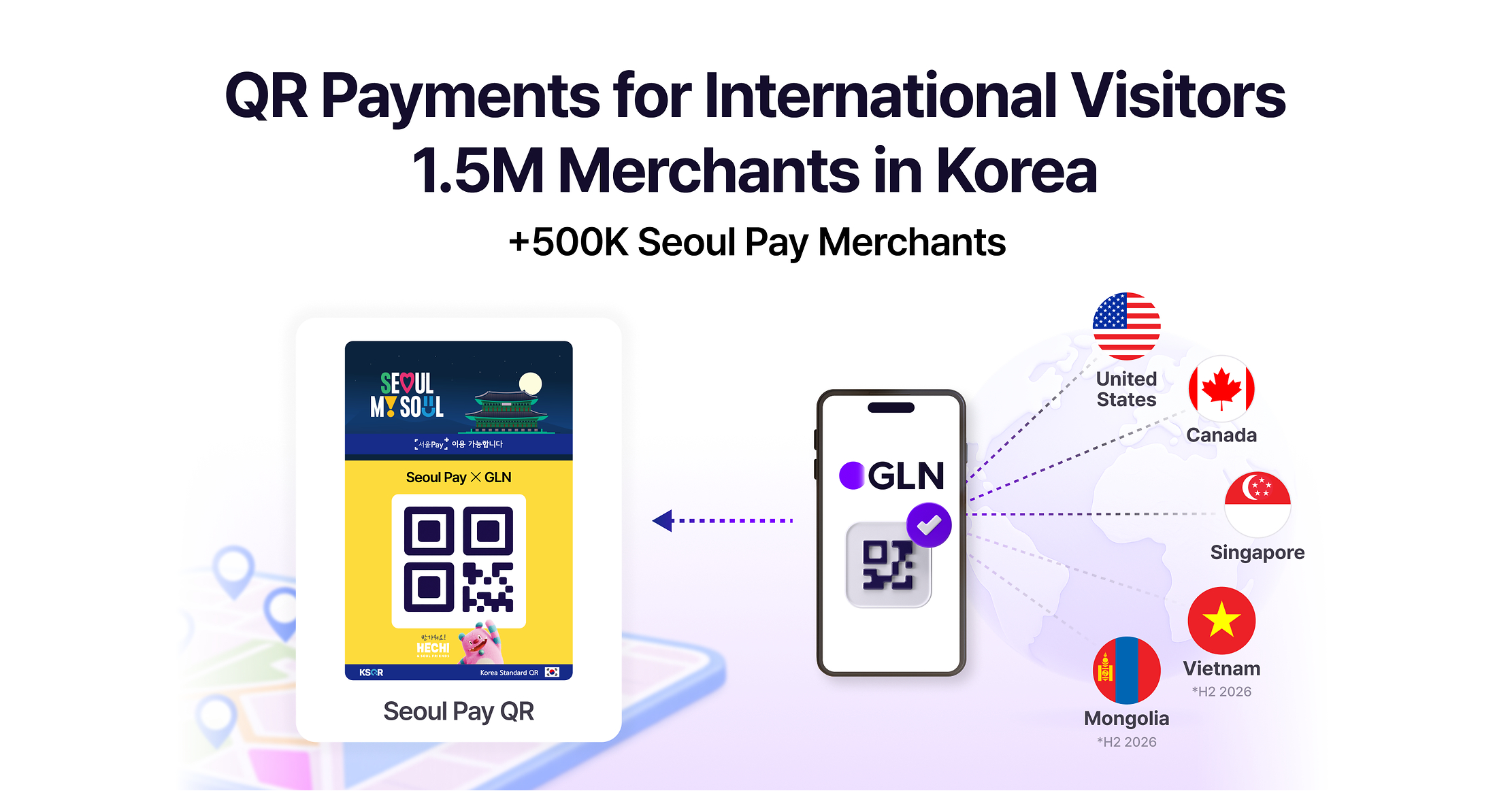
GLN International (Hana Bank subsidiary) expanded its Korea QR merchant network from ~1.0M to ~1.5M merchants via integration with Seoul Pay (Coocon), adding ~500,000 Merchant Presented Mode (MPM) locations. QR payment usage by inbound international travelers rose ~1,000% in both volume and value in 1H 2026 vs 2H 2025, with adoption broadening beyond Myeong-dong into Seongsu and other tourist hubs like Busan and Jeju. GLN plans to expand QR payments to visitors from the US, Canada, Singapore, Vietnam, and Mongolia later in 2026 and target 10+ countries by 2027.
The economic value here is less about payment processing fees and more about distribution. If GLN can keep travelers inside a bank-linked wallet loop, Hana gains low-cost data on inbound spending behavior that can be monetized through FX spreads, deposits, and outbound remittance retention rather than through QR take-rate alone.
The near-term winners are tourist-heavy merchants with high card-fee sensitivity and small average tickets, because frictionless QR can lift conversion and basket frequency. The losers are cash exchange operators and, at the margin, legacy acquiring rails; but the card networks only face a real earnings threat if QR usage becomes habitual across repeat visitors instead of staying a novelty concentrated in a few districts.
The bigger second-order effect is competitive copycat risk. Once a non-tourist neighborhood proves that QR works for beauty, pharmacy, and medical-tourism spend, other Korean banks and wallets will push similar integrations, which can commoditize the advantage quickly. The market should focus on repeat usage into Q4 and whether the rollout expands into a durable cross-sell engine; if inbound travel cools or repeat transaction rates flatten, this is just a low-base marketing win, not a structural payment shift.
AI-powered research, real-time alerts, and portfolio analytics for institutional investors.
Overall Sentiment
mildly positive
Sentiment Score
0.25
Ticker Sentiment
