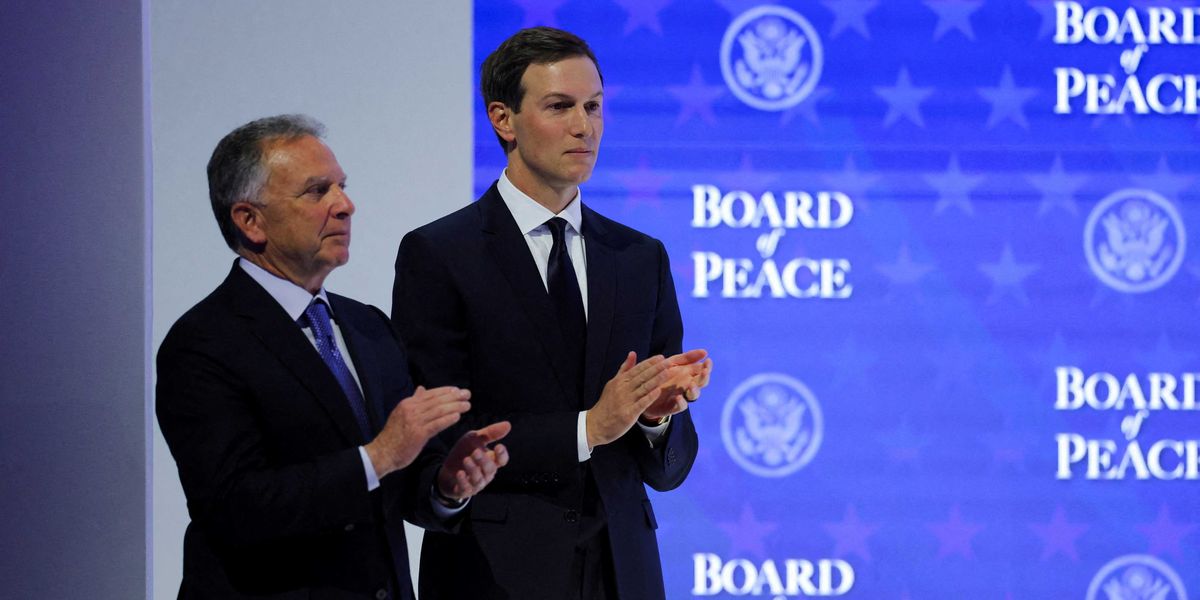
The article highlights legal and ethical scrutiny around Jared Kushner and Steve Witkoff’s roles in Trump’s Board of Peace, including Democratic probes into their financial ties and a proposed Gaza stablecoin that could benefit participants. It also underscores that peace talks with Iran were announced and then abruptly canceled, while the Board’s Middle East ambitions remain unproven. The piece is mostly political and governance-focused, with limited direct market impact beyond crypto and real estate-related conflict-of-interest concerns.
The investable issue is not the optics; it is the monetization channel. When policymaking is run through principals with active balance sheets, the market should expect faster policy swings, weaker process discipline, and a higher probability that “peace” efforts become a vehicle for selective economic rent extraction rather than durable settlement. That creates a paradox: headline geopolitical de-escalation risk may be lower than it appears because incentives favor episodic negotiations that preserve leverage, extend mandates, and keep capital access flowing.
Second-order beneficiaries are likely to be adjacent capital allocators rather than the principals themselves. Any structure tied to reconstruction, payment rails, logistics, or sovereign financing in the region could see speculative inflows on even weak progress, but the trade is fragile because the legal overhang can chill institutional participation. If congressional scrutiny expands over the next 1-3 months, expect a discount rate reset on anything with exposure to Gulf-linked capital, tokenized settlement, or politically connected real assets; the market tends to reprice governance risk only after discovery requests and subpoenas surface.
The cleaner macro implication is for higher volatility in energy and defense rather than a directional trend. Negotiation setbacks or procedural delays raise the odds of a risk-premium bid in crude and a relative bid to defense primes, while a surprise diplomatic breakthrough would likely hit these names first and hardest before broader cyclicals respond. In housing and real estate, the issue is not volume but cost of capital: assets associated with elite policy access may retain access longer than fundamentals justify, but public-market comps with transparent governance can become relative winners as investors rotate toward cleaner ownership structures.
The consensus likely underestimates how slowly reputational and legal friction compounds. These are not immediate P&L shocks, but over 2-4 quarters they can impair fundraising, underwriting, and financing terms for counterparties that rely on politically sensitive channels. The better trade is to fade premium valuations where narrative is outrunning enforceability, while owning beneficiaries of uncertainty, not peace, until there is evidence of a real institutional framework.
AI-powered research, real-time alerts, and portfolio analytics for institutional investors.
Request DemoOverall Sentiment
mildly negative
Sentiment Score
-0.15
