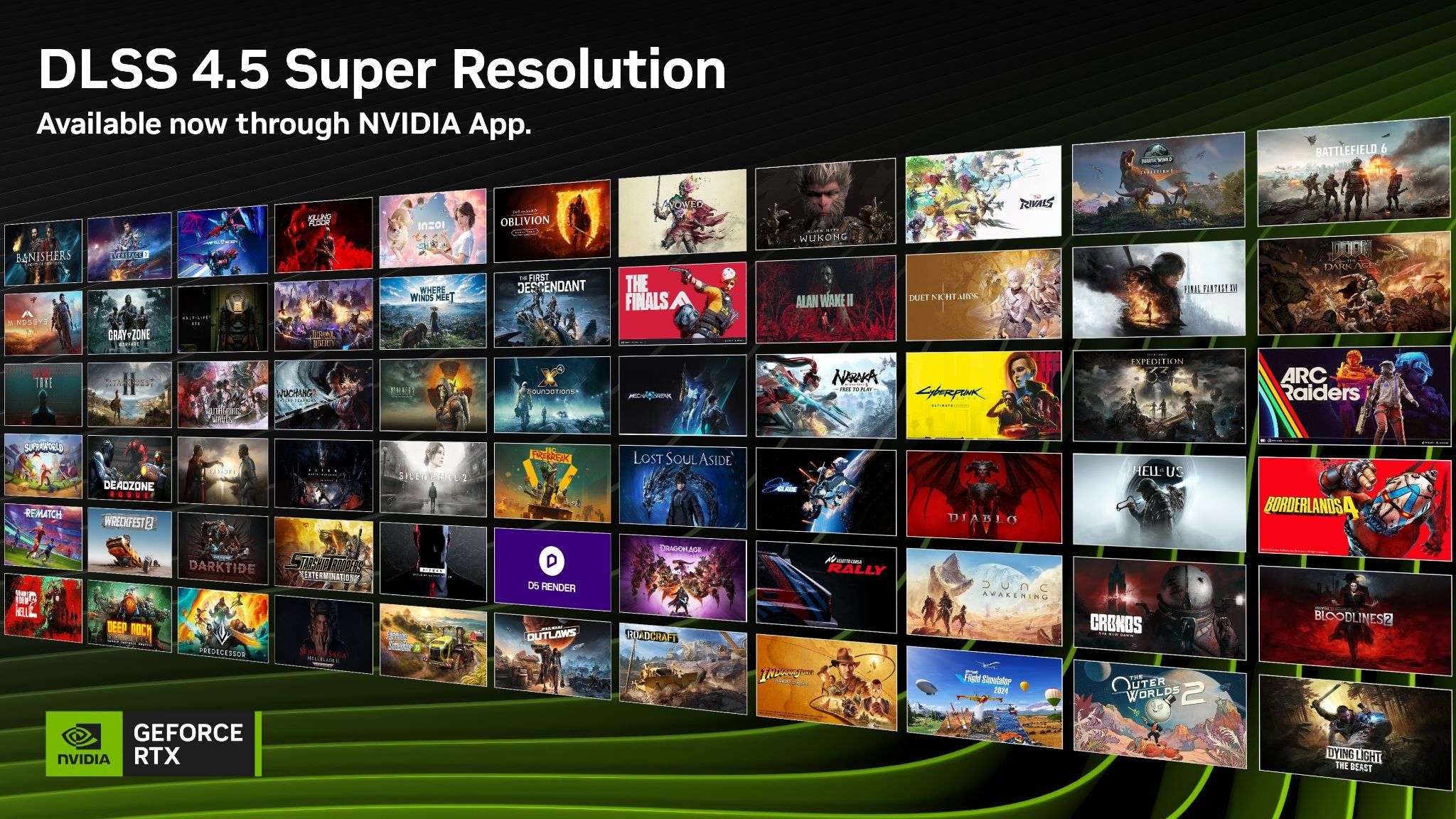
Nvidia has rolled out DLSS 4.5 Super Resolution from beta to all Nvidia app users via auto-update, bringing a second-generation transformer model (claimed to use ~5x the compute of the first-gen) to over 400 games and apps and promising reductions in shimmering and ghosting. The feature supports older RTX 20/30 series (with community reports of up to ~20% performance loss on some cards) while RTX 40/50 series benefit from accelerated FP8 Tensor Core processing; Nvidia also notes DLSS 4 Multi‑Frame Generation is now on 250+ titles though 6x MFG is not yet available.
Market structure: NVIDIA (NVDA) is the clear direct beneficiary—DLSS 4.5 expands perceived moat for RTX 40/50-series, likely increasing upgrade intent among gamers and studios and supporting mix/ASP upside over 6–18 months; incumbents (AMD, INTC) face pressure in premium GPU pricing power while middleware (game engines) and GPU-accelerated dev tools are secondary winners. The 20%+ performance hit on older RTX 20/30 cards signals a near-term bifurcation in demand: replacement demand for high-end cards should rise while used/entry segments may stagnate, tightening lead-times for high-end GPUs and upstream wafer/OSAT demand for the next 2–4 quarters.
Risk assessment: Tail risks include regulatory scrutiny of bundled software/hardware advantages (antitrust) and a reputational hit if multisession artifacts emerge—each could compress multiples by >10% in a stress scenario within 3–12 months. Immediate volatility (days–weeks) will be driven by adoption metrics and driver stability; medium-term (3–9 months) by developer integration pace (track number of games shipping DLSS 4.5), and long-term (12–36 months) by cross-platform alternatives (AMD FSR/improved open models) and GPU replacement cycle elasticity.
Trade implications: Core trade is directional NVDA overweight sized 2–3% of risk capital with asymmetric options overlay (6–9 month call spread 20–30% OTM sized 0.5–1% notional) to cap cost; hedge with a 1–1.5% short/underweight in AMD (AMD) as a relative-value pair over 3–6 months. Rotate modest +1% allocations to TSM (TSM) and ASML (ASML) on conviction of sustained wafer demand; protect positions with size-limited 3–6 month puts if NVDA rallies >25% from entry.
Contrarian angles: Consensus underestimates developer integration friction—not all 400 titles will deliver meaningful user uptake; older-card performance regressions could trigger consumer backlash reducing upgrade intent by >5–10% versus optimistic scenarios. Historical parallels to DLSS 2.0 show initial hype can plateau until killer-app adoption; a faster-than-expected rise in cross-vendor open upscalers or a stability incident would materially reprice expectation within 1–3 quarters.
AI-powered research, real-time alerts, and portfolio analytics for institutional investors.
Request DemoOverall Sentiment
mildly positive
Sentiment Score
0.28
Ticker Sentiment
