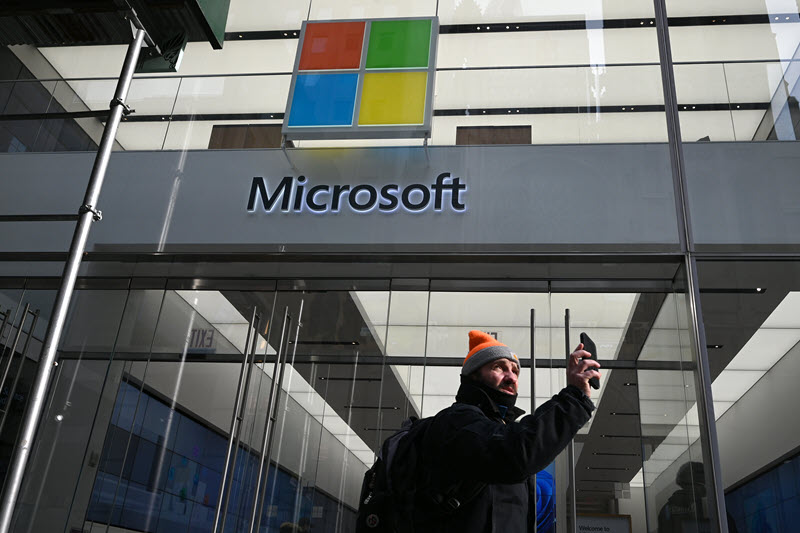
Microsoft reported Q3 revenue of $82.9 billion, up 18.3% year over year and above the $81.29 billion consensus, while EPS of $4.27 also topped the $4.05 estimate. Management guided next-quarter revenue to $86.7 billion-$87.8 billion, implying about 14% growth at the midpoint, with AI annual recurring revenue now above $37 billion, up 123% year over year. DA Davidson cut its price target to $550 from $650 but kept a Buy rating, and the stock fell in after-hours trading despite the beat.
The key read-through is not the quarter itself but the quality of growth: AI is now large enough to function as a second earnings engine, which should keep capital allocation skewed toward infrastructure, inference, and bundled software rather than pure productivity SaaS. That is a medium-term positive for hyperscaler capex beneficiaries, but it also raises the bar for software vendors that cannot show monetization or attach rates — the market will increasingly separate “AI exposure” from actual AI economics.
The softer consumer and gaming mix matters because it implies the next leg of multiple expansion will be driven by enterprise durability, not cyclical beta. If commercial growth keeps outpacing consumer drag, Microsoft can defend premium valuation even if headline EPS beats become less scarce; if not, the stock becomes more sensitive to any deceleration in cloud bookings or capex intensity. The after-hours selloff suggests the market is trading the guide versus the print, which often creates better risk/reward in the next 1-2 sessions than waiting for the open.
Second-order winner: semiconductor and networking suppliers tied to AI buildout, especially those levered to GPU clusters, power, and optics, as Microsoft’s implied demand signal supports another leg of data-center spend. Second-order loser: smaller software names pitching “AI features” without measurable retention or ARPU lift, because Microsoft is proving the model can be embedded into a broad platform and still sustain margin discipline. Over the next 3-6 months, the real catalyst is whether management raises AI capacity commentary again; failure to do so would likely compress the growth multiple before fundamentals roll over.
The contrarian view is that the market may be over-penalizing a beat-and-raise setup because the business has become too large for upside surprise to register cleanly. A 26-27x multiple on a mega-cap growing in the mid-teens is not obviously expensive if the AI contribution is still inflecting, so the asymmetry may favor buying weakness rather than chasing strength. The risk is that any hint of capex fatigue or consumer weakness turns this into a slow multiple de-rate rather than an earnings miss.
AI-powered research, real-time alerts, and portfolio analytics for institutional investors.
Request DemoOverall Sentiment
mildly positive
Sentiment Score
0.32
Ticker Sentiment
