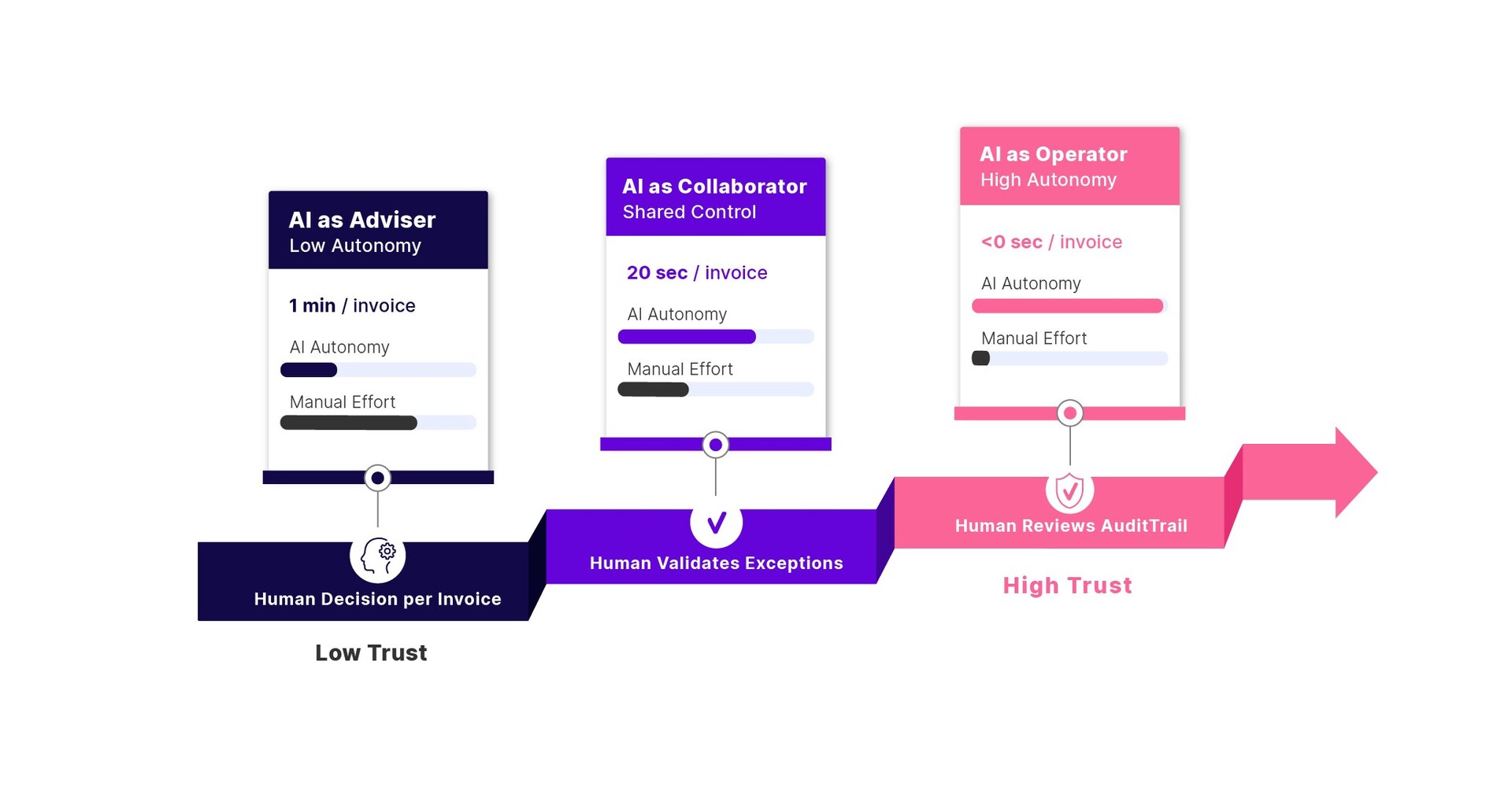
Basware launched its Governed Autonomy Framework for Finance, an operating model designed to expand AI authority in invoice and exception handling while keeping customer-defined controls, audit trails, and human accountability. The article cites Gartner data that only 36% of CFOs feel confident delivering real enterprise impact from AI, alongside PwC findings that 56% report no significant financial benefit yet—positioning the framework as a way to reduce compliance risk from “black box” automation. Basware also highlights scale, citing training on 2.5B+ invoices and 1B+ AI actions annually, and references evolving European e-invoicing/VAT rules (e.g., France, Poland, Germany, EU ViDA).
This is more of a product-validation signal than a near-term revenue event. The economic value is not in “AI” branding; it is in reducing the adoption friction that has kept finance automation budgets stuck in pilot purgatory. That tends to help vendors with embedded workflow + compliance data moats, while hurting point-solution automation tools that cannot prove traceability under audit. The second-order winner is the larger finance-automation stack: once governance is productized, customers can delegate more exceptions and approvals, which raises switching costs and lowers churn.
The clearest public-market implication is for enterprise software and IT services spending patterns, not a single named issuer. In the next 1-3 months, this should read as a sales-enablement message rather than an earnings catalyst; the real test is whether it converts into higher ACV, faster module expansion, or lower implementation churn over the next two quarters. Over 6-18 months, regulatory digitization in Europe should force broader AP modernization, which favors vendors with country-mandate coverage and audit trails, and compresses the addressable market for manual invoice processing and back-office outsourcing.
Contrarian view: consensus may be overestimating how quickly CFOs will hand over authority to AI. In finance, the buyer is not chasing autonomy; they are buying defensibility, and that usually means longer procurement cycles and slower budget conversion than product launches imply. For NOV, the quote is a weak positive validation of category adoption, but not enough to move the needle unless it translates into measurable SG&A leverage or working-capital improvement. The thesis is falsified if enterprise AI budgets remain in pilot mode through the next earnings season, or if European e-invoicing mandates are delayed/softened, reducing urgency for governed automation spend.
AI-powered research, real-time alerts, and portfolio analytics for institutional investors.
Request DemoOverall Sentiment
mildly positive
Sentiment Score
0.18
Ticker Sentiment
