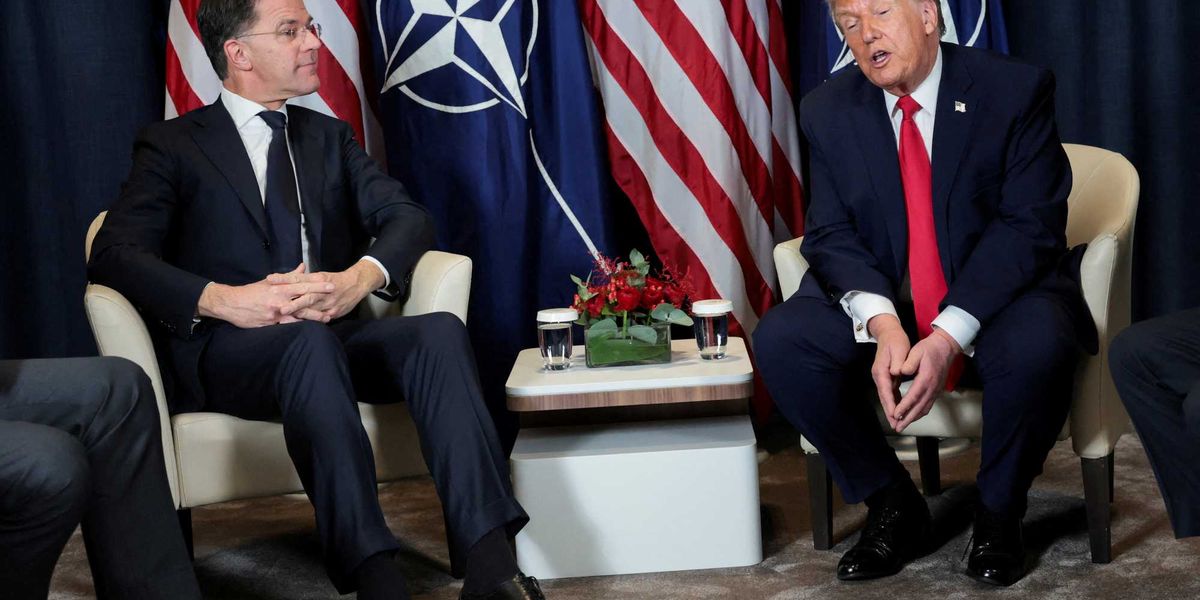
Trump is threatening to withdraw the U.S. from NATO and is reportedly considering ways to punish allies that refused to back the Iran war. The article says the White House has drawn up a NATO 'naughty and nice' list, with potential retaliation including moving U.S. troops—an approach critics say would mainly harm the U.S. and destabilize the alliance. The news raises geopolitical risk for Europe and the broader defense/security backdrop.
The immediate market read is not about a formal NATO exit, but about a higher probability of policy incoherence inside the U.S. security umbrella. That matters because alliance reliability is a hidden input to European capex, defense procurement timing, energy infrastructure routing, and sovereign risk premia; even a small rise in perceived abandonment risk can widen peripheral EU CDS and steepen European defense spending curves over the next 1-3 quarters. The bigger second-order effect is that allies will accelerate hedging behavior, which should support local rearmament and dual-use infrastructure spending regardless of whether Washington follows through.
The near-term winner set is concentrated in European defense, munitions, air defense, cyber, and logistics enablement, especially names tied to continental rearmament rather than U.S.-led expeditionary platforms. Conversely, U.S. primes that rely on multinational coalition programs could face a valuation overhang if budget execution becomes more fragmented and procurement diplomacy turns politicized. A less obvious loser is commercial aerospace and transatlantic transport-linked industrials if political friction begins to contaminate broader U.S.-Europe trade coordination.
The tail risk is a durable shift from "alliance premium" to "self-help premium" in Europe. That is bullish for defense budgets over years, but bearish for short-dated risk assets if markets briefly price a disorderly disengagement scenario: stronger EUR credit spread volatility, weaker European cyclicals, and a higher term premium on U.S. Treasuries if foreign holders demand a governance discount. The catalyst window is days to weeks around rhetoric escalation, but the investable re-rating is more likely over 3-12 months as budget committees and procurement agencies convert rhetoric into line items.
Consensus may be overestimating the odds of an actual NATO rupture and underestimating the durability of bureaucratic inertia. That creates a tradeable asymmetry: headline risk can hit defense-adjacent assets first, but eventual policy gravity tends to pull spending higher, not lower, because European governments cannot quickly replace U.S. deterrence without spending more. The market should treat this as a volatility event with a medium-term fiscal tailwind for European defense and infrastructure, rather than a clean de-risking signal.
AI-powered research, real-time alerts, and portfolio analytics for institutional investors.
Request TrialOverall Sentiment
moderately negative
Sentiment Score
-0.45
